



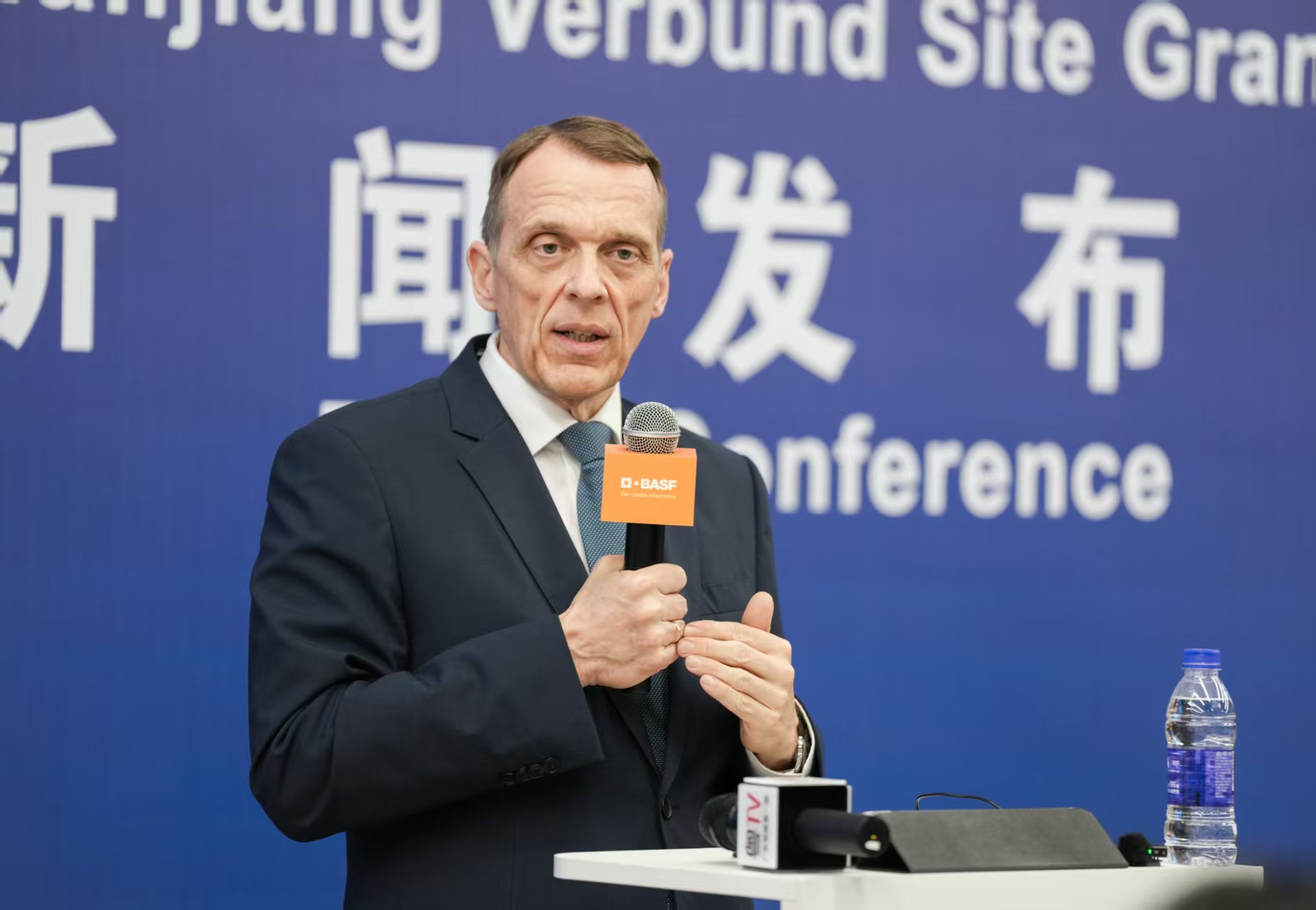
(Yicai) March 30 -- BASF's new Verbund site in the southern Chinese city of Zhanjiang was built "on schedule, even below budget, and with world-class safety performance," according to the chief technology officer of the German chemical giant.
"The vision was to build a world-scale site that is extremely cost-competitive, a lighthouse project for smart manufacturing, a global benchmark for sustainable chemical production," Stephan Kothrade said in an interview with Yicai during the Zhanjiang Verbund's inauguration on March 26. “I take pride in saying this vision has been created and has become reality.”
Covering an area of four square kilometers, the EUR8.7 billion (USD10 billion) Zhanjiang Verbund site became BASF's third-largest Verbund site globally. It employs more than 2,000 workers and produces over 70 products, including basic chemicals, intermediates, and specialty chemicals.
Despite "massive distortions of the global supply chains" during the Covid-19 pandemic, the "BASF team managed to execute the project and to build the site on schedule," he said.
In addition, the Zhanjiang Verbund's steam cracker set a world record with on-specification ethylene output after only nine hours of starting, Kothrade noted, calling it “mind-boggling.”
Kothrade also discussed the path to profitability, artificial intelligence on the plant floor, and how China's green manufacturing credentials can translate into commercial returns.
Excerpts from the interview with Kothrade are below:
Yicai: We interviewed you at the groundbreaking ceremony in 2019 and now at the grand opening ceremony. What went as expected, and what were some surprises in the process?
Stephan Kothrade: I still remember the interview we had in 2019. At that time, BASF had a very clear vision: to build a world-scale Verbund site that is extremely cost-competitive. That is a lighthouse project for smart manufacturing. And that would be a global benchmark for sustainable chemical production. I take pride in saying this vision has been created and has become a reality.
And what confirms that the site is very competitive is that in the current market environment and all the headwinds we are facing from what's happening in the Middle East, still, after a smooth startup of our plants, the plants are running at a very high utilization rate, while our competitors, many of them had to reduce their run rate, some even had to declare force majeure. Given that we are having very good cost positions and we are having a mixed-feed cracker that allows us to shift feedstocks between naphtha and butanes, we can run full.
What came as a surprise? If you think of all the headwinds that came during the global pandemic, we had massive distortions of the global supply chains, and still, our BASF team managed to execute the project and build the site on schedule, even below budget, and with a top-class, world-class safety performance.
The startup was very smooth. Plants are running, and just to give you one detailed startup of our steam cracker, it was really a world record — ethylene, the main product, was on spec after only nine hours. This is mind-boggling, so we are extremely happy about the outcome, and our vision has become a reality.
Profitability Path
Yicai: BASF has said Zhanjiang Verbund will be loss-making this year but will turn profitable next year. Where does this confidence come from?
Kothrade: If you build such a complex site of that scale, we talk here about a multi-billion euro greenfield investment, it's impossible to reach the full profitability on the very first day, and this has to do with startup costs that we still have, but also with the fact that the parameters for utilities and production at a very early stage are still far from the optimum.
There is a steep learning curve. We will adjust this over the weeks to come, and it's quite normal and completely expected that in the first year, you still will not see high profitability. This will change starting from next year. We have also clearly communicated our profitability expectations for the medium term.
We said that by 2030, we expect the EBITDA that we achieve with the new Zhanjiang Verbund site will be between EUR1 billion and EUR1.2 billion (USD1.2 billion and USD1.4 billion). And that's still our expectation. We are confident to get there.
Yicai: What are the pillars that get you to that number?
Kothrade: We've built here a site that is extremely cost-competitive, with the latest technologies. It's the most digitalized site that you can see globally. And this also means that in the future, with all the innovation we have to expect from artificial intelligence, given that we have now all the digital infrastructure in place, this will make the site even more competitive.
We have a mixed-feed steam cracker, so we can use cost arbitrage between butanes and naphtha. We have very long value chains. We are not just having a cracker and polyolefins or MEG, but we have a portfolio of 70 diversified products that will also help us to play the value chain and to create value sometimes more upstream, sometimes more downstream. And the site is 100 percent supplied with green energy.
We apply many new technologies. In the steam cracker, we have replaced the conventional drives, steam turbines that drive the main compressors in the cracker, big machines, 30 megawatt, with electric drives. The first steam cracker in the world that uses this technology, and this enables us to replace steam made from fossil energy with a green power supply, 100 percent green power.
We have applied other technologies. For example, we use the carbon dioxide that is emitted from one production process, the ethylene oxide plant, and use it as a raw material to produce syngas. Combining all these factors together, we have built a Verbund that emits 50 percent less CO2 compared to a conventional petrochemical site that we would build.
And if we compare ourselves to many competitors in China that are using coal as a raw material for chemical production, we even have a factor of three to four times lower CO2 emissions at the site. This is a fantastic competitive edge.
Green Premium
Yicai: BASF has clear advantages in low-carbon products, but that value isn't yet fully reflected in commercial pricing. How do you turn that advantage into profit?
Kothrade: It's absolutely right that the value of a product with a lower product carbon footprint is not yet fully reflected in pricing. It's also not fully valued in all customer segments, and this will have to change. What we can see is that, first of all, our customer industries, be it automotive, electronics, or consumer products, many of our key customers have set themselves very ambitious goals to reduce the product carbon footprint of their own product slate.
They also want to build a stronger position in the circular economy. They need recycled products, and this is what we can offer to them. So we see a stronger demand. And because our production assets are very cost-competitive and at the same time offer these very competitive, greener solutions, we see that the business is gaining momentum.
China has a very clear dual target of achieving the carbon peak by 2030 and full carbon neutrality by 2060. So this will have to come automatically with more regulation, regulation that will encourage our customers and ultimately also the end consumer to buy greener products, to make a conscious decision to buy green. And we are ready with our assets and our innovation power to provide these products to the Chinese markets.
We have done the investments, so we can do this in the existing footprint that we have in China. We are ready to go. So we are confident and believe this will definitely be an accelerator of our profitable growth in China.
Yicai: Many Chinese firms are going global, expanding to Southeast Asia and Europe. Can BASF's low-carbon innovation help them compete internationally?
Kothrade: What BASF can offer is two things. First of all, we have a local-for-local strategy, meaning that we have been investing over many decades into all the markets where we are present, production plants in all major regions: in North America, in Europe, in Asia, in Southeast Asia, and to an increasing extent also in China. So wherever Chinese customers go with their own investments overseas, we are there.
We can provide them with the same product range and same quality in Southeast Asia, Europe, or China, and we also offer the same sustainability attributes, recycled, bio-based, or low or even zero product carbon footprint.
For our customer industries, if they focus on export, especially to Europe, the market with the highest emphasis right now on the green transformation, I would think it's a competitive edge to buy our products with a lower product carbon footprint or other green attributes to be competitive in the European market.
AI's Impact
Yicai: How can AI enhance BASF's innovation, production, and other areas? What is BASF's role in the AI industry?
Kothrade: You get me enthusiastic and excited, because this is something I really think we have to embrace as an industry, but also, of course, as BASF. I would say there is hardly any area where AI cannot contribute to more success.
Let's start here at the site. We use agentic AI to run and optimize our warehouse logistics, so you don't have to do this manually with calculations. It's faster. It's more efficient. So this is just the state of the art, and you do it.
Secondly, the state-of-the-art digital infrastructure that we built in the plants. We have many, many sensors here. We get more data from the processes than from any other plant we have worldwide. And with AI and big data analysis, you will see patterns. You will detect things that you have not seen, or that an expert engineer would not simply detect by following the patterns of a DCS.
This will help us to gradually further improve the run rate of the plant, reducing energy consumption, avoiding waste, reducing the time that you need for scheduled turnarounds, and avoiding unexpected losses through unexpected hiccups in the production process. This will help to make the plants more cost-efficient and run at a higher availability.
What we at BASF also do is we apply AI to even design experiments and to do the analytics of the lab work, and we can massively reduce the time we need in a research program to come to a product that is ready to be launched to the market.
This is just the beginning. There are many, many areas. I'm pretty sure if we meet again in six years, this will be a standard in our industry.
Editor: Martin Kadiev





