![[Exclusive] Europe Is on Different AI Path Than US, China, BSC AI Institute Director Says](https://img.yicaiglobal.com/src/image/2026/03/113338124005061.jpg) [Exclusive] Europe Is on Different AI Path Than US, China, BSC AI Institute Director Says
[Exclusive] Europe Is on Different AI Path Than US, China, BSC AI Institute Director Says(Yicai) March 5 -- Europe has developed its own artificial intelligence path based on its research system, public infrastructure, and data governance frameworks, unlike the United States, which relies heavily on private tech firms, and China, which has strong industrial advantages, according to the director of the AI Institute at the Barcelona Supercomputing Center.
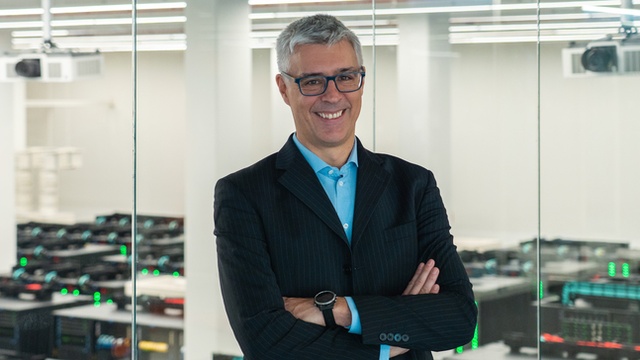
Europe does not focus on competing through a single commercial product in its approach to AI, but on building an open and transparent ecosystem of foundational models, strengthening computing capabilities, and developing AI within its legal and value-based frameworks, Diego Perino said in an interview with Yicai at the Mobile World Congress in Barcelona that ends today.
AI emerged as one of the central themes across almost every exhibition hall at the latest MWC. From generative models to AI agents, and from software systems to real-world Physical AI, its impact is rapidly expanding, reshaping industries and blurring traditional boundaries.
An important question discussed at the event was how Europe can position itself in the global AI landscape alongside the US and China. Computing power, data, and talent are increasingly becoming key foundations of national AI strategies due to AI models continuing to grow in scale and complexity.
Europe's strength does not lie in a single breakthrough, but rather in long-term structural capabilities, Perino pointed out.
Established in 2005, the BSC is Spain's national center for high-performance computing and one of Europe's leading institutions in supercomputing and computational science. It operates the MareNostrum supercomputer, one of the most powerful systems on the continent, and participates in several European Union initiatives on high-performance computing and AI infrastructure.
The BSC expanded its research across climate science, biomedicine, engineering simulations, and AI over recent years. Its AI Institute is working to advance open foundational models and support the development of Europe's AI ecosystem.
Yicai: How does this year's MWC differ from previous editions?
DP: I moved to Barcelona in 2016, and since then I've attended six or seven editions. This year it feels like there are slightly fewer people than in previous years, but the overall atmosphere is still very good.
One clear change over the years is the emergence and growing influence of AI. In the beginning you could hardly see AI at the event. Later the focus shifted to “AI for networks”. Now we see concepts such as generative AI and AI agents everywhere, and almost every industry is talking about AI.
I also really enjoy the start-up area. It’s a place where you can directly interact with entrepreneurs and people who are actually building technologies. Compared with the stands of large corporations, you often see more new ideas and emerging research directions there.
Yicai: From a global perspective, how do you see the AI competition among the US, China and Europe? Where does Europe stand?
: If we look at it from the perspective of academia and public infrastructure, Europe’s role is not about building a single commercial product but about building an ecosystem.
We are developing open, transparent and auditable foundational models. These models are not designed to compete directly with a specific company. Instead, they serve as a foundational capability that researchers, public institutions and SMEs can build upon to develop new innovations.
In other words, we are building infrastructure rather than launching a single product. These foundational models can help create a more open ecosystem where different organisations and companies can develop applications on top of them.
In this context, academia plays a role that goes beyond pure technological development. We also explore new AI architectures and methodologies, study possible future directions, and promote the use of AI in scientific research — for example helping researchers analyse literature, design experiments and generate hypotheses, ultimately accelerating the pace of scientific discovery.
Therefore, one of Europe’s key goals in AI is to build an open technological foundation that society as a whole can benefit from.
Yicai: Compared with the US and China, what are Europe’s main strengths and challenges in AI?
: Europe’s strength does not lie in a single breakthrough, but rather in long-term structural capabilities. Compared with the US, which relies more heavily on private technology companies, and China, which has strong advantages in industrial scale, Europe has developed its own path based on its research system, public infrastructure and data governance frameworks.
First, talent. Europe has accumulated a large pool of highly qualified researchers. Many outstanding scientists are trained in Europe, and many people educated here are active across the global AI industry and academic community. This talent base is extremely important.
Second, data. Europe has many datasets with strong local characteristics that can be used within its own legal framework. These datasets are sometimes not fully represented in global mainstream models, which creates opportunities for Europe to develop AI systems with its own distinctive features.
Third, computing power. Europe hosts several high-performance computing centers and is expanding its computing infrastructure through initiatives such as AI Factories, which support the training and deployment of large-scale models.
At the same time, Europe also faces challenges. One of them is fragmentation. There are many research programmes and innovation initiatives across different countries and institutions, but achieving stronger coordination at a larger scale remains an issue.
Another challenge is private investment. Compared with the United States, private capital investment in frontier AI technologies is still relatively limited in Europe. Europe has strong public funding mechanisms, but greater private-sector participation will be necessary for the AI industry to scale further.
Yicai: Europe places strong emphasis on regulation and “Trustworthy AI”. Do you see this as a constraint?
: I do not see regulation as a barrier. Europe emphasises safety, transparency and alignment with social values, and that reflects Europe’s broader cultural and institutional context.
Of course, technology evolves very quickly, so regulatory frameworks must also continue to adapt and evolve. But in the long run, if designed well, regulation can actually become a differentiating advantage.
In other words, building AI systems that are aligned with European laws and values is itself part of Europe’s development path.
Yicai: What role does the BSC AI Institute play in Europe’s AI development?
: Our work mainly focuses on two areas.
One is the development of open, auditable foundational models aligned with European values. This includes language models as well as interdisciplinary models applied to fields such as life sciences and engineering.
The other is supporting the adoption of AI by SMEs and public institutions through mechanisms such as AI Factories, helping them move from evaluation and experimentation to real-world applications and products.
Our goal is not to build a single commercial product, but rather to support the development of the broader ecosystem.
Yicai: How important is high-performance computing for Europe’s AI strategy?
: I think there are three key ingredients: computing power, data and talent.
Computing power is a necessary condition. Without sufficient computing capacity, it is impossible to train or deploy large-scale models. High-performance computing infrastructure is therefore extremely important for AI development.
However, simply increasing computing power is not enough. AI progress also depends on advances in algorithms and architectures. That is why, alongside expanding computing capacity, we must continue to invest in fundamental research.
From this perspective, computing power, research capability and talent development must advance together. These three elements form the foundation of AI development.
Yicai: With geopolitical tensions increasing, how do you see the future of international cooperation in AI?
: Science has always been highly international, and that has been one of the key drivers of scientific progress.
The current global situation does create some uncertainty, which is a concern. But in the long term I remain optimistic. No country or region can develop AI completely in isolation.
In the short term, countries may focus more on strengthening their own capabilities, but international cooperation will remain essential.
Yicai: How do you view China’s development in AI?
: Some open-source models released in China are already being used by the global scientific community, which is a positive development for science as a whole.
I have also collaborated with research institutions in China in the past. Open science is always beneficial for innovation.
Yicai: How is the AI ecosystem evolving in Spain and Barcelona specifically?
: In recent years, both at the European level and in Spain, investment in artificial intelligence has been increasing.
In Barcelona, we have a strong supercomputing infrastructure, and we are attracting talent from different countries. More and more start-ups and SMEs are using these resources to develop AI applications.
Overall, the ecosystem here is becoming increasingly dynamic.
Editor: Martin Kadiev