



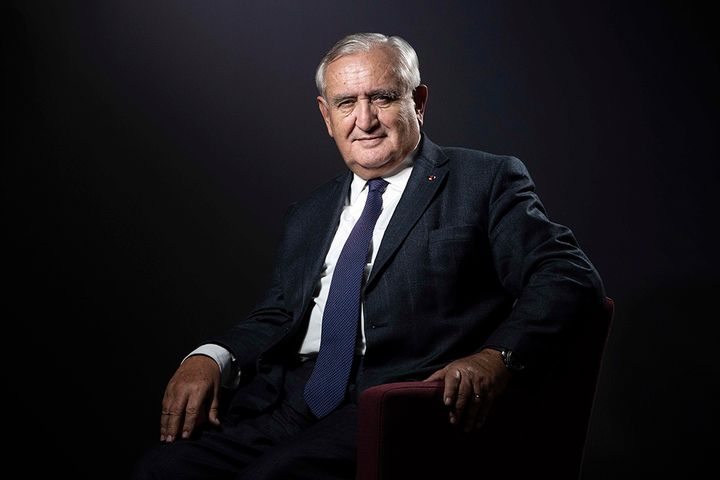
 [Exclusive] Former French PM Urges China to Push on With Reforms Despite Trump
(Yicai Global) July 10 -- China should forge ahead with economic reforms and opening up in defiance of US President Donald Trump's protectionist stance on trade, according to former French Prime Minister Jean-Pierre Raffarin.
Raffarin lauds the "significant progress" made by French companies in China and is optimistic over future developments. "If you listened to President Xi Jinping's speech at the Boao Forum, there were very concrete signals and measures that have been implemented that are pushing things the right way," he said in an exclusive interview with Yicai Global in Shanghai. The former French PM, who is Charles de Gaulle Chair in Global Leadership as well as Distinguished Professor at China Europe International Business School, was speaking ahead of a lecture to the institution's students and alumni. His four-day visit to Shanghai is part of CEIBS' focus on strengthening understanding between China and Europe.
At the Boao Forum for Asia's annual conference in April, Xi said China would launch a number of landmark measures this year to significantly broaden foreign access to the world's second-largest economy. China is easing market restrictions across finance, insurance, and manufacturing, and has cut import tariffs on cars. Meanwhile, the US has escalated trade tensions with China and other countries.
Raffarin, who served under French President Jacques Chirac from 2002 to 2005, is concerned by the Trump administration's protectionist policies. "Progress in China may be subject to economic influences that appear as a consequence of Trump's actions," he said. "Of course, we want to ensure that we have solid discussions in order to push forward a multilateral approach to international trade and I think that this is a common point that we have between China and France."
Tragedy in War
Raffarin criticized the US for its use of the term 'trade war,' highlighting its "sheer brutality."
"When you've experienced war on your territory you don't use this word lightly for trade matters," he said. "There is something of a tragedy in war and this climate is very stressful for the whole world, fueling worries and bringing questions of security back to the forefront for all political leaders globally."
The serious risks posed by Trump's assault on the global trade order are not limited to the bilateral relations between China and the US and could jeopardize development on a global scale, Raffarin pointed out.
"We are very concerned by this current situation and it's not only about dialectics between China and the States," he said. "These unilateral decisions may have a serious impact on growth for the whole world, we will be losing GDP points and also there will below interest rate situations as a result of this dangerous context."
Three-Pronged Approach
In his role as Special Representative of the French Government for China, Raffarin is responsible for staying abreast of deals made during French President Emmanuel Macron's visit to the country in January and more recently those made during incumbent PM Edouard Philippe's trip last month. Raffarin focuses on three key areas in which French firms can capitalize on emerging bilateral projects.
Raffarin will continue to promote large-scale company projects covering traditional industries. "I'm thinking of nuclear power, aerospace and other key industrial sectors that involve major French companies such as Michelin, Schneider Electric, as well as Sanofi in health, along with a whole raft of other large French companies," he said. "These areas have been the subject of a cooperation since the outset of our relations with China."
China's fast-growing tech sector presents emerging areas for future cooperation between the two countries. "There are many young French entrepreneurs working on Chinese-French technology projects which are present in Shanghai and Shenzhen, but also in Beijing."
The third area in which Raffarin aims to nurture joint development relates to China's shift in energy mix and the country's growing focus on environmental protection. "Of course, there's a whole series of cooperation initiatives linked to the energy transition and also aimed at protecting the ecology," he said.
Major French players have made moves this year to expand their presence in the country. These include energy supplier EDF's renewables arm, which established a local joint venture in February, and waste services firm Veolia, which opened its 10th Chinese facility in May.
Raffarin spoke positively about China's increasing role in the promotion of initiatives related to the Paris environmental accord, stating that the country "has set out plans for a greener economy in particular through urban planning and the launch of energy policies."
New Opportunities
Partnership on projects between the two countries is not limited to the Chinese market, according to Raffarin. "The future of cooperation between France and China will primarily be founded in agreements made in third-party countries in Africa, for example, and in countries along the Belt and Road route," he said.
There are ample opportunities for collaboration on projects related to the Belt and Road Initiative, China's 30 to 40-year plan for a vast infrastructure and trade route encompassing Asia, Europe, and Africa. However, Raffarin said there is also a wider scope for partnership projects across third-party nations in general, giving the Hinkley Point power station development in the UK as a key example.
"While the Belt and Road Initiative obviously demonstrates a positive outlook for further cooperation, more generally we are looking at China-France cooperation not just to reinforce our own exchanges but also to develop projects in third-party countries," Raffarin said.
Challenges
Despite the progress made between China and France, Raffarin highlighted the need for both sides to ensure that there is reciprocity over deals between the two nations to ensure "what can be done in one country can also be done in another country," with respect to sovereignty.
In order to make clear the nature of future cooperation, Presidents Macron and Xi need to define sectors considered key in terms of sovereignty for each country and which are going to be protected, Raffarin said, adding that this can allow an equal footing for all involved parties when bidding on tenders for projects.
Raffarin remains optimistic especially in terms of financial investments. "There are increasingly many investors bringing Chinese money and French money to invest in small- and medium-sized firms and startups and these require internationalization," Raffarin said. "The Silk Road Fund's recent agreement with a group of French investors to support European-based companies that want to grow in China is one of many clear signals that show things are progressing in the right way."
Editor: Emmi Laine





