



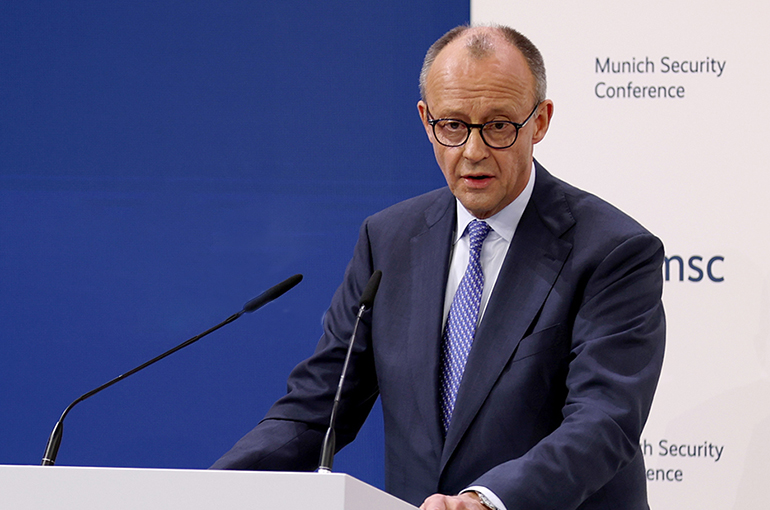
 German Chancellor Merz Visits China Seeking Growth and Strategic Flexibility, Expert Says
(Yicai) Feb. 26 -- German Chancellor Friedrich Merz visited China over the past two days with a delegation of senior executives from about 30 leading companies, aiming to secure new growth drivers for Germany’s economy and gain crucial “room for strategic maneuver” amid global uncertainties, according to a Chinese expert.
The trip comes as Germany grapples with economic headwinds and rising geopolitical tensions. The country slipped into recession in 2024, with growth forecast at around 0.2 percent last year and expected to recover to only about 1 percent this year, while uncertainty over US trade policy and potential tariff barriers has weighed heavily on German exports, particularly to the US.
Zheng Chunrong, director of the German Studies Center at Tongji University, told Yicai that the background of Merz’s visit is “rather complex,” noting that voices advocating “de-risking” from China remain influential in Germany’s political discourse.
Citing Merz, Zheng said that in an era of great power politics, over-reliance on a single major power risks losing strategic flexibility and even being “blackmailed,” making diversification of partnerships an inevitable choice. As China is Germany’s largest trading partner, there is an objective need for cooperation, Zheng added.
The Chinese scholar pointed out that Merz has made clear that “de-risking” does not equal “decoupling,” and that Germany should continue to seek cooperation in areas aligned with its interests, a stance echoed by several European leaders.
Business Focus and Industrial Cooperation
According to Zheng, Merz’s visit carries a dual mission. On the one hand, he is expected to convey the core demands of the German business community to the Chinese side. On the other hand, he plans to visit representative German companies operating in China, including Mercedes-Benz and Siemens, to gain a more intuitive understanding of their operations, cooperation models, profitability, and experience in China’s high-tech sectors, forming a more comprehensive and objective assessment of bilateral economic and trade ties.
Zheng noted that German investment patterns in China have evolved in recent years. More companies have shifted from exporting products from Germany to relocating production lines and even entire industrial chains to China. Cooperation has moved from one-way technology transfer to two-way integration and joint development, particularly in intelligent vehicles, where the two sides have carried out in-depth joint research and development.
Merz also plans to visit Chinese high-tech firms such as Unitree Robotics. In these emerging industries, China has taken a global lead in technology and standards and faces fewer constraints from entrenched traditional industry interests, Zheng said, adding that this creates broader scope for mutually beneficial cooperation.
Editor: Emmi Laine





