



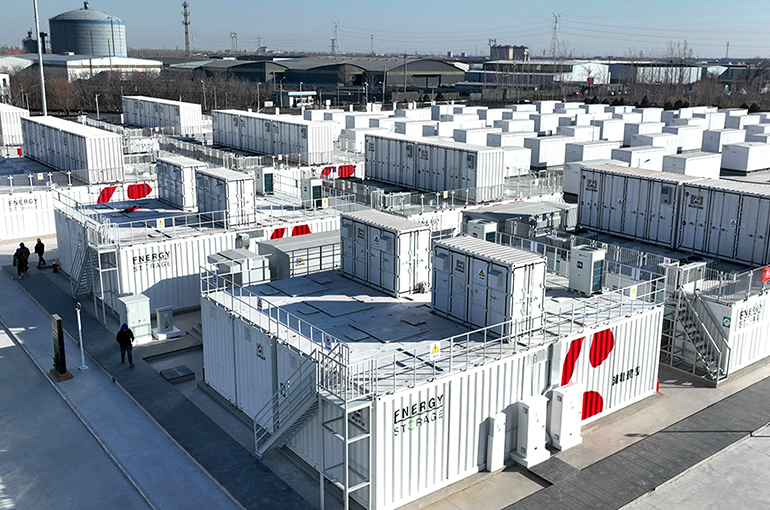
 Global Energy Storage Industry’s Growth to Slow to 30-40% in 2026, Insiders Say
(Yicai) Dec. 10 -- Global shipments of energy storage batteries are expected to grow by 30 to 40 percent year on year next year, falling short of this year’s anticipated increase of more than 80 percent, according to several executives who spoke at an industry conference.
Bu Xiangnan, executive vice president of battery maker Cornex New Energy, said during a roundtable discussion yesterday that the industry is expected to see a growth of 35 percent to 40 percent next year, with shipments reaching 800 to 900 gigawatt-hours. However, the transmission of rising raw material prices may impact terminal profits, which in turn could affect end demand.
Liu Weizeng, chairman of JDEnergy, projected 30 percent growth, noting that this year’s increase was mainly driven by the market-oriented reform of on-grid electricity prices for renewable energy, which has helped resolve existing issues in wind and solar power generation. He expects these issues to be addressed within three years. However, the growth rate of newly installed photovoltaic capacity may be weak in 2026, potentially affecting storage demand.
Capacity and supply chain bottlenecks are the main factors constraining the slowdown in growth. Wang Xiaoqiang, senior vice president of CALB Group, pointed out that although global demand continues to surge, battery cell production capacity remains tight, and there will not be a significant increase in large battery cell output next year.
Wang Yu, chairman of RelyEZ, believes market demand could potentially double, but said it remains to be seen whether the supply chain can keep up and whether rising prices will suppress demand. Xu Hailiang, vice president of TÜV SÜD Smart Energy, added that the growing base and uncertainty surrounding solar and wind installations are also important factors.
At the conference, the Gaogong Industry Research Institute released data showing that global energy storage battery shipments are expected to exceed 650 GWh this year, while China’s energy storage system shipments are projected to surpass 320 GWh, with both expected to grow more than 80 percent. Companies such as Sunwoda Electronic and Cornex reported year-on-year shipment growth of over 150 percent in the first three quarters, while BYD and CALB also recorded year-on-year increases of over 100 percent.
Zhang Xiaofei, chairman of consultancy Gaogong Lithium Battery, said that while production capacity remains tight in the short term, the industry should be cautious about excessive expansion over the long term. He noted that although commercial and industrial energy storage has broad prospects, it faces challenges such as fragmented application scenarios and difficulties in investment recovery. He added that the virtual power plant model and fluctuations in electricity pricing policies will affect the industry’s development path.
Overall, the energy storage sector is expected to move toward scaling, smart technologies, and internationalization amid high growth and intense competition, Zhang said, adding that companies must maintain a global perspective, technological endurance, and strategic determination to navigate cycles and achieve sustainable development.
Editor: Emmi Laine





