



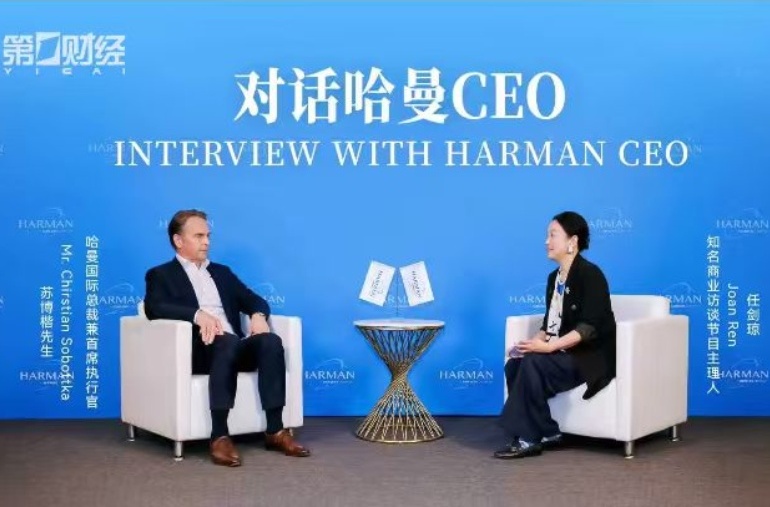
(Yicai) May 19 – As the automotive industry shifts from hardware-driven to software-defined & experience-centric innovation, competitive advantage is moving away from hardware itself toward intelligence, digital cockpit experience, and continuous software upgrades. During Auto China 2026, Mr. Christian Sobottka, President and CEO of HARMAN International, stated that the entire industry is undergoing a profound transition—from a traditional hierarchical, chain-like structure to a more networked ecosystem during his interview with Yicai
“Against this backdrop, I have stopped thinking about these classical Tier definitions. Instead, each company is a network node, one position in the network. And your right to exist depends on whether you have something to say and to bring something to the table.” Mr. Sobottka said.
Previously serving as President of HARMAN Automotive, Mr. Sobottka assumed his current role in April 2025. Over the past year, he has been leading HARMAN through a fundamental transformation—from a supplier role to a co-creation partner. In this process, HARMAN Automotive is redefining its role in China through its value proposition: “Consumer Experiences. Automotive Grade”.
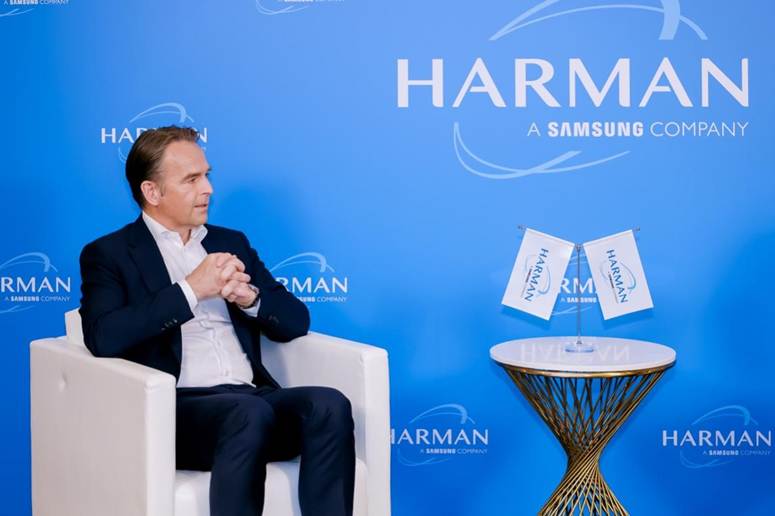
Christian Sobottka, President & CEO of HARMAN International.
Strategic Evolution: From Automotive Technology Leader to Full-Spectrum Ecosystem Partner
In recent years, China’s Tier-1 supplier landscape has undergone rapid transformation, with domestic players rising quickly. As a leading company in the automotive field, HARMAN is redefining its positioning. HARMAN Automotive has put forward the value proposition of “Consumer Experiences. Automotive Grade”, combining global resources with local execution capabilities to empower OEMs with specialized expertise, enabling them to achieve differentiation and rapid implementation.
Mr. Sobottka explained that many of HARMAN’s customers are themselves transforming, prompting HARMAN to rethink what is truly needed to drive industry progress. “Today, I think if you think about our role today, we see us as a partner to the industry, offering tech nuggets, bits and pieces, systems that help the industry to transform.” This philosophy is reflected in HARMAN’s core strength—bridging the fast innovation cycles of consumer electronics with the reliability requirements of automotive grade systems, enabling OEMs to quickly translate innovation into scalable, production-ready solutions.
During Auto China 2026, HARMAN showcased its upgraded Ready Products and central computing unit solutions, turning this strategy into tangible offerings. The Ready Products span the full spectrum—from personalized audio, safety perception, and visual display to SDV toolchains—enabling OEMs to scale differentiated digital cockpit experiences across vehicle lines.
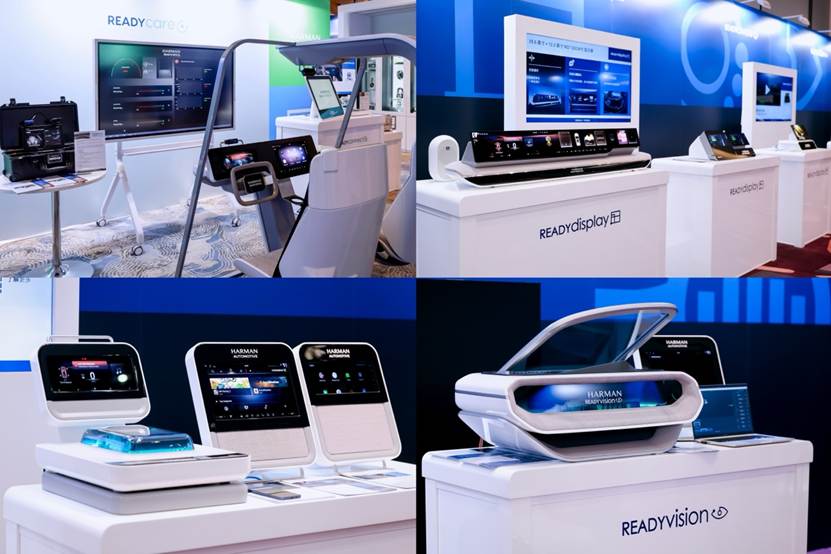
HARMAN Ready Products
The BAIC ARCFOX Wendao V9 is the first mass-production vehicle in China to feature HARMAN Ready Display, incorporating a 15.6-inch, modern touchscreen built using proprietary Quantum Dot and Blue Mini-LED local dimming technology that delivers up to 1,000 nits peak brightness, a contrast ratio of over 400,000:1, and 95% NTSC color gamut. Compared to a 15.6-inch TFT LCD, it provides up to 4x higher contrast, 12% improved color performance, and up to 40% lower power consumption, bringing consumer-grade visual quality into an automotive-grade display.
Cockpit–driving integration has emerged as one of the most significant technology trends at this year’s auto show, requiring not only computing integration but also deep fusion of sensors and data.
HARMAN has been steadily advancing integration between digital cockpit and smart driving. Following the announcement of its strategic partnership with Qualcomm at IAA Mobility 2025, the collaboration has further deepened during Auto China 2026. HARMAN showcased a production-ready Central Compute Unit (CCU) based on Qualcomm’s Snapdragon SA8775 platform. This solution integrates digital cockpit and ADAS domains, enabling multiple functions to run on a single chip and supporting deep fusion between digital cockpit systems and L2+ ADAS. This unified architecture significantly reduces system complexity and development costs for OEMs.
Next-gen HARMAN CCU and Cockpit Domain Controller (CDC) platforms based on Snapdragon Ride Elite (SA8797) and Cockpit Elite (SA8397), in active development, targeting start of production (SOP) readiness later this year
These platforms are being designed with high scalability to support: On-device deployment of generative AI; Multi‑screen, multi‑zone audio, multi‑user immersive entertainment; Door-to-door seamless driving and parking experiences.

HARMAN and Qualcomm deepening collaboration to advance AI cockpits and advanced driver assistance integration
In addition, HARMAN announced earlier this year its intended €1.5 billion acquisition of ZF’s ADAS business, covering a full stack of capabilities—from smart cameras and radar to domain controllers and ADAS software. The transaction is expected to close in the second half of 2026.
Regarding the rationale behind this, Mr. Sobottka explained: “we believe that the future in-cabin experience and the experience in the car also connects to what happens around the car. So the automation topic, the connection requires not just a great audio system in the car. It requires much more. We are adding now strategically several things which are determining the future of the company, and the intended acquisition of ZF’s autonomous driving and ADAS is one of them.”
By integrating ZF’s ADAS capabilities with HARMAN’s digital cockpit expertise, OEMs will gain access to highly integrated solutions, positioning HARMAN strongly in the cockpit–driving integration landscape.
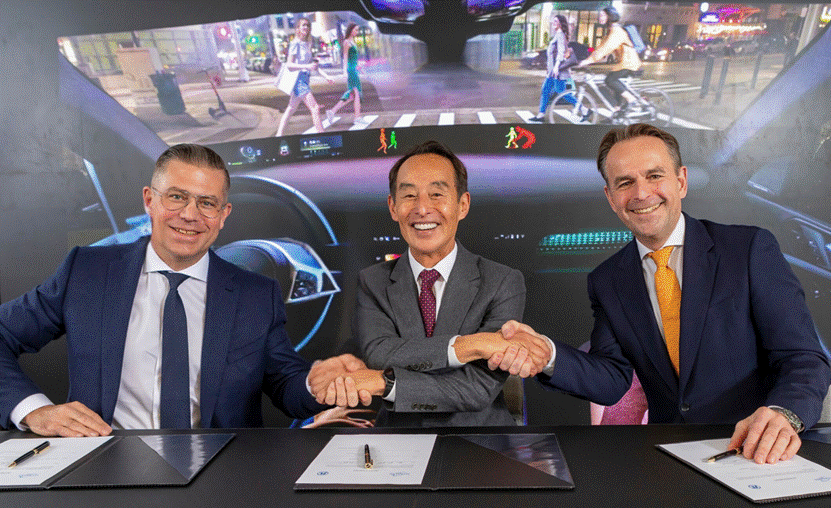
HARMAN intended acquisition of ZF’s Advanced Driver Assistance Systems (ADAS) business
China’s automotive exports are entering a phase of rapid growth. In 2025, exports surpassed 8 million units, reaching 8.324 million units, up 29.9% year-on-year. In the first quarter of 2026, exports totaled 2.226 million units, up 56.7% year-on-year.
However, global expansion remains complex. Differences in regulatory standards, data privacy requirements, and functional compliance across markets means that solutions that “work domestically” often cannot be directly replicated overseas. For Chinese OEMs eager to expand into international markets, these “hidden barriers” are often harder to overcome than the technology itself.
HARMAN’s global presence and local expertise position it uniquely to help Chinese OEMs overcome these barriers. Its globalization empowerment strategy is built on three pillars:
Today, HARMAN has established close partnerships with leading global OEMs and is deepening collaboration with top Chinese independent automakers, continuously supplying high-quality digital cockpit and intelligent mobility solutions for the global market.
Winning Formula in China: Three Keywords
Since entering China in 2005, HARMAN has regarded China as the key strategic market and set up R&D centers in Shanghai, Chengdu, Shenzhen and Suzhou, and built world-class manufacturing plants in Suzhou and Dandong. Today, HARMAN employs over 5,200 staff in China, covering automotive and lifestyle business segments, and cooperates with hundreds of industry partners.
While China is a core strategic market for many international brands, the competition here remains extremely fierce. So, how HARMAN will expand in China?
Mr. Sobottka summarized HARMAN’s winning formula in China with three keywords: Mission & Vision, Professional Competence, Decision-Making Autonomy.
“When these three elements come together, then I think you have a great secret source of success.” he said. Taking Automotive business as an example, HARMAN has realized it cannot manage China business merely from the global headquarters perspective and has granted greater independent decision-making power to local teams. The global and China teams always maintain high consistency in corporate mission, vision and strategic goals. Meanwhile, the rapid improvement of local professional competence enables the China team to independently advance business layout with high standards. Currently, HARMAN has truly achieved a harmonious synergy among these three elements in China.
At its core, this development logic is rooted in trust and talent cultivation, Mr. Sobottka added.
For HARMAN, success in China is not merely about product sales—it is about empowering Chinese automakers to expand globally at “China speed”. The development speed achieved in China has become the benchmark for HARMAN’s global service. Through in-depth reshaping of technology, talent and industrial ecosystem, HARMAN is turning its value proposition — “Consumer Experiences. Automotive Grade” — into tangible results.
During Auto China 2026, Mr. Sobottka repeatedly emphasized the importance of corporate culture. He believes future enterprises, in terms of organizational structure and thinking logic, must be more fluid, open and innovation-inclusive. “When failure can also come into play, because if you're operating at the limit, things go wrong, and then it becomes a question that how do we deal with this in a culture? I think we are clearly going into something like experimentation driving at the limit, exploring and co-creating.”
Evolving from an automotive technology giant to a full-spectrum ecosystem partner, and from technology output to cultural synergy, HARMAN’s transformation mirrors the profound restructuring of the global automotive industry. As the boundary definition of automobiles continues to blur, HARMAN is repositioning itself as a technology company. With forward-looking strategic layout, it drives self-growth, and joins hands with Chinese automakers to achieve co-creation, win-win and coordinated development.





