 Hefei Emerges as Key Hub in China’s Nuclear Fusion Push
(Yicai) Jan. 23 -- China now accounts for nearly a quarter of the world’s 58 nuclear fusion companies, cementing its role as a major force in the global nuclear fusion race. And Hefei, the capital of eastern Anhui province, is establishing itself as one of the country’s core centers in this sector.
“Hefei is leading the way in China in terms of the depth and breadth of its nuclear fusion industrial chain layout,” said Xu Qiang, chief analyst at Guotai Haitong Securities. "We have been coming to Hefei almost every month for the last two years to inspect the nuclear fusion industry, and each time we notice more changes."
"From a global perspective, China's development in nuclear fusion has entered the fast lane, shifting from basic scientific research to engineering and industrialization,” an expert said at the recent Fusion Energy Technology and Industry Conference 2026. “With artificial intelligence now entering the mix, progress is likely to be much faster than expected."
At the conference, Hefei released its top 10 innovative achievements in fusion for 2025, which included breakthroughs in fusion devices, core component manufacturing and key aspects of materials research.
Device Cluster
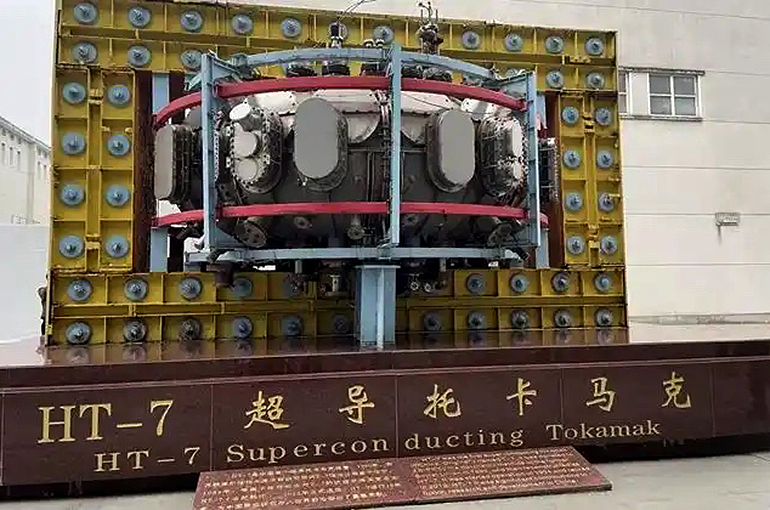
Hefei is home to what is known as the ‘EAST-BEST-CRAFT’ cluster of fusion devices.
EAST, short for Experimental Advanced Superconducting Tokamak, focuses on long-duration, stable operation of high-temperature plasma, providing important physics data for fusion reactors. BEST, also known as Burning plasma Experimental Superconducting Tokamak, concentrates on testing compact reactor concepts and exploring pathways toward commercialization, while CRAFT, or Comprehensive Research Facility for Fusion Technology, targets the key systems of fusion reactor cores.
"These three devices each have their own focus and complement each other, forming a complete system from basic research to engineering validation," said Liu Lu, general manager of the Hefei Science and Technology Innovation Group. This cluster is at the heart of Hefei’s competitiveness edge in fusion, he added.
Technical Breakthroughs
In January 2025, EAST, the world’s first fully superconducting tokamak, achieved stable plasma operation at a temperature of 100 million degrees Celsius for 1,066 seconds, setting a new world record. Reaching the thousand-second level is a critical milestone for achieving stable fusion reactions, as the longer the operation time, the harder it is to confine the plasma. This breakthrough demonstrated the feasibility of steady high-confinement operations, a major step forward for the construction and operation of fusion reactors.
And in September 2025, the first major component of the compact fusion experimental device BEST’s main unit, the Dewar base, was successfully installed, marking faster progress in component manufacturing and engineering installation. In the same month, a key subsystem of CRAFT, the Ion Cyclotron Range of Frequencies heating system, passed acceptance tests after delivering two megawatts of steady power. This marked a major advance in domestic production of core components and full-chain technological self-reliance.
Fusion Ecosystem
Breakthroughs in major scientific devices have continued to attract companies from across the entire industrial chain. The Anhui Province Fusion Industry Federation, established last year, already has more than 200 member organizations, covering 12 key sectors including divertors, magnet systems and vacuum equipment. Hefei’s full fusion industry ecosystem is beginning to take shape.
Funding for procurement related to EAST upgrades as well as the BEST and CRAFT projects will amount to nearly CNY10 billion (USD1.4 billion) this year, Yicai learned. State-backed funds are taking the lead as ‘patient capital.’ At the conference, Hefei Industry Investment Holding announced the launch of the first phase of the Hefei Future Fusion Energy Venture Capital Fund, with an initial size of CNY1 billion (USD143 million) and a 15-year lifespan.
Anhui province aims to complete fusion power generation demonstration projects based on BEST between 2022 and 2027, according to the eastern province’s strategic plan released in 2023. By 2030, it plans to build the China Fusion Engineering Demonstration Reactor and around 2040, commercial companies, working with industry partners, will build higher-power commercial fusion power reactors and achieve low-cost electricity generation.
Guotai Haitong Securities estimates that declared capital spending on commercial fusion projects such as BEST has approached CNY200 billion (USD28.7 billion). As progress toward commercial reactors accelerates, the market potential for controllable nuclear fusion is expected to continue expanding.
Editor: Kim Taylor