


 How a Zhejiang County Is Building a CNY100 Billion Auto Hub From Scratch
(Yicai) June 26 -- Changxing county in Huzhou city, southeastern Zhejiang province has emerged as a standout example of how traditional manufacturing regions in China can successfully transition into emerging industries. Since attracting Chinese car giant Geely Automobile eight years ago, the county has built up an intelligent vehicle and key auto parts industry that generated around CNY50 billion (USD7.3 billion) in output value last year, and is now seeking to double its scale.
Textiles and refractory materials were once Changxing’s two traditional pillar industries, Zhang Kai, deputy director of the Economic Development Bureau of Changxing Economic Development Zone Management Committee, told Yicai. However, both sectors originated from family-run workshops and their fragmented, unstructured and small-scale nature became increasingly problematic as they expanded. Combined with tightening environmental requirements and the need for technological upgrading, industrial transformation became unavoidable.
Around 2013, Changxing introduced a new energy vehicle manufacturer. Although the company later withdrew due to market conditions, the project enabled the county to accumulate experience and resources in batteries and manufacturing. At the same time, the continued growth of two local battery giants, Tianneng Group and Chilwee Group, as well as equipment manufacturers such as Noblelift Group laid the foundation for Changxing’s automotive ambitions.
Geely Effect
The real turning point came in 2018 when Geely decided to establish operations in Changxing. Zhang Jiwu, who led the investment attraction effort at the time, recalled that Geely made it clear that the Hangzhou-based company had never located a manufacturing project in a county-level city before, and that Changxing’s resource base could not compete with that of big cities.
“Events have proven that this was the right decision,” said Tong Zhiyuan, vice president of Zhejiang Geely Holding Group and chairman of Geely Changxing New Energy Automobile.
Changxing’s advantages include its strategic location at the heart of the Yangtze River Delta region, its well-developed industrial ecosystem and a government team that treats corporate needs as its own, Tong said.
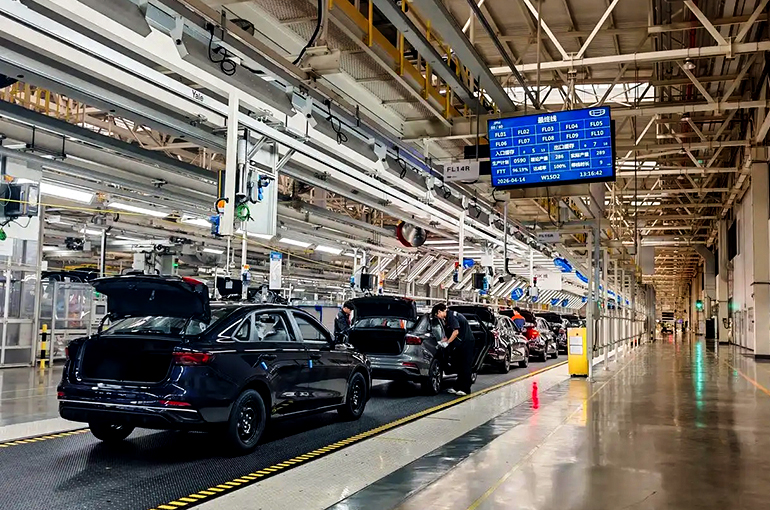
Geely completed the Changxing project in less than 28 months, setting the world’s fastest record for bringing an NEV project from blueprint to mass production, Tong said in a public statement last year. In 2021, the plant entered production and became an industrial enterprise above a designated size, which refers to one with an annual revenue of at least CNY20 million (USD2.9 million), the same year. This made it a benchmark project for Geely and even the entire industry with the fastest construction speed, highest construction standards and the quickest return on investment.
Output value exceeded CNY23 billion in 2024 and by 2025, the Changxing Digital Factory had reached an annual production capacity of 400,000 vehicles, with one new car rolling off the production line every 55 seconds.
Geely’s impact extended far beyond boosting its own production output to fundamentally upgrade the local supply chain. “Before Geely arrived, Changxing’s largest companies generated annual output of only between CNY100 million to CNY200 million,” Zhang said. Geely has not only brought its own supplier network, but also accelerated the coordinated upgrading of the local industrial chain.
There are currently 16 upstream and downstream companies that directly supply Geely, while the number of indirect suppliers has yet to be fully counted, according to Changxing county data. When Geely arrived in 2018, Changxing had about 26 enterprises above a designated size in the automotive supply chain. By 2025 that figure had risen to 61. Today, Changxing alone accounts for more than half of Huzhou’s total automotive industry output.
Supplier Cluster
Ditong Automotive Parts is a typical example of a supplier that closely followed Geely’s footsteps. Based in Xiangtan, central Hunan province, the company set up a base in Changxing in 2018 right next to Geely’s automobile factory, with transport times of less than 10 minutes.
Changxing Ditong mainly produces body and chassis components, said Huo Zhongwei, deputy general manager of the firm. Its entire production capacity in Changxing is dedicated exclusively to supplying Geely’s local vehicle plant. The first phase of the Changxing facility has been operating for two years and generated an output value of about CNY400 million (USD58.8 million) last year.
Jirui Intelligent Systems, which develops advanced driver assistance system domain controllers and other intelligent driving products, also followed Geely to Changxing. Unlike Changxing Ditong, part of Jirui Intelligent’s management team previously worked at Geely.
Changxing Jirui Intelligent was set up in June 2024 and went into production within one year, said Chen Yu, director of government relations at the company. Its output value surpassed CNY200 million (USD29.4 million) in 2025, and it aims to double this figure this year. By 2029, annual output value is expected to reach CNY1 billion, increasing by roughly CNY200 million each year.
Industrial Expansion
Changxing attracted commercial vehicle startup DeepWay Technology in 2025. Unlike Geely, which focuses on passenger cars, DeepWay develops new energy heavy-duty trucks. Its power battery, drive motor and electronic control system project in Changxing has already started production, while construction of its vehicle manufacturing facility is underway.
Industrial expansion is also moving further upstream. DeepBlue Technology, a wholly-owned subsidiary of Demark Group that specializes in semiconductor equipment and key components, went online in Changxing in the second half of last year.
The first phase of the project is currently in trial production and sample manufacturing, Wang Yafei, general manager of Shanghai-based DeepBlue, told Yicai. It is expected to generate about CNY60 million (USD8.8 million) in output value this year and this will rise to CNY300 million after the plant reaches full capacity.
Challenges Ahead
Despite its rapid progress, Changxing’s NEV industry still faces challenges. Compared with cities such as Shanghai and Hangzhou, Changxing remains at a disadvantage in terms of attracting high-end research and development talent. Earlier this year, Changxing Ditong voiced its need for highly skilled professionals during one of the county’s regular government-business consultations. For this reason, many companies have chosen to locate their R&D centers in Shanghai or Hangzhou, with Changxing serving more as a manufacturing base, forming a coordinated division of labor across the Yangtze River Delta region.
In addition to high-end talent shortages, recruiting general workers remains a common challenge for manufacturers.
Beginning in 2024, Changxing county launched the “Changxing Changqing” initiative to recruit, train and retain highly skilled workers. Under the program, the county organizes “Changqing Classes” for junior high school, senior high school and vocational school graduates from central and western provinces such as Yunnan, Guizhou, Jiangxi and Sichuan. Participants receive free tuition and accommodation, enabling a model in which enrollment also serves as recruitment, admission marks the start of employment and graduation leads to jobs.
Editor: Kim Taylor