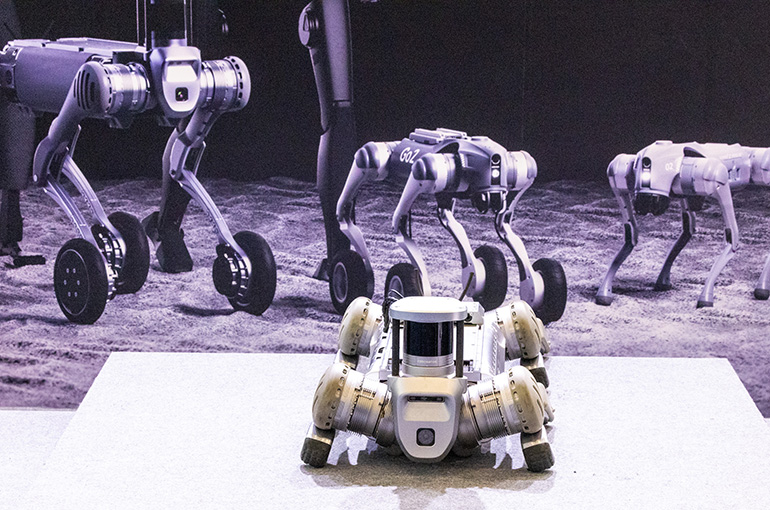
 Industrial-Grade Robodogs Make Up 40% of Global Shipments in First Half, Report Shows
(Yicai) Sept. 23 -- Robot dogs for vertical industrial applications accounted for about 40 percent of the global total in the first half of the year, with AgiBot’s spin-off AgiQuad ranking first in this segment, according to the latest report by Counterpoint Research.
AgiQuad secured a nearly 28 percent share of the quadruped robot market in the six months ended June 30, followed by Deep Robotics with a 26 percent share, per the report released on Sept. 21. Genisom AI and Unitree Robotics ranked third and fourth with shares of 19 percent and 18 percent, respectively.
Global robodog shipments reached about 35,000 units in the first half, with China as the core driver behind the market’s transformative leap to regular deployment in real business scenarios. Unitree ranked first by overall shipments with a 37 percent market share, followed by AgiQuad with 16 percent, Genisom AI with 13 percent, and Deep Robotics with 10 percent.
While robodog manufacturers continue to deepen their layout in the cultural entertainment, education, and science sectors, they are also accelerating penetration into various vertical industries, Counterpoint noted, adding that their products have achieved large-scale deployment and undertaken core operational tasks in key scenarios, such as security patrols, industrial inspection, fire emergency response, and logistics transportation.
Small quadruped robots with dynamic payloads of up to 20 kilograms are widely used in scenarios including commercial performances, scientific research and education, family companionship, lightweight security patrols, and underground pipeline inspection, leveraging their faster commercialization process and greater scalability thanks to their standardized chassis design.
Medium- and large-sized, heavy-duty robodogs, which accounted for about one-fifth of the global first-half shipments, are primarily applied for inspections in complex environments, such as industrial sites, power facilities, and mines.
They feature enhanced durability and can be equipped with various sensors, including depth cameras, light detection and ranging, gas detectors, and thermal imaging cameras, as well as functional modules, such as robotic arms, laser cutting devices, and wireless base stations for fire rescue and post-disaster search scenarios.
As industrial adoption expands, competition has shifted from a focus on robot locomotion performance to the delivery capability of vertical, scenario-based solutions.
Counterpoint expects global quadruped robot shipments to exceed 90,000 units for the first time this year, with annual industrial revenue projected to top USD1.5 billion. The market will likely surpass USD10 billion by 2030, with industrial inspection and security patrols accounting for about 60 percent of the total applications.
Integrating embodied artificial intelligence models into robodogs’ control systems can improve their ability to navigate complex environments and handle unforeseen operational conditions, potentially supporting wider industrial deployment, Counterpoint noted.
Editor: Futura Costaglione