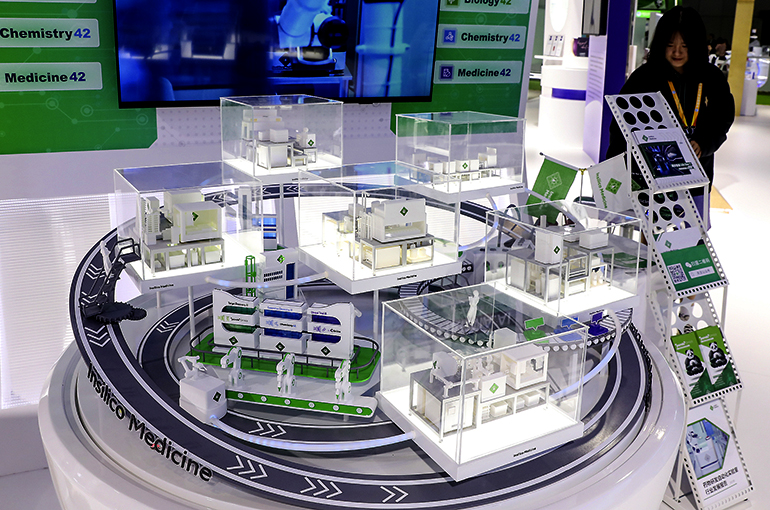
 Insilico Medicine Partners With Liquid AI to Build Drug Research Models; Shares Rise
(Yicai) March 10 -- Shares of Hong Kong-listed Insilico Medicine surged after the artificial intelligence-driven biotechnology company said it has partnered with Liquid AI to develop lightweight scientific foundation models for pharmaceutical research.
Shares of Insilico [HKG: 3696] rose 10.8 percent to HKD65.85 (USD8.40) today, representing a nearly 120% jump since its listing in December.
The collaboration will focus on building scientific foundation models tailored for drug research, the Boston-headquartered drug developer announced yesterday. The first jointly developed model, LFM2-2.6B-MMAI (v0.2.1), was released simultaneously by the two firms and is trained using Insilico Medicine’s proprietary large-model training framework, MMAI Gym.
Liquid AI is an AI startup spun out of the MIT Computer Science and Artificial Intelligence Laboratory. Founded by researchers including Ramin Hasani, Mathias Lechner, Alexander Amini, and Daniela Rus, the company develops general-purpose AI models for businesses and developers.
The LFM2-2.6B-MMAI model can support more than 200 task types across multiple stages of drug development, including prediction of absorption, distribution, metabolism, excretion, and toxicity (ADMET); multi-parameter molecular optimization; protein pocket condition and target assessment; molecular pharmacophore reasoning; and retrosynthetic path planning.
Competition in the AI pharmaceutical industry has shifted from a contest of algorithm models to a battle over clinical value and commercial realization, Alex Aliper, co-founder and president of Insilico, told Yicai. Capital is no longer simply paying for technological concepts but is focusing on the real performance of AI pipelines in the clinical stage, he said.
To hedge against the extremely high risks and long timelines of innovative drug research and development, AI pharmaceutical companies are also leveraging technological spillover to accelerate exploration of a “second growth curve” in non-pharmaceutical sectors, Aliper added.
Headquartered in Boston with its core business in Shanghai, Insilico listed on the Hong Kong Stock Exchange on Dec. 30. The company, which develops treatments for fibrosis and cancer, has yet to achieve profitability. However, as the first AI pharmaceutical firm listed in Hong Kong, it has been included in the Stock Connect program linking the Hong Kong and China's mainland stock markets.
Insilico forecast revenue of up to USD56.3 million last year, down from USD85.8 million the previous year, while losses attributable to the company’s owners are expected to widen to as much as USD356 million, an increase of USD17.1 million from a year earlier, according to its earnings forecast released March 6.
Editor: Emmi Laine