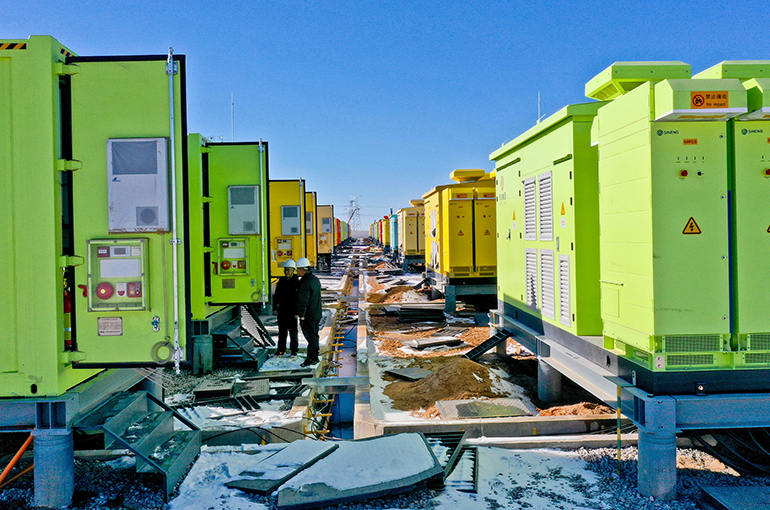
 Policy Shift Sparks China Boom in Independent Energy Storage Projects as Early Losses Emerge
(Yicai) Dec. 12 -- Investment in independent energy storage projects in China has soared since the National Development and Reform Commission scrapped the previous rule requiring new renewable energy power projects to include storage facilities earlier this year. However, the business model for these projects is still unclear and some are already reporting losses, Yicai learned from industry insiders.
The key feature of independent energy storage projects is that the project owner operates independently. Since they are not tied to specific new energy power projects, they can sign grid connection and dispatch agreements directly with power authorities, and their grid connection points are not limited.
After the new policy took effect, the number of registered independent energy storage projects surged. One hundred and seventy-eight such projects have been approved in Guangdong province so far this year, almost four times the 47 projects given the green light in the whole of 2024, according to the southern province’s online investment project approval platform.
The new policy has fully unlocked the value of independent energy storage as a power system regulator, an executive from a major energy storage equipment manufacturer in Guangdong province said. This has created a clearer and more favorable policy environment for investors.
"Independent energy storage projects are very popular this year," he said. His company's inventory of battery cells is tight and customer orders placed on short notice often can only be delivered after several months.
Another executive from a battery cell manufacturer confirmed the supply crunch, saying that the firm’s production lines are running at full capacity.
Before the new rules, most independent energy storage companies made money by leasing storage capacity to renewable energy power plants, industry insiders told Yicai. Now, they can also generate revenue through participating in electricity spot trading, providing frequency regulation and peak-shaving services to grid companies, as well as receiving government capacity subsidies.
Uncertain Profits
Profits, though, are still highly uncertain, Du Xiaotian, chairman of the Electrical Energy Storage Alliance, told Yicai. Policies and market regulations vary across different regions, so whether a project can turn a profit depends heavily on the local regulatory and market environment, as well as the company's ability to tap multiple revenue channels.
In the Inner Mongolia Autonomous Region, for example, the capacity compensation rate this year is CNY0.35 (USD0.05) per kWh, but it will be reduced to CNY0.28 per kWh next year, Du said. This increases the risk of fluctuations in investment returns.
Independent energy storage stations in Guangdong province have already reported operating losses with similar losses occurring in Guangxi Zhuang Autonomous Region, central Hunan province and other areas, insiders said.
"The profit model for independent energy storage is still unclear," a senior executive at a new energy storage company told Yicai. Even where provinces have set clear capacity compensation policies, relying on government subsidies alone is usually not enough to cover investment costs. Owners need to boost revenue through spot market trading and other channels.
In northwest China, for example, there are challenges absorbing renewable energy and insufficient demand, the executive said. "In that situation, who are you going to sell the electricity to?" he asked
Editors: Tang Shihua, Kim Taylor