 More Chinese Provinces Launch Own Subsidies to Refine National Home Appliance Trade-In Program
(Yicai) May 6 -- More Chinese provincial-level regions have introduced their own purchase subsidies on home appliances to reinforce the national consumer goods trade-in program, which is expected to boost sales of related products.
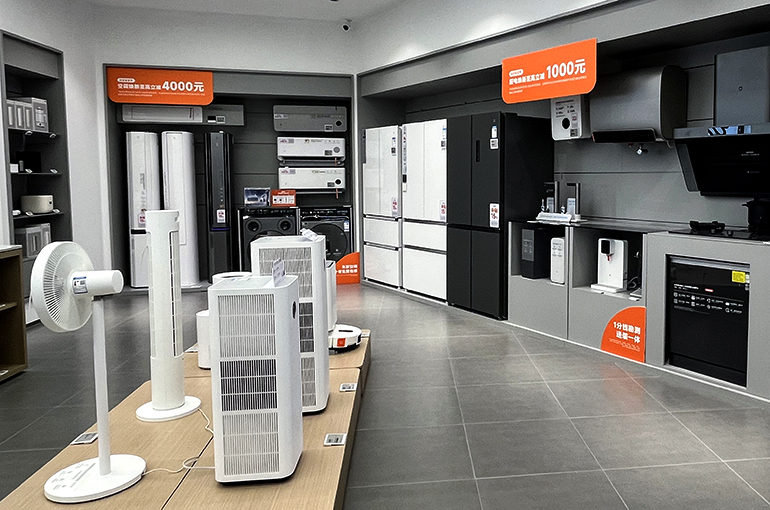
Shanghai, Chongqing, Hubei province, and Guizhou province launched local subsidy policies on May 1 to expand the scope of the national consumer good trade-in program to include range hoods, gas stoves, digital cameras, water purifiers, dishwashers, smart toilets, smart beds, sweeping robots, and exoskeleton robots.
The local subsidies cover between 10 percent and 20 percent of the selling prices, with a maximum amount of CNY1,000 to CNY2,000 (USD147 to USD294) per product.
Sales of range hoods, stoves, dishwashers, water purifiers, and cleaning appliances at the Shanghai stores of Suning.Com surged 183 percent on May 1 from a month earlier, buoyed by the new local subsidies and the Labor Day holiday, according to data disclosed by the Chinese electronics retailer.
China introduced the national consumer goods trade-in policy three years ago, but its coverage and intensity have narrowed since this year. For example, the home appliance subsidies only cover refrigerators, washing machines, televisions, air conditioners, water heaters, and computers now, as other kitchen appliances were removed from the scope. Moreover, the subsidy ratio was cut to 15 percent from 20 percent.
As a result, China’s retail sales of domestic kitchen and bathroom appliances plunged 10 percent to CNY28.1 billion (USD4.1 billion) in the first quarter of the year from a year earlier, Zhao Zhiwei, vice president and general manager of the kitchen, bathroom, and home appliance division at market research firm All View Cloud, told Yicai.
In response, Jiangsu and Heilongjiang provinces in April released new policies to stiffen the national consumer goods trade-in program by offering their own purchase subsidies on home appliances in a bid to lift household spending.
With the launch of local subsidy policies, the market is expected to stabilize and rebound in the second quarter, Zhao predicted.
Editors: Dou Shicong, Futura Costaglione