



 Multinationals Deepen China Localization Even as FDI Growth Slows
(Yicai) Dec. 19 -- Foreign-funded companies in China are stepping up efforts to localize their operations across production, research and development, supply chains, and talent, even as the country’s overall pace of attracting foreign direct investment has slowed, Yicai learned from interviews with several multinational firms.
The trend reflects a strategic shift among foreign enterprises seeking to strengthen competitiveness by embedding more deeply in China’s market and industrial ecosystem. Executives said China’s scale, supply chain efficiency, and rapid innovation cycles continue to make the country indispensable to their global strategies.
“It took less than six months for Veolia to achieve localized production of submerged ultrafiltration equipment used in water treatment processes in China this year,” said Shang Tong, Asia-Pacific director of supply chain manufacturing engineering at Veolia Water Technologies. He noted that such speed was unprecedented and highlighted the sharp acceleration of localization in the company’s China business in recent years.
Pan Bingmei, China supply chain director at Veolia Water Technologies, said that although the product range completeness of Veolia’s plant in Wuxi, an eastern Chinese city, already leads the company’s global facilities, Veolia plans to further expand the plant’s production capacity and introduce more new products.
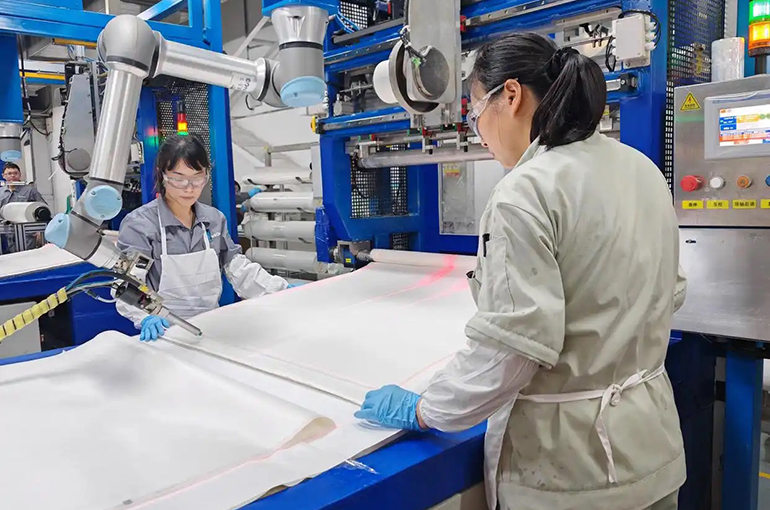
Veolia will also continue investing more than USD1 million annually in automation, intelligent upgrades, and green transformation at the Wuxi factory to enhance operating efficiency and supply chain flexibility, Shang said. These upgrades have enabled the factory to achieve double-digit annual output growth without expanding its footprint.
Antonio López, chief executive officer of Spain-based Gestamp’s Asia-Pacific region, told Yicai that 99.5 percent of employees in the company’s China operations are local, and that its logistics and supply chain systems in China have essentially been fully localized.
China’s vast market and well-developed supply chains are the main drivers behind foreign firms’ continued push for localization, and are also critical to maintaining their global competitiveness, López said. Beyond scale, he added, China’s cost advantages allow new technologies to be rapidly deployed and applied across the entire value chain.
China has also emerged as a technology leader, particularly in electric vehicles and batteries, where domestic firms are no longer followers but global standard-setters, López said. In his view, Chinese companies are able to roll out new products, optimize costs, and upgrade technologies at an unmatched speed, giving local automakers and suppliers a decisive edge in responding to market shifts and globalizing new technologies.
China has become one of Gestamp’s most important markets globally, accounting for about 14 percent of the group’s revenue, López said, adding that China will continue to be a key driver of Gestamp’s global growth.
Foreign-funded companies are also increasingly developing, manufacturing, and applying new products in China before exporting them worldwide, creating a new source of export growth. Pan, who has also served as head of Veolia’s Wuxi factory for five years, said that nearly all of the company’s water treatment chemical production and research and development is now based in China. About 30 percent of output from the Wuxi plant is exported globally, with export volumes expected to rise as product offerings and market reach expand.
López added that Gestamp’s China strategy enables it to develop products better suited to local electric vehicle platforms, while strengthening links between Chinese automakers and the company’s global supply network spanning 24 countries.
Editors: Tang Shihua, Emmi Laine





