



 Global Business Leaders Share Views on the Future of China’s AI Sector at WAIC 2026
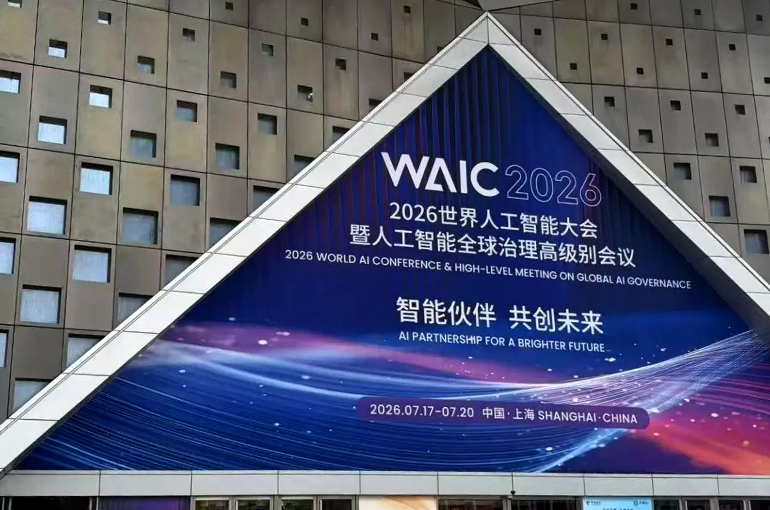
(Yicai) July 18 -- On the opening day of the 2026 World Artificial Intelligence Conference and the High-Level Meeting on Global AI Governance in Shanghai, nearly 30 Chinese and international entrepreneurs shared their perspectives on the direction of China’s AI sector, highlighting key areas such as open-source technology, embodied AI, industrial application, and global AI governance.
International corporate leaders expressed strong confidence in China’s AI ecosystem. Alex Zhavoronkov, founder and co-chief executive officer of US biotech firm Insilico Medicine, said China is leveraging cutting-edge AI to develop novel drugs and advance treatments and cures for various diseases. He expressed excitement about being part of this innovation ecosystem and pledged to continue supporting China’s health and longevity sector with talent, resources, and infrastructure.
Vincent Boinay, president of L'Oréal North Asia and CEO of L'Oréal China, said China’s long-term strategic investment, diverse application scenarios, and open innovation environment have created fertile ground for AI development worldwide. He added that the French cosmetics and beauty company remains committed to innovating in China, with Chinese firm, and for China.
Lee Jae-chul, co-founder and CEO of SKAI Intelligence, revealed that the South Korean developer of embodied AI technology is collaborating with China’s ABB Robotics to combine high-precision synthetic data generation capabilities with digital engineering environments for industrial robots. The partnership aims to help manufacturers identify potential issues and test AI vision systems before introducing them into actual production lines.
Among Chinese business leaders, embodied AI and its industrial application were among the most frequently discussed topics. Jiang Xu, founder and CEO of Liangyuan Xinchuang, a startup also known as Light Robotics, argued that the key challenge for the next stage of AI development is enabling foundation models to mimic and surpass human abilities in the physical world. Embodied AI will continue to evolve through large-scale pre-training, alignment, and deployment, he said.
Yu Enyuan, who set up and is chief executive at robovan maker Neolix, said physical AI has the potential to achieve early large-scale commercialization in China’s logistics sector. He expects unmanned logistics systems to evolve beyond transportation and eventually take on additional tasks such as loading, unloading, and material handling.
Gong Yicheng, vice president of e-commerce giant JD.Com and head of JD Cloud's infrastructure cloud business, pointed out that a lack of high-quality, large-scale data from the physical world is a key bottleneck hindering the development of embodied AI. JD plans to leverage its extensive real-world applications across logistics, retail, manufacturing, and healthcare to provide higher-quality datasets for robot training, he said.
Xue Fei, who established Liaode Technology, a producer of humanoid robotics, pointed out that the rapid growth of China’s bionic robotics industry is down to the state's sustained investment in AI innovation and the fortification of governance frameworks.
Zhang Jiaming, CEO of emotional companion AI bionic robots manufacturer Wuxin Technology, noted that embodied intelligence has been incorporated into the national strategic roadmap for future industries. He looks forward to integrating the entire value chain spanning research and development, clinical validation, regulatory approval, and mass production to accelerate the deployment of AI-powered health and elderly care products in nursing homes and communities.
Zhipu AI, also known as Z.ai internationally, said that competition in the artificial intelligence field is not a zero-sum game and that true security stems from openness rather than isolation. The unicorn said it remains committed to a technological path characterized by open-source, trustworthiness, inclusivity, and societal benefit.
Safety and governance frameworks were also often highlighted as key issues at the WAIC. Tony Li, founder and CEO of Keenon Robotics, which specializes in autonomous indoor delivery and cleaning solutions, called for the establishment of a humanoid robot safety assessment framework and a technology open-source sharing mechanism under the framework of the World Artificial Intelligence Cooperation Organization.
Li emphasized that China should speed the development of safety access standards for different scenarios, transforming its first-mover advantage into a leading role in global standard-setting.
Li Chunzhi, chief operating officer of the Beijing Humanoid Robot Innovation Center, said that overcoming technological barriers requires replacing division between competing camps with collaboration among partners. Through open-sourcing, data sharing, and joint R&D efforts involving industry, academia, and research institutions, an open and inclusive global intelligent ecosystem can be built, she said.
On the topic of corporate management and industrial integration, Digital China Chairman Guo Wei noted that the focus of global competition in the AI era has shifted from a contest around large language model capabilities to the reconstruction of organizational structures, processes, and management systems. The information technology services and cloud computing firm is exploring a new "AI for Process" paradigm, aiming to shift operational productivity from "intelligent change" to “qualitative change.”
Yang Zaifei, CEO of Haizhi Technology Group, urged the industry to move away from the path of merely pursuing larger parameter scales. He suggested prioritizing "the strategic capability to master and steer large language models" as a key area for cultivating "new quality productive forces,” emphasizing the need to strengthen top-level design to bridge the gap between basic research and industrial application.
New quality productive forces is a Chinese economic concept that describes an innovation-led growth model powered by disruptive technologies, advanced manufacturing, and green energy.
Kingsoft Office Software’s CEO Zhang Qingyuan expressed the hope that China's AI innovations would be more deeply integrated into the global ecosystem, enabling Chinese businesses to work alongside the world's leading players to define the standards for the next generation of productivity tools.
Zhen Lixin, who chairs Intsig Information, said that as the AI and software company expands its multimodal intelligent text recognition business overseas, it adheres to the principles of "openness for good" and "compliance for win-win," balancing data regulations across different regions to build an open, fair, and secure global AI ecosystem.
Sun Changxun, founder and CEO of Cloopen Group Holding, a cloud-based provider of communications solutions, said he expects China’s AI sector to focus on real-world applications and measure technological value by practical outcomes. He also called for global AI companies to embrace open collaboration and co-create governance rules.
These statements reflect a shift among Chinese enterprises from a race based solely on model capabilities to a stage that places equal emphasis on organizational efficiency and the export of global standards.
A number of business heads also discussed the implementation paths for AI in specific industries. Dr. Chris Lai, co-founder, chairman, and CEO of Metis TechBio, said that AI’s greatest value in the life sciences is not merely in boosting the efficiency of R&D, but also in empowering humanity to rewrite the instructions of life, opening up new avenues to tackle major challenges such as cancer, immune diseases, and neurodegenerative illnesses.
Li Shimin, co-founder and chief executive of AI startup Mosi Intelligence Technology, believes that China’s industrial use cases, complete manufacturing system, and vast developer ecosystem are important advantages for developing next-generation AI. Li said he looks forward to more original Chinese AI technologies and open-source models going global.
Dawning Information Industry’s Senior VP Li Bin said his company, which develops supercomputers, servers, and data center products, is advancing a new generation of intelligent computing infrastructure. Its latest offering, the Sugon 8000 -- China’s first fully domestically developed 100,000-GPU AI supercluster -- is part of its effort to make AI capabilities more accessible and easier for a wider range of industries to adopt.
Zhou Bin, CEO of Runke Juneng Technology, a business specializing in robotics and embodied AI, looks forward to the industry stepping up the creation of unified standards and open interfaces to enable AI agents to truly interconnect with each other and form an “intelligent partner network.” He said he also eagerly awaits seeing more robust, real-world applications in industrial, medical, and specialized sectors.
Wang Yishan, chief technology officer of Senad Technology, which concerns itself with embodied AI, warehouse automation, and smart logistics, anticipates deep integration between large AI models and the physical logistics economy, aiming to address industry pain points such as labor shortages and non-standard operational environments through autonomous loading and unloading robots.
Manycore Tech Chairman Huang Xiaohuang stated that China has the world’s richest industrial scenarios and manufacturing foundation, which is the best soil for AI to transition from “showing off” to “practical use.” The spatial intelligence and software company hopes to collaborate with global developers to explore new paradigms for industrial embodied AI, he said.
CosmoPlat’s Chen Lucheng, who chairs the industrial internet platform, expressed a commitment to taking a full role in global AI governance and industry collaboration, delivering mature industrial intelligence solutions tailored to global markets, and driving the use of China’s industrial AI innovations to upgrade global manufacturing.
Several entrepreneurs present at the WAIC’s first day focused on AI for public well-being. Yusheng Science and Technology’s Chairman Chen Danian noted that AI applications have not yet truly benefited everyday users. As a Shanghai-based AI incubator, his company plans to go on investing capital to connect industry resources and foster the growth of young AI entrepreneurs, he said.
Li Nan, founder, chairman, and CEO of Mcmug Technology Group, said that AI’s greatest value lies in whether it can be actually used to empower the ancient agricultural sector with young technology.
HuiHua Intelligence’s CEO Jia Xuefeng expects AI to evolve from a “passive response tool” to an “active care partner” in addressing the challenges of aging, while Yu Xiang, general manager of broadcaster Oriental Cable Network, said he hopes his company can leverage its public service attributes to deeply root AI in local communities and become “intelligent partners” for residents.
Editor: Tom Litting





