



 New BCI Devices Target Rehabilitation and Autism Treatment at Wuhan Expo
(Yicai) April 9 -- Several new brain-computer interface technologies were unveiled at the 2026 World Health Expo that opened in Wuhan yesterday, highlighting advances in medical diagnosis, rehabilitation, and neural regulation as the sector increasingly integrates artificial intelligence.
The expo showcased innovations spanning brain signal acquisition, biochemical brain indicator detection, and precision intervention technologies, reflecting how BCIs -- an interdisciplinary field combining integrated circuits, AI, neuroscience, and clinical medicine -- are expanding beyond single electrical signal collection toward more comprehensive diagnostic and treatment applications.
Among the highlights was a wireless dry-electrode brain function assessment and disease-assisted diagnosis system developed by the Chengdu Frontier Brain AI Innovation Center. The system is China’s first wireless dry-electrode electroencephalogram (EEG) collection and analysis platform approved by the National Medical Products Administration for both clinical assessment and scientific research. Featuring short preparation times, high signal quality, and wireless portability, it uses deep neural network diagnostic models to support autism diagnosis and treatment and help improve patients’ language and social abilities.
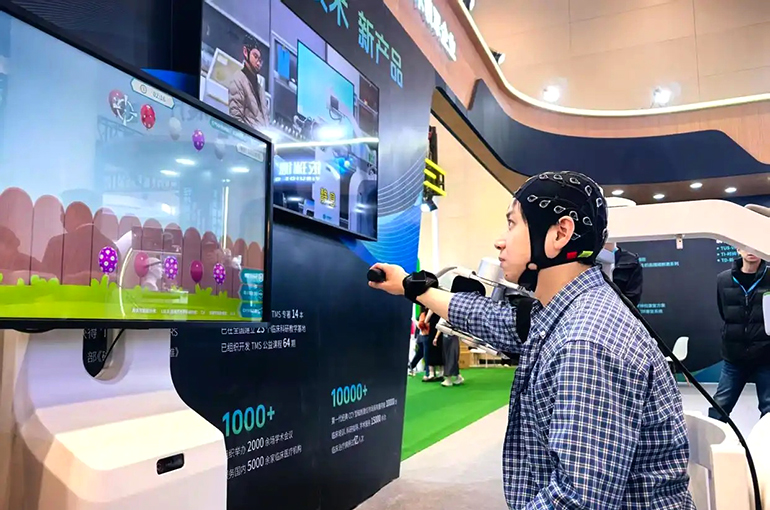
Haitian Intelligence Engineering presented several self-developed products, including a Brain-Computer Interface Rehabilitation Training System, a Brain-Computer Interface Hand Function Rehabilitation Training System, and a Brain-Computer Interface Lower Limb Exoskeleton Robot. Clinical data show that these brain-controlled robotic devices can reduce disability rates among stroke and autism patients by 25 percent during rehabilitation training.
Yiruide Medical Equipment New Technology demonstrated a closed-loop solution for non-invasive BCI and neuromodulation technologies. By combining near-infrared brain function imaging with EEG technology, the system can accurately “read the brain” and decode intentions before applying transcranial magnetic, electrical, and ultrasound neuromodulation technologies to “write the brain or control the brain.” The system forms a complete loop from brain function detection and targeted intervention to efficacy evaluation, providing non-invasive and visualized full-cycle services for diagnosing and treating neurological diseases.
Zhonghua Brain Computer Integration Technology Development also introduced the Zhonghua Intelligent Bionic Hand, which reads the wearer’s surface electromyographic (sEMG) signals and instantly converts movement intentions into mechanical hand actions. The device also supports intuitive voice commands, enabling dual-modal control combining “intention + voice” to expand functionality in complex daily living scenarios.
Executives from several pharmaceutical companies said at the expo that the broader healthcare industry is rapidly embracing AI. New technologies such as AI, big data, and large language models are not only helping companies improve efficiency and quality, but are also expected to establish a new development paradigm for the healthcare industry.
Editor: Emmi Laine





