



 New China-Made Polymer Thermoelectric Film Could Power Wearables With Body Heat
(Yicai) March 6 -- Chinese scientists have developed a new polymer thermoelectric film that significantly improves the performance of flexible thermoelectric materials, potentially advancing energy-harvesting technologies for wearable devices and Internet of Things sensors.
The material, developed by researchers at the Institute of Chemistry under the Chinese Academy of Sciences, achieved a thermoelectric figure-of-merit (zT) of 1.64 at 343 kelvin -- a record among flexible thermoelectric materials operating in the same temperature range and a key step toward overcoming a longstanding performance bottleneck for polymer-based thermoelectric materials, according to a study published yesterday in the journal Science.
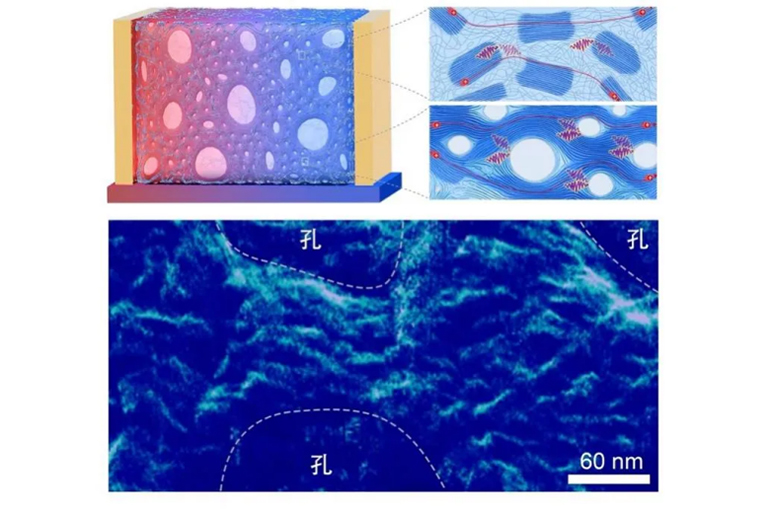
The team, led by Zhu Daoben and Di Chongan, created irregular hierarchical-porous thermoelectric polymer (IHP-TEP) films using a fine-tuned critical-transition phase separation technique. The approach enables simultaneous control of thermal conductivity and charge transport, significantly improving thermoelectric performance in flexible materials.
Thermoelectric materials can directly convert thermal energy into electricity, enabling energy savings and emissions reduction by recycling waste heat. Flexible thermoelectric materials can be attached to the human body or clothing to convert heat generated during daily activities into electricity without noise or pollution.
For years, polymer thermoelectric materials have lagged behind inorganic materials in zT performance, limiting their practical applications. The newly developed IHP-TEP films reached a maximum zT value of 1.64 at 343 kelvin, setting a record for flexible thermoelectric materials operating in the same temperature range, compared with the previous polymer thermoelectric material record of 1.28, the study showed.
For thermoelectric materials to perform efficiently, they must combine high electrical conductivity with low thermal conductivity, allowing electric charges to move efficiently while minimizing heat loss. The thermoelectric figure-of-merit (zT) is a comprehensive indicator that measures these properties.
Unlike many existing high-performance thermoelectric materials that require complex manufacturing processes, IHP-TEP films can be produced at large scale and low cost using spray-coating technology. The design principle can also be applied to various polymer systems, offering a practical pathway to scalable and sustainable thermoelectric generators for wearable and portable energy-harvesting technologies, the researchers said.
Editor: Emmi Laine





