



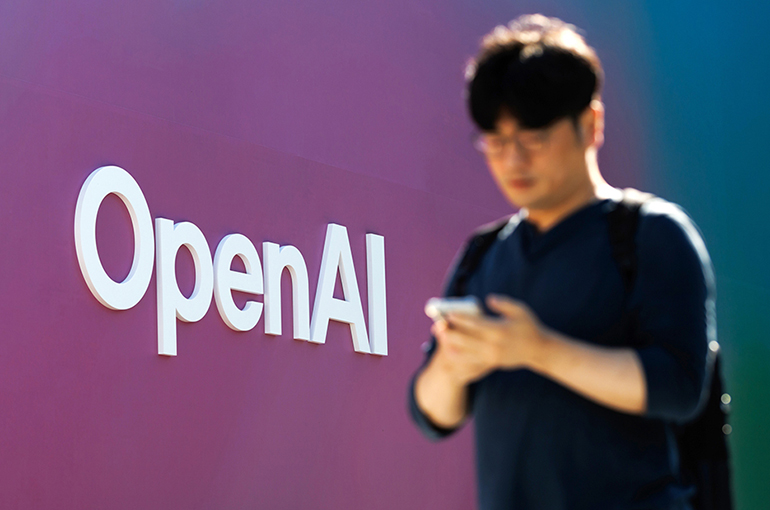
 OpenAI Price Cuts Trigger Drop in Asian Stock Markets
(Yicai) Aug. 4 -- OpenAI, the US developer of ChatGPT, slashed the price of two of its latest low- and mid-tier artificial intelligence models, leading to Asian stock markets tumbling on a technology selloff.
The Kospi index in Seoul was trading down 1.2 percent as of 1.02 p.m. Beijing time today, after closing down 5.1 percent yesterday. The Shanghai Star 50 Index, which dropped 5.1 percent yesterday, rose 3.4 percent today, while Tokyo's Nikkei 225 fell 0.3 percent today to add to the 0.9 percent drop the previous day.
On July 30, OpenAI cut the price of the GPT-5.6 Terra by 20 percent to USD2 per million input tokens and USD12 per million output tokens, as well as that of the GPT-5.6 Luna by 80 percent to 20 US cents per million input tokens and USD1.20 per million output tokens. The move stoked investor concern over shifting supply-and-demand dynamics across the AI supply chain.
The price cut was mainly driven by OpenAI's push to improve efficiency, offset cost pressure, and respond to competition from open-source models, said Wen Tianna, chief executive officer of Boda Capital International. The move will likely trigger near-term concerns about falling inference costs and slowing growth in computing power demand, weighing on sentiment toward AI hardware and semiconductor stocks, he noted.
However, lower prices could spur usage and broader adoption over the long term, benefiting software and cloud providers, he pointed out, adding that the slump in South Korean stocks was not driven solely by OpenAI's price cut but also by forced deleveraging, while that in the Chinese mainland tech shares was more a spillover from weak global sentiment toward hardware.
OpenAI's price cut has amplified valuation swings across global AI assets, according to Pan Jun, an investment manager at Cheese Fund. The move has pushed markets to reprice AI investments, shifting the focus from compute capacity expansion toward returns on investment and monetization of AI applications, he added.
The rout in South Korean stocks also reflects a gap between memory chipmakers' earnings expectations and reality, as well as an unwinding of crowded, leveraged trades, Pan said. This has not yet evolved into a global systemic risk, he stressed.
OpenAI's move is prompting global investors to reconsider the sustainability of profits at the compute and model layer of AI, which has been the core logic behind capital crowding into the sector over the past two years, said Mo Xiaocheng, general manager of Huanrui Fund. The fate of AI infrastructure is one of intensifying competition and falling prices over the long run, he added, noting that the recent bout of volatility reflects a normal correction after the earlier rally.
The price war among large language models will make it harder and slower for downstream AI applications to commercialize and generate returns, which will in turn dampen upstream investment appetite, according to Li Zeming, chief investment officer at Blue Water Capital Management Limited. A potential drop in AI infrastructure spending will affect the semiconductors, memory chips, power equipment, optical communications, and other sectors, he said.
When hardware stocks come under pressure, capital tends to rotate into application-layer names with lower valuations and improving fundamentals, Wen said. Internet companies listed in Hong Kong remain undervalued by historical standards and could show relative resilience during the hardware-led correction, he stressed.
Shares of Alibaba Group Holding [HKG: 9988] rose 0.7 percent to HKD126.10 (USD16.08) each in Hong Kong today. The stock closed up 7 percent yesterday after the Hangzhou-based company unveiled a new AI product. Tencent Holdings [HKG: 0700] fell 0.9 percent to HKD485.80 today after ending 3.2 percent higher yesterday.
Editor: Martin Kadiev





