



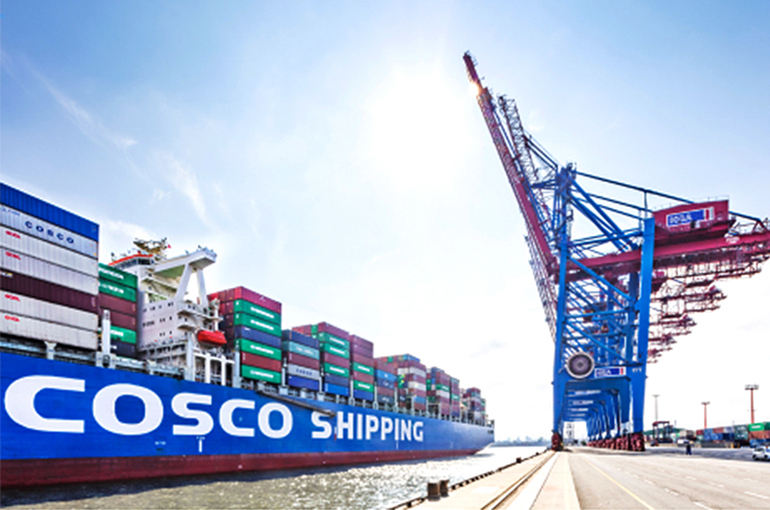
 Cosco Shipping Units Downplay Impact of Mideast Crisis After Container Freight Arm Halts Bookings
(Yicai) March 6 -- After Cosco Shipping Lines said it will halt new bookings on routes to and from the Middle East due to restrictions on the region’s maritime traffic, other listed units of state-owned giant China Cosco Shipping told Yicai that operations remain normal.
Cosco Shipping Energy Transportation, which ships crude oil and natural gas, told Yicai yesterday that it is operating normally, even though the closure of the Strait of Hormuz has hit global energy flows. The impact cannot be assessed yet, as first-quarter earnings results typically reflect freight rates from December, January, and February, the company said.
Cosco Shipping Lines, a container shipper, announced on March 4 that it would suspend all new bookings on routes connecting global ports with several Mideast destinations until further notice, citing the escalating regional conflict and resulting restrictions on maritime traffic through the Strait of Hormuz. The stoppage will affect shipments to and from the United Arab Emirates, Qatar, Bahrain, Iraq, Saudi Arabia, and Kuwait.
All Middle East shipping routes have been upended and some vessels en route have turned back, according to a senior industry source told Yicai. The sector is in wait-and-see mode, weighing whether to accept costly diversions and complex transshipments or to wait for services to resume, they told Yicai.
Cosco Shipping Development told Yicai that its main businesses -- container production and container and vessel leasing -- will not be directly affected by the current disruption.
Marine and coastal freight operator Cosco Shipping Specialized Carriers said shipments to the Middle East represent only a small share of its transport volumes, so the conflict will likely have a limited impact on revenue. The firm will monitor developments and may take similar steps to those of Cosco Shipping Lines in the event of security risks, it added.
Meanwhile, Cosco Shipping Holdings said it will follow Cosco Shipping Lines and suspend all Middle East bookings. Any financial impact will have to be assessed when first-quarter earnings are released, it told Yicai, adding that vessel and cargo safety are the immediate priorities and that freight rates are influenced by many factors.
As of the end of last year, Cosco Shipping’s fleet of 1,660 vessels had a total capacity of 135 million deadweight tons, ranking first globally, according to its website. The Shanghai-based company has more than 1,600 branches globally, and its routes cover more than 1,500 ports in over 160 countries and regions.
Wider Industry Reaction
Other Chinese shipping firms have also addressed concerns stemming from the situation in the Middle East. On March 3, China Merchants Energy Shipping said operations are normal, with the overall impact expected to be controllable. Though tanker access to the Persian Gulf faces major safety risks, the company believes the overall operational impact is manageable.
On the same day, Shenghang Shipping said that its international hazardous-chemicals shipping is mainly concentrated in Northeast Asia, Southeast Asia, and India, so the Mideast conflict has no direct impact on its business. But global oil price volatility may have a certain impact, it added.
The industry has experienced multiple reversals in just a few days. The main futures contract for the Container Shipping Index (Europe Route) on the Shanghai International Energy Exchange hit the daily trading upper limit on March 2 and 3, but plunged the following day, with multiple individual company stocks falling by their daily limit.
The contract surged more than 17 percent yesterday before closing over 3 percent lower after the deputy commander of Iran’s armed forces command headquarters said on state television that the country has not blocked the Strait of Hormuz and that vessels continue to pass in accordance with international protocols.
Escalating geopolitical tensions have pushed demand in the Very Large Crude Carrier market above expectations, while supply has undergone a contraction, driving exceptionally strong gains in spot freight rates, according to ICBC UBS Asset Management.
Closure of the strait may further drive up VLCC freight rates in the near term despite already elevated levels, it said, adding that market participants should continue to closely monitor developments in the Middle East.
Editor: Futura Costaglione





