



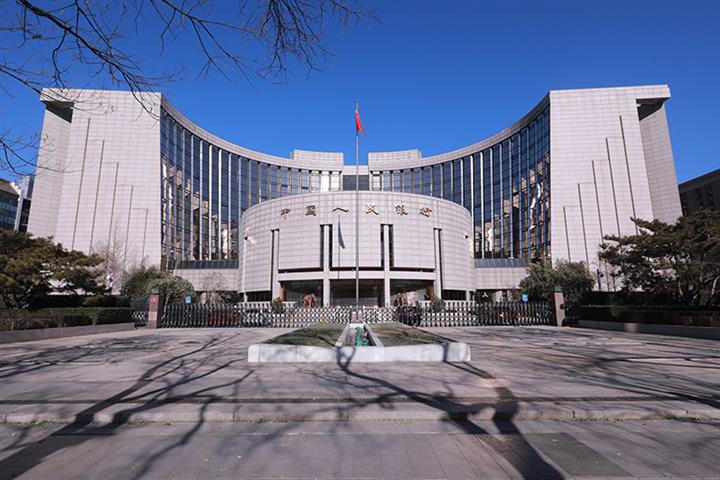
 China’s Central Bank Shoots Down SLF Rate Rise Rumors, Alerts Police
(Yicai Global) Jan. 29 -- The People’s Bank of China today dismissed rumors that it will raise the interest rate for its standing lending facility, and said it has reported the matter to the police.
The SLF rate generally serves as the ceiling of the PBOC’s interest-rate corridor, through which the bank maintains the smooth functioning of money market rates.
Today is the last trading day in January, and liquidity remains tight overall. According to data from Wind, in the interbank pledged repo market the weighted average interest rate of overnight pledge-style repos, DR001, closed up 29 basis points at 3.34 percent. That is higher than the 3.05 percent SLF rate for the same maturities, breaking the upper limit of the interest-rate corridor.
The PBOC has signaled tighter liquidity with repeated net withdrawals of funds recently. It conducted reverse repos worth CNY100 billion (USD15.5 billion) yesterday, with a net CNY328 billion drained from the financial system in the last three trading days.
The withdrawals were made because fiscal expenditure increased substantially toward the end of the month, which means that as fiscal funds flow to the market, they ease the growing capital margin strain, the PBOC said yesterday.
At around 2.00 p.m. local time yesterday, the overnight repo interest rate stood at 11 percent, and the seven-day rate reached 7 percent. Almost all institutions are tight on funds and joint-stock banks and large city commercial banks are borrowing money, the Shanghai Securities News reported, citing a trader at a fund company.
The market had expected the central bank to continue releasing funds for 14 days starting yesterday to stabilize liquidity in the run-up to the Spring Festival holiday. But this expectation has faded, leading yesterday to a sharp rise of nearly 50 basis points in the 14-day interest rate.
The tightening may be related to the situation in China’s real estate market. Property prices in some cities have risen sharply and new purchase and loan restrictions have been introduced. The central bank has also tightened interbank liquidity, according to Ming Ming, deputy director of Citic Securities Research Institute.
Although PBOC Governor Yi Gang has said monetary policy will remain stable this year, comments which buoyed market confidence, it seems the aim is to stabilize the macro leverage ratio and avoid systemic financial risks, rather than ensure the supply of funds, said Zhang Jiqiangbi, a fixed-income analyst at Huatai Securities Research Institute.
Editor: Tom Litting





