



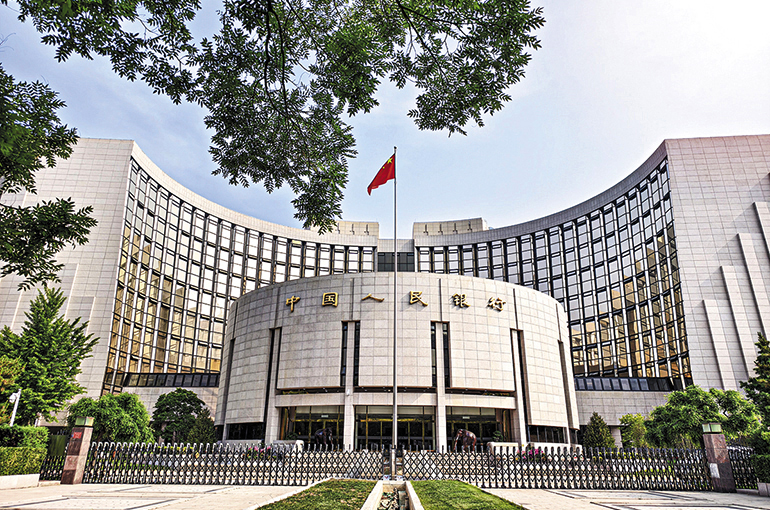
 PBOC Raises Overnight Reverse Repo Cap to CNY1 Trillion as Tool Takes Bigger Role
(Yicai) Sept. 24 -- China’s central bank has raised the daily ceiling for overnight reverse repos to CNY1 trillion (USD149.1 billion) as the tool takes on a bigger role in managing short-term liquidity, while adding CNY800 billion (USD119.3 billion) through a medium-term lending facility operation.
The People’s Bank of China lifted the overnight reverse repo ceiling from CNY600 billion seen in the last three rounds with the MLF operation, signaling support for liquidity at both the short and medium term. The MLF operation will result in a net injection of CNY200 billion this month, ending August’s net withdrawal.
The PBOC said yesterday that it will conduct overnight reverse repos from Sept. 28 to Oct. 8 to better match the banking system’s short-term liquidity needs. The operations will use a fixed interest rate and quantity bidding, with a daily volume of up to CNY1 trillion.
Looking ahead, overnight reverse repos could become the PBOC’s main tool for managing short-term liquidity, according to Wang Qing, chief macro analyst at Golden Credit Rating International.
The PBOC uses reverse repos to manage banks’ short-term funding and influence money-market rates, while the MLF provides longer-dated funds to the banking system. Greater use of overnight operations could help keep short-term rates around the policy rate and limit volatility.
Overnight Reverse Repo Ceiling Rises
The PBOC previously conducted overnight reverse repos in late July, late August, and mid-September, with the daily ceiling set at CNY600 billion.
Raising the daily ceiling can fully meet financial institutions’ short-term funding needs, guide the overnight depository-institution repo rate, or DR001, to move steadily around the policy rate, and more effectively control its volatility, Wang said.
The central bank may further increase the frequency of overnight reverse repo operations in the future, gradually replacing seven-day reverse repos and making the overnight tool its core policy instrument for short-term liquidity management, Wang predicted.
The spread between overnight funding rates and the seven-day reverse repo rate has remained relatively stable recently, according to Ming Ming, chief economist at Citic Securities.
The latest overnight reverse repo operation reflects an intention to maintain neutral-to-ample short-term liquidity, while the return of net MLF injections signals stronger support for medium-term liquidity, Ming said.
MLF Returns to Net Injection
The PBOC will conduct a CNY800 billion one-year MLF operation today using a fixed quantity and interest-rate bidding, with winning bids determined at multiple price levels, to maintain ample liquidity in the banking system.
Together with the short-term liquidity tool, the MLF operation will result in a net injection of CNY200 billion in September, ending the net withdrawal recorded in August.
The increased MLF operation was in line with market expectations and can be explained by two factors, Wang said.
First, government bond issuance has increased recently, significantly boosting net financing, and government bond financing is expected to remain relatively high, Wang noted. Injecting medium-term liquidity through MLF operations can help support the smooth issuance of government bonds and reflects coordination between monetary and fiscal policies.
Second, DR001 has recently been moving broadly around the policy rate, Wang said. The increased MLF operation in September extends the net injection of medium-term liquidity, helping maintain ample liquidity and stabilize market expectations.
Macroeconomic policies will likely tilt further toward stabilizing growth, Wang predicted. In the short term, medium-term liquidity tools including MLF and outright reverse repos are expected to continue providing net liquidity to support government bond issuance and related bank lending.
This is an important focus of the current monetary policy push to strengthen countercyclical adjustments, Wang added.
Editor: Emmi Laine





