



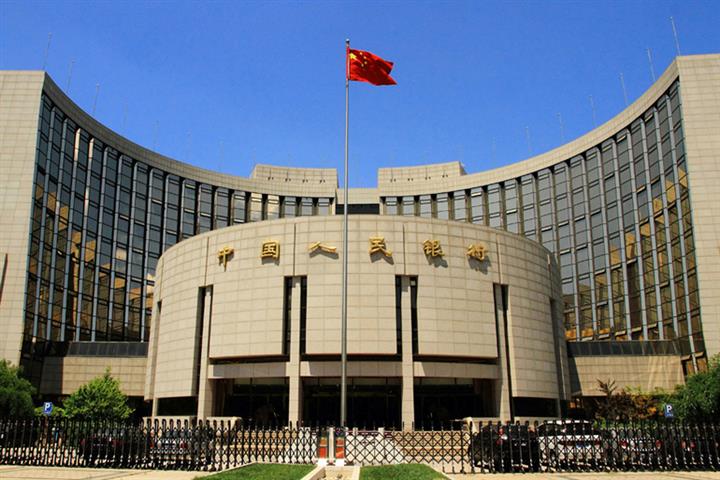
 PBOC Is Likely to Cut RRR Again This Year to Boost Funding to Smaller Firms, Analysts Say
(Yicai Global) Aug. 25 -- The People’s Bank of China has held a meeting to consider the country’s monetary and lending situation three months ahead of usual. Bringing the meeting forward shows that the central bank is concerned about weak loan demand and makes another cut in the reserve requirement ratio for lenders more likely this year, according to analysts.
Financial institutions must boost loan support to the real economy, especially micro, small and medium-sized businesses, PBOC Governor Yi Gang said at yesterday’s meeting.
Last month social financing was CNY1.1 trillion (USD163.3 billion), per PBOC statistics. That was CNY636.2 billion (USD98 billion) less than the amount extended in the same period of last year and below the CNY1.5 trillion the market had expected.
Participants in the meeting said China must give serving the real economy more prominence, support high-quality economic development through moderate currency growth, help small and mid-sized firms and industries in difficulty to continue to recover, and continue to run the economy within a reasonable range.
Behind the meeting lies the PBOC’s effort to maintain stable credit growth, the analysts said, noting that giving a boost to lending and enhancing stable credit growth are likely to become major policy lines, indirectly stimulating more borrowing.
The PBOC does not meet at a fixed time to consider the monetary and lending situation, but usually when social financing is sluggish and loan demand is inadequate, said Guan Qingyou, head of the Reality Institute of Advanced Finance. The policy signals from every meeting are generally positive, and RRR cuts take place afterwards, Guan said.
This means that China will probably boost liquidity, according to Dong Ximiao, chief researcher at Merchants Union Consumer Finance, who noted that an RRR cut is still possible in the second half of the year. But economic policies will be mostly structural, Dong added.
Individual and new agricultural businesses -- both badly hit by the pandemic and recent floods and in need of loans to pull them through -- were a new topic of discussion at the meeting, Guan said.
“We must notice that the Covid-19 pandemic is still evolving worldwide, the external environment is becoming more severe and complex, and the domestic economic recovery is still unstable and unbalanced,” the PBOC said in a press release on Aug. 23.
More funds must flow to micro, small and mid-sized businesses as well as individual and new agricultural enterprises, it said, adding that the country must drive down actual interest rates on loans and the overall financing costs of micro and small firms.
Commercial banks will hike non-mortgage lending as well as issue policies to lower actual interest rates on loans, said Wang Yifeng, chief financial analyst at Everbright Securities. The cost of consumer and credit card borrowing also still has room to fall, he added.
Editor: Futura Costaglione





