



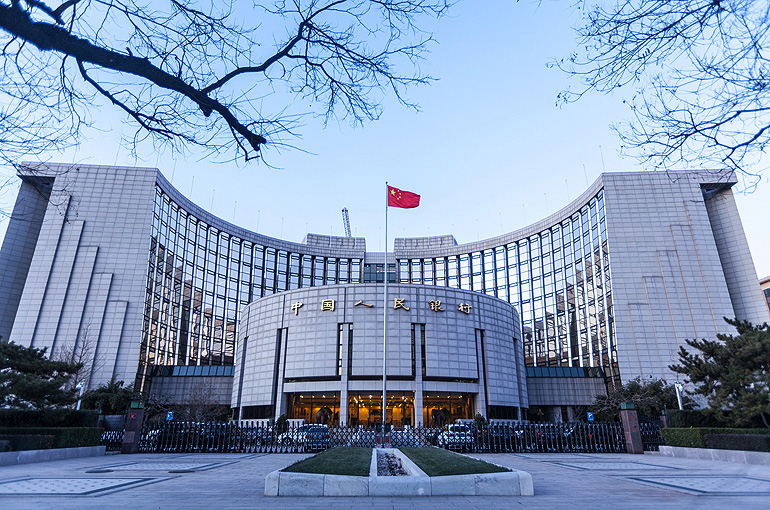
 China's Central Bank Maps Out Financial Reforms, AI Sector Support in Quarterly Policy Report
(Yicai) May 12 -- China’s central bank outlined plans to accelerate financial market reforms, strengthen bond market development, expand high-level opening-up, and expressed optimism about the growth prospects of the artificial intelligence industry in its first-quarter monetary policy report.
The People’s Bank of China said in the report published yesterday that it will focus on the high-quality development of a “technology board” for the bond market and better utilize risk-sharing tools for bonds issued by technology innovation firms and private enterprises. The measures are intended to support more private technology companies and private equity investment institutions in raising funds through bond issuance.
The report also said the PBOC will promote the legal framework for corporate bonds, accelerate the development of a multi-tiered bond market, and continue expanding and standardizing over-the-counter bond business. The central bank added that it will further regulate issuance pricing, underwriting, and market-making activities while strengthening risk monitoring in key sectors and industries.
The PBOC said it welcomes more qualified overseas issuers to sell panda bonds and will continue promoting the internationalization of the yuan and improving capital account openness. It also plans to launch pilot programs for high-level opening-up in cross-border trade and investment, optimize cross-border fund management for direct investment and overseas loans, and further expand the use of the yuan in cross-border trade and investment. The central bank will deepen international monetary cooperation and develop the offshore yuan market, it added.
Monetary Policy and Financial Stability
The report said China will proactively and steadily prevent and defuse financial risks in the next phase. The PBOC plans to establish a comprehensive macro-prudential management framework, improve mechanisms for preventing and resolving systemic financial risks, and broaden the scope of macro-prudential oversight. It also aims to enrich its macro-prudential policy toolkit and expand the central bank’s financial stability functions through innovative financial instruments to maintain stable financial market operations.
The central bank reiterated that it will continue implementing a moderately accommodative monetary policy. It said policy adjustments will be made flexibly and precisely based on domestic and international economic and financial conditions, as well as financial market performance. The PBOC also pledged to strengthen coordination between monetary and fiscal policies, improve monetary policy transmission mechanisms, and support stable economic growth and a reasonable recovery in prices.
The report also emphasized the need to improve the resilience of the foreign exchange market, stabilize market expectations, prevent excessive exchange-rate fluctuations, and maintain the yuan exchange rate at a reasonable and balanced level.
AI Industry Outlook
The PBOC also highlighted the development prospects of the artificial intelligence industry, saying the sector will inject more momentum into China’s high-quality economic growth.
According to the report, technological innovation in AI is expected to accelerate further as breakthroughs continue in areas such as multimodal processing and advanced logical reasoning, improving the performance of domestically developed large language models. The central bank also said AI will become more deeply integrated into industries, including intelligent manufacturing, finance, healthcare, and transportation, helping drive the intelligent transformation of traditional industries.
In addition, the report noted that Chinese AI companies are expanding in emerging markets such as Southeast Asia and the Middle East, with exports of AI-related products and services accelerating and international competitiveness steadily improving.
Editor: Emmi Laine





