



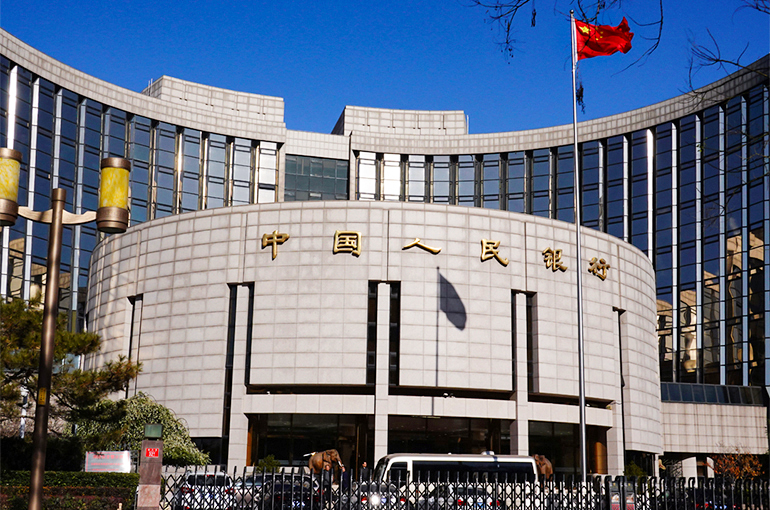
 PBOC’s 'Tiny' Reverse Repos in April Reflect Ample Liquidity, Not Policy Tightening, Analysts Say
(Yicai) April 9 -- Although the People’s Bank of China has conducted low volume seven-day reverse repurchase operations on almost every trading day this month, analysts say that these ‘tiny’ amounts do not signal a tightening of monetary policy, but rather reflect ample liquidity in the banking system. Market participants are also advised against drawing a direct link between open market operation volumes and stock market performance.
The central bank has conducted seven-day reverse repo operations of CNY500 million (USD73 million) on each trading day in April, with the exception of April 3, when CNY1 billion was injected.
The reduced scale of operations does not signal policy tightening, according to a research report by Guotai Haitong Securities, citing official announcements. The PBOC has clearly stated that the operation size “fully meets the demands of primary dealers,” suggesting that demand for central bank funds has declined.
Banks may already be in a state of “self-driven easing,” Liu Jie, chief analyst of banks at TF Securities, said in a research report. Although CNY1.7 trillion (USD248.8 billion) of outright reverse repos will mature this month, even if the central bank reduces the amount that is rolled over, this should not be over-interpreted as an intention to tighten liquidity.
Liquidity in the banking system and that in the stock market are two different concepts, said Zhang Xu, chief fixed income analyst at Everbright Securities. Bank funds do not flow directly into the stock market, and liquidity in the stock market depends on both the potential pool of funds and investor willingness, he added
Stock market performance is influenced by multiple factors, such as geopolitics, external market volatility, macroeconomic trends, valuation levels and market sentiment, Zhang said. Therefore, it is inappropriate to link liquidity in the banking system, or OMO volumes, to stock market movements.
“In short, the scale of OMOs is largely determined by financial institutions. The ‘tiny,’ or low, OMO volumes observed this month reflect ample liquidity in the banking system and a marked decline in demand for central bank base money,” said Zhang.
Guotai Haitong noted that the contraction in OMO volumes in early April does not represent a deliberate effort by the central bank to tighten liquidity, nor does it aim to send such a signal to the bond market.
Relying excessively on quantitative indicators such as OMO volumes or net liquidity injections to assess the stance of monetary policy can lead to overgeneralized conclusions, Zhang said.
Liquidity in the banking system is affected by factors such as monetary policy operations, cash circulation, fiscal revenue and expenditure such as tax collection and government bond issuance, cross border capital flows, reserve requirement adjustments and the structure of funds held by market entities and their willingness to hold funds. OMO activity is just one of many factors, he added.
The current pattern of abundant liquidity in the banking system is very clear, a market expert said. The DR001 interbank rate, which is a good indicator for assessing liquidity conditions, has remained below the seven-day OMO policy rate of 1.4 percent since February, and its level dipped further in March to 1.31 percent.
Editor: Kim Taylor





