



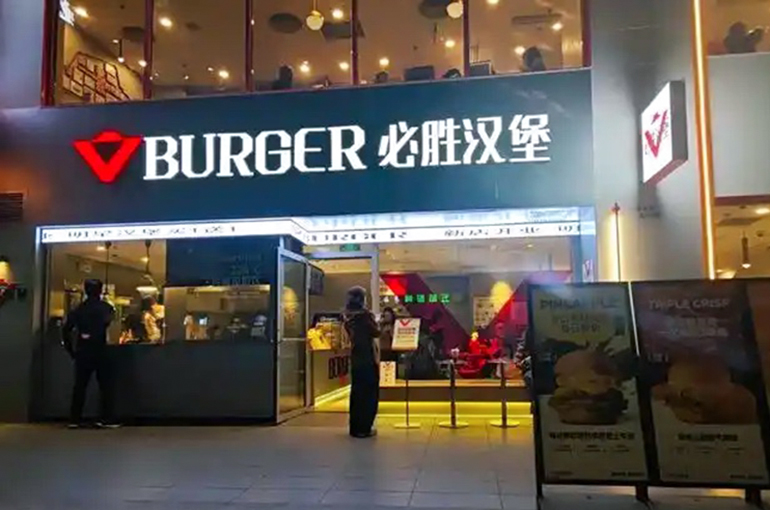
 Pizza Hut Opens First Burger Stores in Shenzhen Despite Tough Competition
(Yicai) Jan. 7 -- Pizza Hut, which is run by Yum China Holdings in the Chinese mainland, has opened its first two burger restaurants, both located in the southern Chinese city of Shenzhen, despite intense competition in the market.
Pizza Hut's burger business focuses on solo diners and offers freshly made food with each order. The new restaurant's menu includes 10 chicken and beef burgers priced between CNY23 and CNY42 (USD3.29 and USD6.01).
The average Pizza Hut burger costs CNY32.50 (USD4.65), lower than the average of CNY50 spent per customer at its pizza restaurants but more than the average burger cost of CNY28 at KFC and McDonald's, according to Meituan's crowd-sourced review app Dianping.
Pizza Hut first entered the burger market with its Cheeseburger Melt, a Parmesan thin crust folded in half with cheddar & mozzarella cheese, onions, beef, and bacon, launched in April 2024. Opening the new burger stores is part of Yum China's brand portfolio expansion after previously launching KCOFFEE, KPRO, and KFC Fried Chicken Brothers.
Competition in the Western fast food market is fierce in China, with the burger segment relatively saturated. Foreign giants such as KFC and McDonald's and Chinese chains, including Wallace and Tasiting, each have around 10,000 stores in the country.
Consumption downgrading and the pursuit of "quality-effective" currently coexist, An Guangyong, an expert from China Mergers & Acquisitions Association's Professional Committee of Credit Management, told Yicai. KFC has reached the ceiling of the mass fast food business, while Pizza Hut's burger business is targeting the segment between McDonald's, KFC, and premium burger spots to lure customers, which is a way for Yum China to reduce the sensitivity of a single brand to external fluctuations through a multi-brand strategy, An added.
The burger market has shifted its sales focus from "efficiency" to "experience," said Gao Chengyuan, chairman and chief executive of TY Marketing. On the one hand, no matter how good the taste of freshly made burgers is, the serving time cannot exceed eight minutes, which poses a high requirement for store operation, he noted.
On the other hand, fast food is transformed into "light meals" and relies on flavors with regional features, exclusive ingredients, and intellectual property collaborations to increase repurchase frequency and thereby raise product prices, Gao noted. More importantly, a multi-period operation is needed to extend the daily working hours of a single restaurant to over 16 hours to amortize the fixed costs, he pointed out.
Editor: Martin Kadiev





