



 Humanoids Shatter Records and Suffer Epic Fails at ‘Robot Olympics’ in Beijing
(Yicai) Aug. 27 -- Humanoid robots have broken several human records at the second World Humanoid Robot Games held in Beijing, often dubbed the “Robot Olympics,” while also attracting worldwide attention for their hilarious bloopers.
At the five-day games that ended yesterday, the Tiangong Ultra, developed by Beijing Humanoid Robot Innovation Center, won the large-sized humanoid robot 100-meter final in 8.64 seconds, smashing Usain Bolt’s 9.58-second world record. Robot running speeds have dramatically increased since last year’s event, Tang Jian, the center’s chief technology officer, told Yicai.
The games have demonstrated that humans can no longer outrun or outfight robots, whose motion control capabilities have reached a respectable level, according to Zhao Tongyang, founder of EngineAI Robotics Technology.
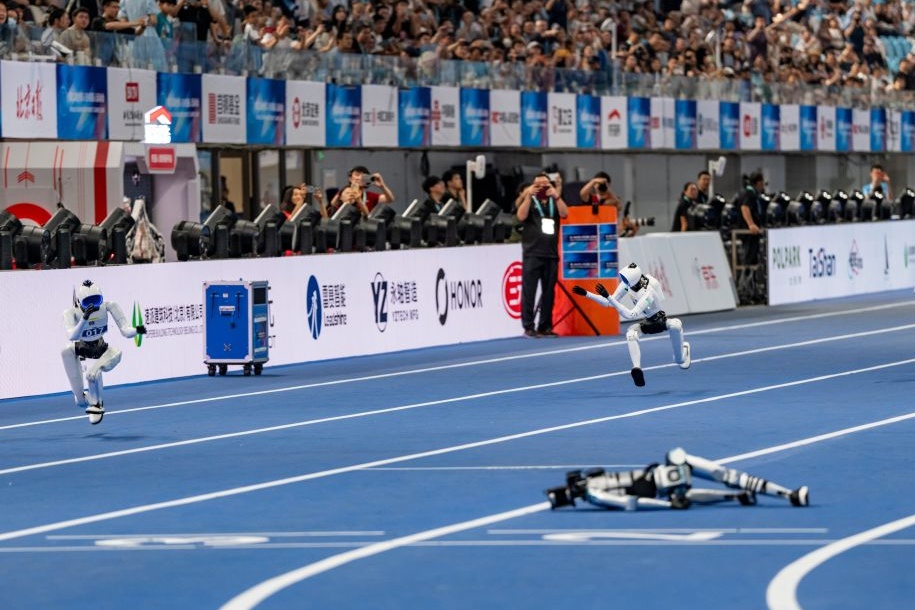
Besides record-breaking performances, the spotlight also fell on a number of on-track malfunctions. Some robots collapsed the instant the starting pistol fired, others made erratic movements while negotiating obstacles, and several crashed into the safety wall at the end of the track, unable to brake after the race, sending sparks flying.
Motion control becomes extremely challenging at very high speeds, Tang explained. For instance, robots risk being thrown off balance when navigating bends if their algorithmic controls are sub-optimal, an issue requiring much engineering work and algorithm refinement.
Humanoid robots are performing at only 60 out of 100 points, with the other 40 points hinging on fine-tuned, long-term stable operational control, Tang noted, adding that motion-control technology still has much improvement to make.
Multi-obstacle challenges test robots’ real-time judgment of terrain, velocity, center of gravity, and foot placement, said Li Delong, motion-control algorithm engineer at Unitree Robotics, the first humanoid maker to go public in the Chinese mainland earlier this month. Successful completion depends on the combined performance of perception, decision-making, motion control, and hardware reliability, he explained.
Obstacle course failures at this year’s games stemmed largely from balance control, motion sequencing, and body coordination when navigating complex barriers, Li pointed out.
Several competition events demanded higher-level coordination between robot eyes, brain, and hands, long-term task planning, and on-site adaptability, said Gao Naixiang, full-stack algorithm engineer at Unitree. Interrupted movements, inaccurate object recognition, and failures when grasping during are typical issues robots face in complex, real-world environments.
“The value of the games does not lie only in rankings but also in exposing systemic weaknesses of robots through high-intensity, long-duration real-world trials,” Gao pointed out. “These weaknesses pave the way for improvements in algorithms, hardware, and engineering deployment.”
Continuous exposure to practical challenges is essential if robots are to become genuinely effective at solving real-world problems, he noted.
Editors: Tang Shihua, Futura Costaglione





