



 Chinese Carmakers With Own Ships Have an Edge Amid Export Boom, Middle East Turmoil
(Yicai) April 23 -- Against the backdrop of increasing exports and global transportation bottlenecks due to the Middle East conflict, having self-operated car carriers is a great advantage for Chinese automakers to ensure shipping capacity.
Companies without their own car carrier fleet are facing three major challenges when exporting. The first issue is the mismatch between the shipping schedule and production. In fact, the output pace may not align with the available shipping date, leading to cargo being left behind, which results in inventory build-up. This can even cause losses if there are no products available to fulfill orders.
A second challenge is that ports' external shipping capacity cannot be controlled, making it difficult to schedule transportation from factories to ports. This can significantly increase inland transportation costs. Finally, it is challenging to ensure emergency allocation of resources during peak shipping periods, as there is no way to mobilize third-party ships to support special tasks at any given time.
China exported about 875,000 vehicles in March, up 73 percent from a year earlier, according to data from the China Association of Automobile Manufacturers. Exports of new energy vehicles surged 130 percent to around 371,000 units.
The closure of the Strait of Hormuz has significantly impacted the transportation time and costs for Chinese auto exports. Reports from various automakers, foreign trade firms, and shipping companies indicate that car shipping costs have risen 30 percent to 40 percent in the past month, with notable tightness in shipping capacity.
Shipping accounts for about 10 percent of Chinese carmakers' export costs. The current situation remains uncertain, as even if the Straight of Hormuz fully reopens, logistics prices are unlikely to drop in the short term, Wang Xing, general manager of Guangzhou Automobile Group Import and Export Trading, told Yicai.
"The increase and decrease in shipping prices is a gradual process within a range," Wang noted. "There is already a significant backlog of vehicles, and we need to seize this opportunity to increase exports as quickly as possible."
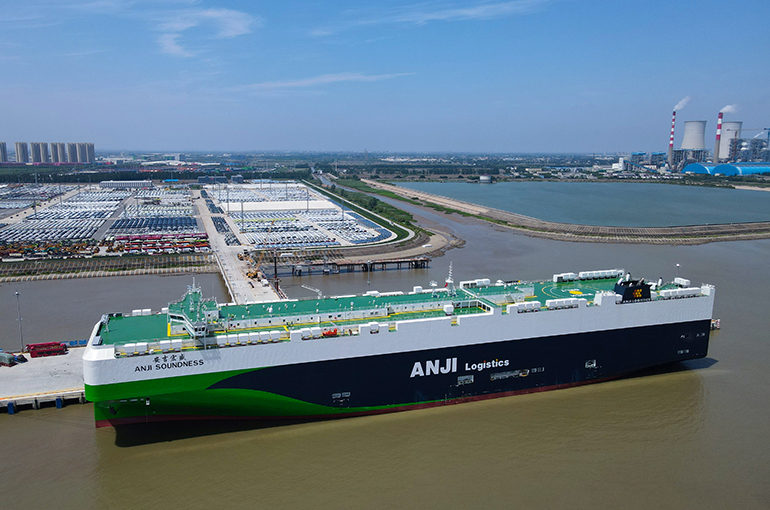
Several Chinese automakers, including SAIC Motor, BYD, and Chery Automobile, have already built and put into operation their own car-carrying vessels, having launched related plans to tackle transportation issues during the Covid-19 pandemic.
BYD announced in 2022 that it would invest CNY5 billion (USD730 million) to build a roll-on/roll-off ship fleet, placing orders with domestic shipyards, such as China State Shipbuilding Corporation Offshore and Marine Engineering Group, China Merchants Shipbuilding Industry Group, and China International Marine Containers Raffles Ocean Technology Group. It now has eight car carriers in operation, with an annual shipping capacity of 250,000 to 300,000 passenger vehicles.
SAIC Anji Logistics already has a foreign trade ocean shipping fleet of more than 20 vessels, Chery Auto has three car carriers in operation, and Geely Automobile Holdings' unit Jisu Logistics has two self-operated ro-ro ships in service.
Car carrier rental prices began increasing in 2020 and peaked in 2024, when the daily rental fee for a car carrier with 6,500 spaces reached USD123,500 per day, a six-fold increase from about USD20,000 per day in 2021. The rates have been declining since the beginning of last year, as the number of pure car and truck carriers continues to increase.
Editor: Futura Costaglione





