



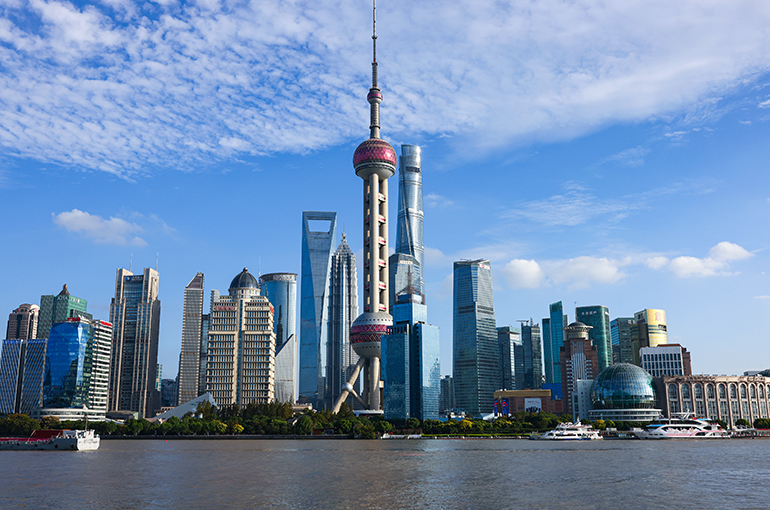
 Shanghai Targets 33% Jump in Service Sector Added Value by 2030
(Yicai) May 27 -- Shanghai aims to raise the added value of its service sector by about 33 percent over the next five years, making the industry a key engine of growth during the 15th Five-Year Plan period through 2030, according to the latest municipal government plan.
By 2030, the added value of Shanghai’s service sector should reach about CNY6 trillion (USD885 billion), while the city’s total service trade imports and exports should exceed USD300 billion, according to a service industry development guideline released by the municipal government today.
The city also aims to cultivate a group of globally competitive service industry leaders, the document said.
Shanghai’s service sector added CNY4.5 trillion last year, up 6 percent from a year earlier, accounting for 79.3 percent of the city’s gross domestic product and contributing more than 80 percent of its economic growth, according to earlier data from the municipal statistics bureau.
Financial and Trade Strength
As an international financial center, Shanghai’s financial sector added value rose 10 percent to CNY898 billion (USD132.5 billion) last year, while the total transaction volume of its financial markets climbed 11 percent to CNY4,059 trillion (USD598.59 trillion).
In trade and shipping, Shanghai’s goods imports and exports rose 5.6 percent to CNY4.5 trillion last year. Its container throughput jumped 6.9 percent to 55.1 million twenty-foot equivalent units, keeping the port the world’s busiest for the 16th straight year.
Shanghai’s digital services sector has also expanded rapidly in recent years. The city leads China in the number of registered generative artificial intelligence models and the scale of intelligent computing power, while revenue from e-sports events accounts for nearly 50 percent of the national total.
To achieve its 2030 goals, Shanghai will accelerate the implementation of its “AI+” initiative, promote the research and development and application of AI models and general AI agents, and support large-scale adoption in industries such as manufacturing and finance, the guideline said.
The city will also explore incentive mechanisms to encourage platform companies to speed up the transformation of information services and build comprehensive cross-sector internet platforms.
Shanghai will deepen the integration of culture, commerce, tourism, sports, and exhibitions, promote upgrades in housekeeping and catering services, improve supply-demand matching in elderly care and childcare, and make services more convenient for residents, the document added.
Editors: Dou Shicong, Emmi Laine





