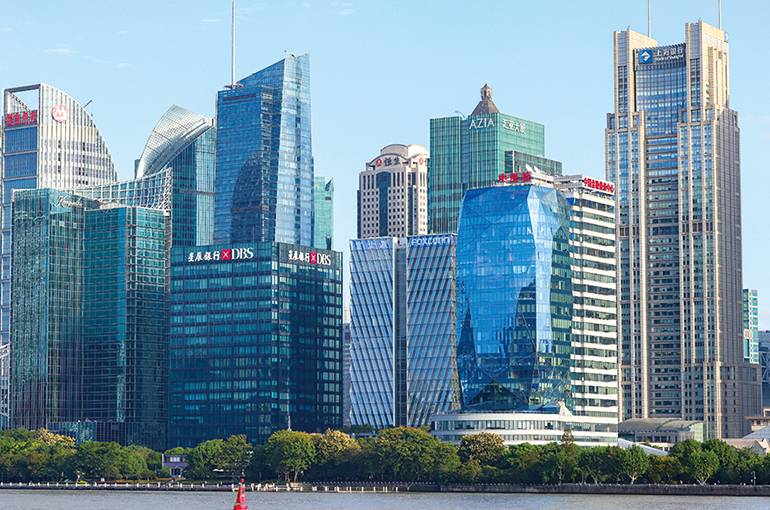
 Shanghai’s Bulk Property Sales Market to Stay Centered on Smaller Deals in 2026
(Yicai) Jan. 26 -- The reset that began taking shape in Shanghai’s market for bulk property sales last year -- with both the type of assets changing hands and the profile of buyers shifting -- is expected to continue this year, according to industry insiders.
Amid ongoing domestic fiscal and monetary policy easing, small- and mid-sized assets under CNY300 million (USD43 million) will remain the key focus for bulk property market deals in 2026, mainly because of their clear property rights and more flexible decision processes, Lu Qiang, executive director of East China capital markets at Cushman & Wakefield, told Yicai.
Properties in core areas of first-tier cities, such as Shanghai, will continue to attract capital inflows, as investment strategies evolve from a narrow focus on financial returns toward deeper value creation through capitalization, asset management, and resource utilization, he added.
As China’s pilot program for real estate investment trusts expands and the country presses ahead with urban-renewal initiatives, exit routes for investors are becoming clearer, setting the stage for more high-quality opportunities in Shanghai’s bulk-property market, said Sun Ling, head of investment and capital markets for East China at Jones Lang LaSalle.
Seventy-five bulk property deals were completed in Shanghai last year, with a combined value of CNY42.4 billion (USD5.9 billion), according to Cushman & Wakefield. Deals valued below CNY300 million jumped to 38 over the year, accounting for more than half of all transactions.
Jones Lang LaSalle’s data point to the same shift. The real estate services giant recorded 89 bulk property transactions in 2025, totaling CNY48.7 billion -- about 15 percent less than in 2024 -- with deals under CNY500 million making up 63 percent of the total.
Deals worth CNY1 billion or even CNY10 billion once characterized the market, but buyers now favor projects of more modest size, lower risk, and shorter decision-making cycles, industry participants told Yicai, a change that has pushed small- and mid-sized assets to the fore.
Shifting Buyer Profile
The buyer mix is also changing. Traditional institutional investors and foreign capital no longer dominate, as non-institutional and corporate buyers account for a growing share of transactions, according to Cushman & Wakefield.
“While searching for office investment targets in Lujiazui and along the Yangpu riverfront, we encountered many private-sector firms -- mostly small and mid-sized companies from other provinces -- that were also looking to buy office buildings,” an investment executive at a northern state-owned enterprise told Yicai. “They are all attracted by the price correction.”
One recent example is Fangda Carbon New Materials Technology, based in Lanzhou in northwestern China, which said on Jan. 12 that it acquired an office building in central Shanghai at a judicial auction for CNY456 million (USD63.8 million) to support its business expansion in the east coast city.
Domestic buyers now account for the vast majority of bulk-property purchases in Shanghai. Cushman & Wakefield’s figures show that foreign buyers completed just three such acquisitions last year, representing only about 3 percent of total transaction value.
Among domestic purchasers, acquisitions for self-use accounted for about 26 percent of total bulk-deal value, as companies bought office space for their own operations or residential projects to house staff, Yicai found.
Foreign Divestments
Foreign firms, by contrast, were more active on the sell side. They completed 15 bulk property disposals last year, with a combined value of about CNY12.9 billion, roughly one-third of the market’s total transaction value, according to Cushman & Wakefield.
“This reflects how a phased pullback by some foreign investors has released a pool of high-quality assets at more attractive prices, creating opportunities for domestic buyers,” Lu said, adding that the shift reflects a structural adjustment rather than a permanent retreat, Lu added.
“Some foreign institutions are preparing Chinese yuan-denominated funds and reorienting their strategies toward localization and long-term positioning, meaning foreign capital retains the potential to return and inject fresh momentum into the market,” Lu said.
Editors: Tang Shihua, Futura Costaglione