 Shanghai's Culture and Tourism Sector Builds a New "AI Plus" Development Ecosystem
(Yicai) July 19 — The 2026 World Artificial Intelligence Conference (WAIC) recently opened in Shanghai. Teaming up with the Shanghai Municipal Administration of Culture and Tourism, this year's WAIC has rolled out 16 culture-and-tourism-themed routes, allowing visitors to experience real-world AI applications while taking in the city's iconic sights.
A major highlight at this year's conference is the "Play with AI" entertainment route, which seamlessly blends AI with urban culture. A new wave of intelligent culture-and-tourism products and services has emerged in response, including interactive AI robot tour guides, automated AI visa services, smart guided tours, and AI micro-dramas. The "AI Plus" initiative driven by Shanghai's culture and tourism sector is rapidly moving from a conceptual framework to real-world deployment.
These new AI-integrated services are taking shape across the entire hospitality and tourism vertical. At the Shanghai History Museum, an embodied-AI tour guide robot named "Li Xiaobo" has officially gone on duty. It can plan routes autonomously, identify obstacles with precision, and even wave to visitors, combining professional utility with an approachable personality.
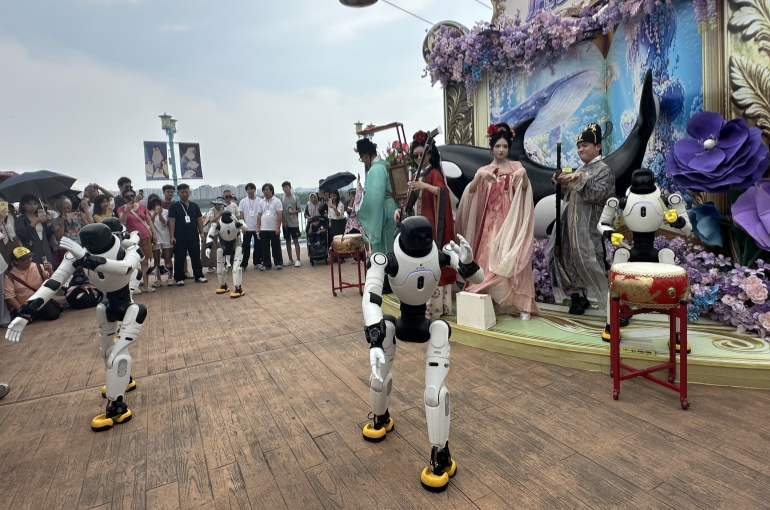
Meanwhile, at Shanghai Haichang Ocean Park yesterday, a troupe of robotic dancers performed a Chinese-style routine live on stage. Robots also doubled as docents, sharing popular-science knowledge with visitors, and even joined the sea lion show as synchronized dance partners.
To better serve foreign visitors, Shanghai's culture and tourism authorities have launched "Hu Xiaoyou," an AI agent tailored for urban life. The digital assistant integrates culture and tourism resources across 36 major categories and 107 subcategories, offering services in more than 10 foreign languages. It establishes a one-stop smart tourism loop that covers pre-trip planning, in-trip navigation, and ticketing transactions. To date, the agent has supported nearly 20 million visits by travelers to Shanghai.
On the exhibition floor at the WAIC venue, Yicai also observed newly launched companion robots designed for various culture and tourism projects. Shaped like small plush toys that can be worn as pendants or held as dolls, these devices feature voice recognition and interactive capabilities. They can chat with tourists, offer companionship throughout their journeys, and provide unique emotional value.
In addition, on the entertainment and tourism content production front, WAIC's inaugural youth AI music variety show successfully brought the winning entries of its AIGC music competition to the West Bund stage.