



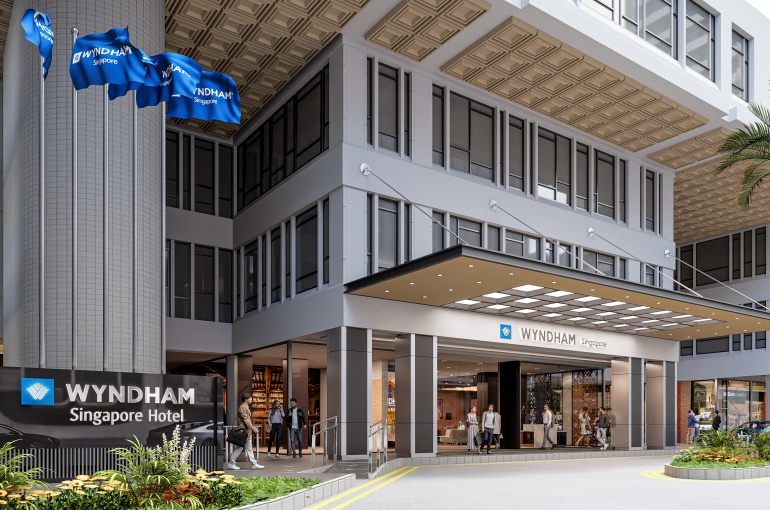
 Singapore’s Wyndham Expands China Strategy as Asia-Pacific Travel Demand Diversifies
(Yicai) July 24 -- Wyndham Hotels & Resorts, the world’s largest hotel franchiser by property count, has outlined its strategy for the Asia Pacific region during a media briefing in Singapore, with China as a key growth driver.
With over 8,400 hotels across 100 countries and regions and backed by a network of 126 million Wyndham Rewards members, Singapore-based Wyndham is positioning itself to capitalize on Asia Pacific’s strong economic growth.
Asia-Pacific remains a high-growth region for travel, as its annual gross domestic product growth averages 5 percent, and its travel and tourism industry has been expanding at about 4 percent a year, Joon Aun Ooi, president of Wyndham Asia Pacific, told Yicai Global.
Between 2020 and 2025, Wyndham added over 500 direct franchise and managed hotels, representing 80,000 rooms across more than 20 regional markets, led by China, South Korea, Southeast Asia, and Australia, Ooi noted.
China is a key growth driver for Asia Pacific and Singapore’s largest foreign visitor source. The city-state welcomed about 3.1 million Chinese mainland tourists last year, accounting for nearly 19 percent of all international arrivals. The momentum has continued into this year, with 1.3 million Chinese arrivals recorded in the first five months, bolstered by mutual visa-free policies, expanded flight routes, and major events.
China’s Evolving Tourist Dynamics
The demographics of Chinese tourists are shifting. They are becoming younger, more independent, and increasingly purpose-driven. Chinese travelers aged 25 to 34 are the fastest-growing segment, relying heavily on social media platforms, such as Xiaohongshu and TikTok, for itinerary planning, said Eyvonne Lin, Wyndham’s vice president of marketing and commercial performance for Asia Pacific.
“Chinese consumer demand is diversifying rapidly,” Lin noted. “Travelers are increasingly seeking out destination-driven locations rich in culture, niche experiences, and natural resources. This shift creates an incredible runway for our premium brands in emerging markets.”
To adapt to changes, Wyndham is balancing its footprint between tier-one gateway cities and emerging destinations across China.
A recent addition is the Wyndham Grand Yichang Riverside in China’s central Hubei province. Situated near the Three Gorges, the hotel operates in partnership with the Hubei Three Gorges Tourism Group to offer integrated packages combining luxury accommodation, scenic cruises, and local tours.
Introducing a high-end brand like Wyndham Grand into emerging markets requires strong local demand drivers, an ownership group with a deeply rooted commitment to premium hospitality, and a property that offers a distinct commercial proposition beyond just room inventory, Lin pointed out.
Franchising and Owner Retention
A core component of Wyndham’s business model in China and the broader Asia Pacific region is pure-play franchising. Ooi described it as a cost-efficient framework for experienced hotel owners seeking operational autonomy while leveraging global distribution systems, sales networks, revenue management tools, and loyalty programs.
Wyndham maintains an average repeat owner rate of 25 percent across Asia Pacific, with one-quarter of all new hotel contracts signed annually coming from existing ownership groups expanding their portfolios.
“Our profitability is tied to two core dimensions: how we continue to expand our footprint successfully, and how we continuously optimize our ongoing operations,” said Michael Yu, head of finance for Asia Pacific at Wyndham. “When our properties maximize their top-line revenue, streamline their operations, and increase their bottom-line return on investment, Wyndham’s profitability naturally increases alongside theirs.”
The company practices strict territorial protections to avoid market dilution, Ooi noted, adding that it has declined potential deals in densely saturated resort markets to protect the interests of existing franchisees.
Integrating Technology and ESG Practices
With over USD450 million allocated globally toward its technology infrastructure, Wyndham is focusing on digital solutions to improve operational efficiency, generate incremental revenue, and update guest experiences.
“We do not view artificial intelligence, generative technology, or robotics as tools to replace human labor or simply cut costs,” Yu said. “Instead, we see technology as a powerful enabler, an enhancement designed to elevate the guest experience, maximize operational efficiency, and drive stronger bottom-line returns for our owners.”
Similarly, Wyndham incorporates its sustainability framework Wyndham Green as an operational strategy rather than a passive compliance requirement. Its regional environmental, social, and governance initiatives include smart energy controls, water conservation systems, food waste digestors, and the elimination of single-use plastics.
Wyndham views sustainability not as a corporate dictate, but as an operational tool and commercial advantage that delivers value in three distinct ways, according to Yu. It directly drives business efficiency and bottom-line health, addresses rapidly evolving regional regulations, and serves as a core driver of consumer and corporate demand.
Editor: Futura Costaglione





