



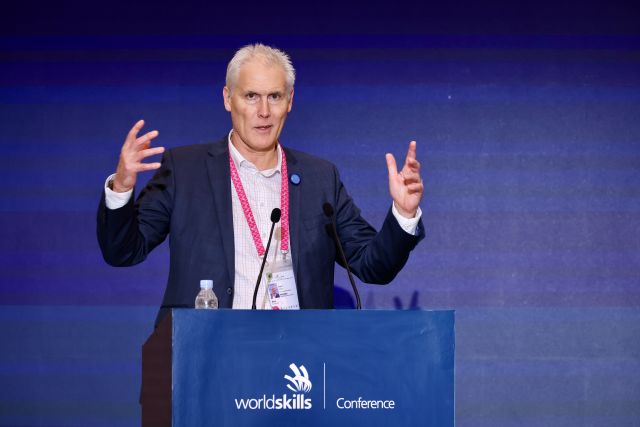
 Skills, Trades, and Technologies Are Good First Choice Career Options, WorldSkills International CEO Says
(Yicai) Sept. 30 -- The WorldSkills Competition, a contest often dubbed the “Skills Olympics,” shows young people that skills, trades, and technologies are very good career first choices, according to David Hoey, chief executive officer of WorldSkills International, which organizes the biennial championships.
Careers in skills, trades, and technologies are just as “good as university, if not better,” Hoey said in an exclusive interview with Yicai while attending the latest WorldSkills Competition, which was held in Shanghai from Sept. 22 to 27.
China joined WorldSkills International in 2019, becoming the Amsterdam-based non-profit organizations 53rd member, and took part in its first WorldSkills Competition the following year. At that championship, held in London, China fielded competitors in only six skills categories and won a silver medal for welding.
China has subsequently emerged as a major force at the WorldSkills Competition. At the previous contest in Lyon in 2024, the Chinese delegation participated in all 59 categories, and left with the biggest gold medal haul and highest team score for the fourth consecutive time. At the competition just held, China took a record-breaking 41 gold medals and secured first place for total team points for fifth time in a row, after taking part in all 64 categories.
Hoey attributed China's rapid rise to factors extending beyond the competition itself. First, the improvement in its competition results has not been an isolated phenomenon, but is closely linked with the country's economic development over the same period. Second, China's vocational education and training system has developed the capacity to produce a larger pool of outstanding students.
“China has studied, has launched, has implemented the methodology of using skills competitions to drive up performance in a TVET system,” Hoey pointed out.
China’s participation in the WorldSkills Competition has produced effects in both directions. As Hoey wrote in the foreword to a report WorldSkills International published on Sept. 24, China's active participation has strengthened the contest’s standing and global influence, while also demonstrating that international competitions can serve as a catalyst for strengthening a country's national skills system.
At 64, the competition now has the most ever number of skills categories. Among them are seven newly added events: rail vehicle technology, drone systems, smart security technology, software testing, digital interactive media design, dental repair technology, and retail.
The new categories reflect emerging industrial trends and changing requirements in the workplace, with the influence of artificial intelligence particularly apparent in several areas. The software testing and digital interactive media design events, for instance, address quality control across the software development lifecycle and the creation of immersive digital content.
Job requirements are shifting away from narrowly defined operational tasks toward automated testing, AI-assisted design, and interactive engine development, highlighting the growing importance of digital skills.
Hoey said that in the face of the irreversible advance of AI technology, WorldSkills International must examine how AI will permeate and integrate into competitions. The organization must ensure that competitors can keep pace with technological developments around the world, he said.
Editor: Tom Litting





