



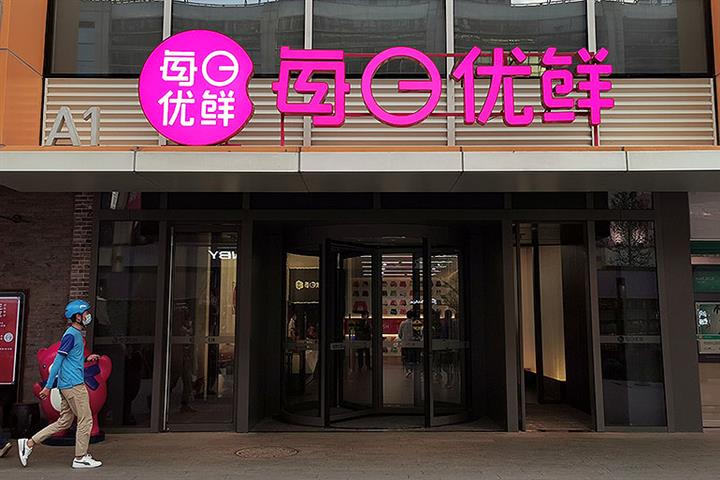
 Tencent-Backed Grocer Missfresh Quadruples Second-Quarter Loss Due to Discounting
(Yicai Global) Aug. 27 -- China's Missfresh, an emerging rival of Pinduoduo and Meituan, widened its net loss by four times in the second quarter due to its intensifying efforts to attract new grocery shoppers.
The fresh food seller's net loss increased by 320 percent to CNY1.4 billion (USD222 million) over the three-month period from a year ago, the Qingdao-based company wrote yesterday in its first earnings report published since its initial public offering in June.
The Tencent-backed firm offered earnings guidance. Missfresh expects its third-quarter revenue to be in the range of CNY2.02 billion and CNY2.09 billion, rising as much as 50 percent from a year ago. Its gross margin should climb by 250 basis points to 350 bips from the second quarter.
Costly Sales
Sales were rising in the second quarter due to an enlarging number of users and orders.
Revenue surged by 41 percent to CNY1.9 billion. The firm's gross merchandise volume jumped 35 percent to CNY2.3 billion. The number of orders climbed 32 percent to 23.8 million with an average sum of CNY96.1 (USD15) per order.
However, the expansion turned out pricey. The cost of revenues increased by 66 percent to CNY1.8 billion due to the firm's growing operating expenses. Missfresh had offered more discounts, coupons, and incentives to attract new customers. Evidently, its gross margin was 7.5 percent in the second quarter, whereas it had been 21.3 percent a year earlier.
The firm announced two new executive hires. Wang Jun and Chen Xi were appointed as co-chief financial officers.
Missfresh raised USD273 million by listing its shares on the Nasdaq last June. "Our recent listing on the NASDAQ further reinforces our brand name recognition and influence in the industry," said co-CFO Chen Xi.
Missfresh's stock price [NASDAQ: MF] was 1 percent down in after-hours trading after closing 0.4 percent higher at USD4.85 yesterday.
Founded in 2014, Missfresh operates almost 660 mini-warehouses in 16 Chinese cities.
Editor: Emmi Laine, Xiao Yi





