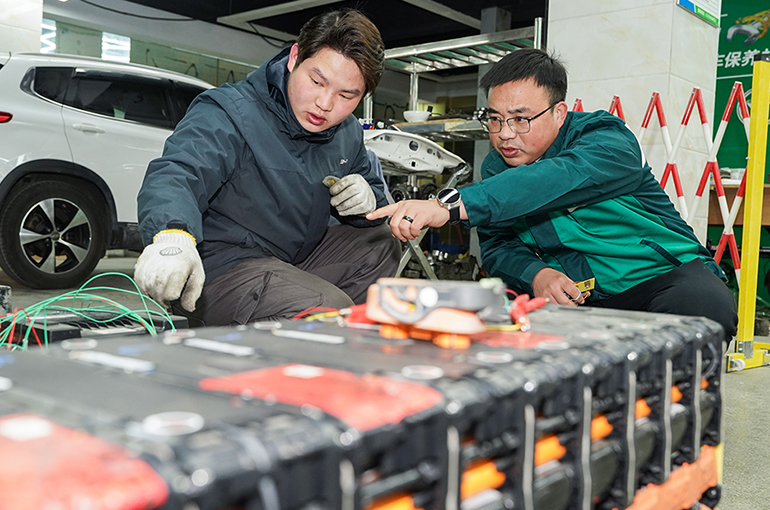
 Third-Party Auto Repair Shops Say They're Shut Out of China’s Fast-Growing NEV Services Market by Carmakers
(Yicai) May 18 -- Despite demand for new energy vehicle after-sales services gradually expanding in China, third-party repair stores say they are struggling to enter the market due to carmakers' monopolistic control over the supply of core parts related to the three electric systems -battery, motor, and electronic controls -- and technical data.
Third-party repair shops are unable to access specialized equipment for data matching and calibration needed for NEVs' three electric systems repairs, meaning that automakers have monopolized the relevant after-sales market for the systems via technical means, the owner of a large car after-sales service platform in Shanghai told Yicai. "This makes us unable to repair the three electric systems."
The three electric systems are the most expensive components when it comes to NEV repairs, the person said. For example, the battery could account for about half the cost of a vehicle priced around CNY100,000 (USD14,679), the person pointed out.
Small and medium-sized repair shops find it difficult to engage in the core NEV repair business, Song Quanye, a senior figure in the auto after-sales service industry, said to Yicai. "Not only do they lack core repair technical data for these components, but they also cannot obtain the necessary spare parts."
Compared to the mature after-sales service system for fuel vehicles, the relevant market for NEVs has not yet formed an open structure, Song noted, adding that original equipment manufacturers often control access to core repair operations through technical permissions, isolating third-party firms from engaging in these essential services.
Brand-owned stores and authorized dealers dominate the NEV repair market, Yicai found. Carmakers control the components, technology, and data access rights of the three electric systems through an "authorized repair" model and even employ remote encryption for fault diagnostics, making it difficult for third-party repair shops to offer relevant services, which allows carmakers to fully control repair prices.
Automakers often justify this practice by citing the need to ensure vehicle safety and quality, claiming that if independent repair shops intervene in the maintenance of the three electric systems, it could lead to battery pack malfunctions or even serious safety incidents, which will make it difficult to determine liability in the event of an accident.
Carmakers have numerous concerns about fully opening up their core technologies, as this could involve issues related to intellectual property and trade secrets, weakening their core competitiveness, an analyst said. In addition, this could disrupt their high-margin after-sales service systems, he added.
Therefore, as the market has not yet reached a fully mature stage, automakers will not easily relinquish control over the maintenance of the three electric systems, the sale of components, and other high-profit areas, the analyst stresses.
The after-sales service gross profit margin of NEV dealers reached 37.1 percent last year, thanks to the repair privileges granted by manufacturers, according to the findings of a survey by the China Automobile Dealers Association. In comparison, their new car sales gross profit margin was 26.5 percent.
However, the core reason for the high maintenance costs of NEVs is still the insufficient supply of parts, Song pointed out. Due to the relatively small market, third-party parts manufacturers are still reluctant to invest in the production of NEV components, he added.
Similar to the development stage of after-sales monopoly experienced by traditional fuel vehicles, the NEV industry also needs time and market expansion to resolve existing challenges, according to Song.
When the number of NEVs in China reaches 100 million, or one-third of all cars, issues such as insufficient supply of parts and limited technology accessibility with NEV maintenance will likely see systematic alleviation, Song noted, adding that the monopoly by manufacturers is expected to gradually dissolve as the market expands.
The number of NEVs in China topped 30.22 million as of Dec. 31, accounting for 8.3 percent of all autos and 6.4 percent of the total number of motor vehicles, according to data from the Ministry of Public Security.
Editors: Tang Shihua, Martin Kadiev