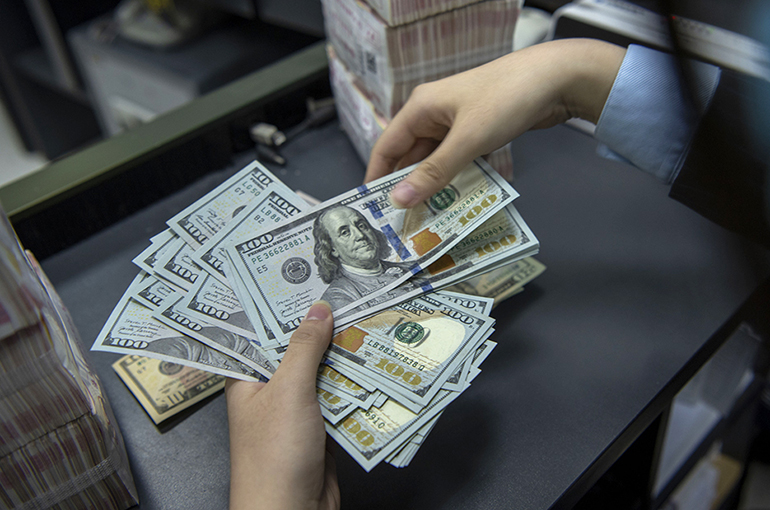
 US Dollar Deposit Rates in China Hit 4% as Banks Vie for Funds
(Yicai) Aug. 11 -- Banks in China are raising US dollar fixed deposit rates to as high as 4 percent as they compete for fresh funds amid a stronger yuan.
Chinese branches of offshore banks are offering some of the highest rates on fixed deposits, which pay a set interest rate for money kept at a bank for a specified period. Chinese joint-stock and regional commercial banks are also stepping up efforts to attract foreign-currency deposits, Yicai learned from interviews. Most products now offer more than 3 percent.
Hong Kong-headquartered Hang Seng Bank, for example, offered a promotional rate for new US dollar fixed deposits in July, with a minimum deposit of USD20,000. Its one-month US dollar fixed deposit offers an annualized rate of 4 percent, currently the highest among such products on the market.
The increases are being driven by multiple factors, including the exchange-rate environment, competition for deposits, and expectations of Federal Reserve rate cuts, which have contributed to an unusual reversal in which shorter-term deposits offer higher rates than longer-term ones.
Offshore Banks Lead Rate Hikes
Hong Kong-based Bank of East Asia is offering promotional rates on US dollar fixed deposits to new individual customers, with annualized rates ranging from 3.2 percent to 3.4 percent and minimum deposits of between USD10,000 and USD50,000. The promotional rates are available until Aug. 31.
Chinese banks have followed suit, generally with lower minimum deposit requirements. China Minsheng Bank and China Citic Bank offer annualized rates of 3.1 percent and 3 percent, respectively, on deposits of more than USD100.
Shenyang-based Shengjing Bank requires a minimum deposit of just USD50 and offers annualized rates of 3.1 percent on both one-year and two-year deposits. Bank of Beijing offers a 3 percent annualized rate on one-year US dollar fixed deposits, with a minimum deposit of USD5,000.
Stronger Yuan, Fed Outlook Drive Rates
The latest wave of increases in US dollar fixed deposit rates reflects a combination of factors related to exchange rates and banks’ operations.
The yuan has been on an appreciating trend since the end of 2025 and has gained more than 3 percent against the US dollar so far this year.
According to Zeng Gang, president of Tianfu Liyan Financial Research Institute, the stronger yuan has made foreign exchange holders less willing to convert their funds into yuan, while residents and businesses are increasingly keeping their money in US dollar deposits. Some city commercial and foreign banks are consequently competing for these funds, “attracting funds from new depositors by taking advantage of the window of opportunity created by interest rates,” he said.
Yuan-denominated deposits shrank for two consecutive months in April and May, falling by more than CNY2 trillion (USD296.5 billion) in total. Household deposits did not rebound until June, mainly because depositors opted not to renew maturing deposits at low interest rates and instead shifted their money into various asset management products and capital markets.
Yuan deposit rates have fallen to around 1 percent, so banks are using higher rates on US dollar deposits to compensate for the low returns on yuan deposits and ease pressure to attract funds, said Lou Feipeng, a researcher at Postal Savings Bank of China.
In an unusual reversal of the typical pattern, the market now generally shows an inverted maturity structure, with short-term deposit rates higher than medium- and long-term rates. China Minsheng Bank, for example, offers an annualized rate of 3.1 percent on one-year US dollar fixed deposits, compared with 2.8 percent for two-year deposits.
In Zeng’s view, the underlying reason is that market expectations for the Federal Reserve’s future rate-cut path are relatively stable and banks generally expect medium- and long-term US dollar interest rates to continue falling. If banks lock in two-year liabilities at high costs now, asset yields may have fallen significantly by the time those liabilities mature, creating a risk that banks pay more interest on deposits than they earn from the assets funded by them.
Editor: Emmi Laine