



 As US Dollar Rally Pushes Yuan Lower, Analysts See Two-Way Volatility Ahead
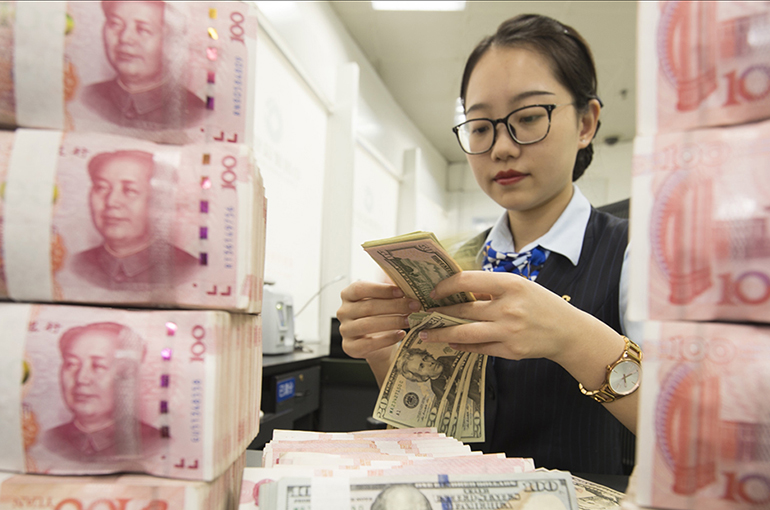
(Yicai) June 29 -- The Chinese yuan has retreated from this year's highs after the US dollar rallied on unexpectedly hawkish rate signals from the Federal Reserve, and analysts say the currency's medium- and long-term fundamentals remain intact and foresee two-way volatility for the rest of the year.
The yuan’s pullback follows a sharp rise in the US Dollar Index -- a measure of the greenback's value relative to a basket of other currencies -- after the Federal Open Market Committee signaled a more aggressive stance on interest rates than markets had anticipated on June 16. The Fed's Summary of Economic Projections showed officials raised the median forecast for the federal funds rate this year to 3.8 percent from 3.4 percent in March.
The US Dollar Index climbed to 101.5 on June 25 before easing to 101.36 the following day. The onshore yuan closed at 6.7978 per dollar on June 26 after reaching this year's strongest level of 6.7547 on June 17. The offshore yuan closed at 6.8048 on June 26, compared with this year's high of 6.7529 on June 17.
Still, analysts expect China's export strength and other fundamentals will continue to support the redback over the longer term, although exchange rate trends are likely to vary across different quarters. They expect the yuan to remain relatively resilient despite increased volatility.
A More Hawkish Fed
New Fed Chair Kevin Warsh's first Federal Open Market Committee meeting delivered a more hawkish message on rates than had been anticipated, Wang Qing, chief macro analyst at Golden Credit Rating International, told Yicai. That has had a greater impact on the dollar than the easing of safe-haven demand following the June 15 memorandum of understanding between the US and Iran, pushing the US Dollar Index from 100.4 on June 17 to 101.5 on June 25, he noted.
Wang expects the yuan to remain relatively strong in the short term. He said the US-Iran MOU and the gradual reopening of shipping through the Strait of Hormuz should help ease inflationary pressures and reduce the need for further Fed rate hikes, limiting additional dollar gains. At the same time, China's exports are expected to maintain solid growth, underpinning the yuan.
Zhao Wei, chief economist at Shenwan Hongyuan Securities, rejected the view that the yuan's appreciation may be nearing an end. Since July 2025, he said, both the yuan and the US dollar have strengthened simultaneously, with the yuan continuing to appreciate even as the dollar rebounded.
Higher US interest rates do not necessarily guarantee a substantially stronger dollar, Zhao added, as policy uncertainty under US President Donald Trump also weighs on the greenback. Meanwhile, China's economic recovery remains in the early stages of an atypical recovery, with recent setbacks largely reflecting temporary disruptions.
Yuan Export Support
The stronger yuan has not simply tracked movements in the US Dollar Index, according to Nanhua Futures. Although the greenback strengthened again in May, the Chinese currency continued to appreciate as China's exports consistently exceeded expectations.
The export foreign-exchange settlement ratio fell to 60 percent in April and May from 68 percent in the first quarter, below the seasonal average. Some market participants have interpreted the decline as a signal that the yuan’s gains may be ending.
The settlement ratio measures foreign-exchange settlements as a share of total forex income, indicating how much exporters convert their overseas earnings into yuan.
Nanhua Futures argued that a lower ratio does not necessarily mean the value of forex settlements has fallen. Settlement data at banks reflects actual export receipts and settlements, which typically lag customs export and shipment data by around 30 to 90 days.
As exports reached fresh highs for the year in April and May, the delayed release of export proceeds is expected to continue supporting the yuan. Although the settlement ratio has declined, the actual amount of foreign-exchange settlements has remained broadly stable, providing important support for the currency this month.
Editor: Emmi Laine





