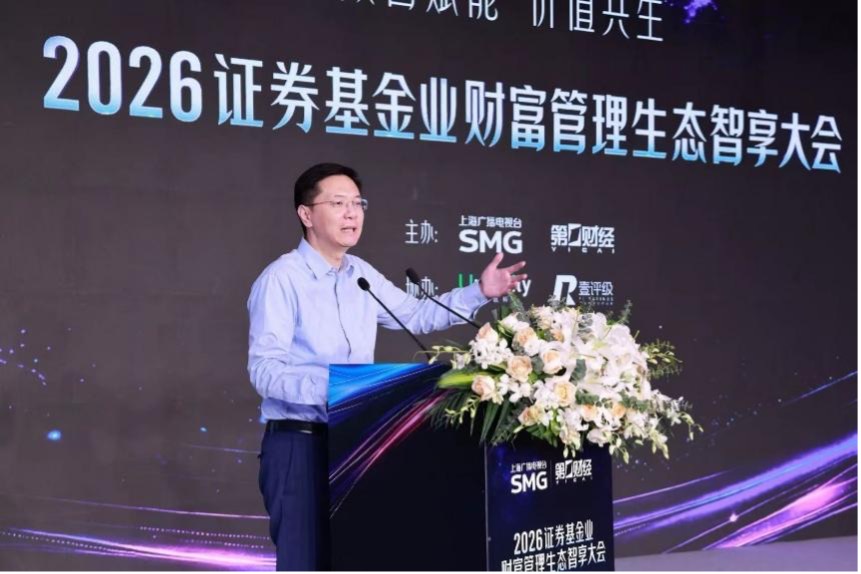
 Yicai-Run Conference Debates How Wealth Management Can Handle Personal Deposit Migration
(Yicai) June 29 -- More and more Chinese people are shifting their funds away from deposits, given the low interest rates. How the wealth management industry can accommodate a large volume of personal deposits and adapt to people's diverse and comprehensive asset allocation needs was the main topic at the 2026 Securities and Fund Industry Wealth Management Conference organized by Yicai.
Wu Qing, chairman of the China Securities Regulatory Commission, emphasized three times at different industry conferences this year the importance of accelerating the establishment of an evaluation system centered on investment returns, Yang Yudong, editor-in-chief of Yicai, said at the Securities and Fund Industry Wealth Management Conference on June 26. The transformation of wealth management has reached a critical window period, he added.
The scale of exchange-traded funds in the Shanghai Stock Exchange has reached CNY1.7 trillion (USD250.1 billion), ranking among the top in Asia, said Ye Wu, director of product innovation at the SSE. In the future, the market will continue to enhance the ETF ecosystem by diversifying the broad-based index system, launching actively managed ETFs and other innovative products, and optimizing ETF trading mechanisms, he noted.
The K-shaped trend is more evident this year and is expected to intensify with the development of artificial intelligence, according to Li Xunlei, chief economist at Zhongtai Financial International. The allocation ratio of equity assets can still be further improved, but caution is needed regarding the volatility risks brought by rapidly rising valuations.
To empower the entire financial technology innovation chain, it is essential to be more inclusive toward entrepreneurs and investment institutions, said Tian Xuan, dean of Peking University's Guanghua School of Management. He also advocated for the development of corporate venture capital to support technological innovation.
Overall, participants in the Securities and Fund Industry Wealth Management Conference believe that the demand from ordinary investors for professional investment advice, diversified investment products, and long-term support presents new development opportunities for the wealth management industry.
Wealth Management Industry Shifts Towards Buy-Side Advisory Model
The transition to a buy-side advisory model has become a consensus in the industry. AI has evolved from a back-end tool to a front-end core productivity engine and an enabler of client relationships, said Shi Benliang, director of Citic Securities' Wealth Management Committee. However, AI cannot replace the emotional support provided by human advisors, he pointed out.
Brokerage firms should focus on professionalism and technological empowerment to enhance the long-term success rate of clients' asset allocation, noted Geng Xuling, president of the Wealth Management Committee of Guotai Haitong Securities.
The number of personal pension accounts in China has exceeded 200 million, said Chen Tong, vice general manager of E Fund Management. However, issues such as insufficient contributions and conservative asset allocation persist, he noted, adding that the advisory business can assist in dynamic asset allocation.
Soochow Securities' President Xue Zhen believes that the industry should explore the use of assessment mechanisms to break the mindset of prioritizing sales over service and scale over companionship. This would help promote the industry's transformation towards a client-centered advisory model.
The entire wealth management industry should deepen the integration and innovation of AI, suggested Owen Wu, vice president of China CICC Wealth Management Securities. He emphasized the need to jointly build a healthy and sustainable new ecosystem, promoting a shift in residents' wealth from short-term speculation to long-term investment value.
Yicai's subsidiaries Yinfinity Digital Technology and Yi Ratings released two industry insights at the conference, based on their respective research and service practices. They revealed that the scarcity of professional talent remains the biggest challenge for brokerage firms in transforming their advisory business. Most institutions heavily rely on the capabilities of a few individual advisors, which has limited replicability.
Additionally, the research showed that all surveyed institutions are increasing their AI budgets, with more than half of practitioners already relying on AI tools in their work.
Editor: Futura Costaglione