 Yuan’s Rise Leaves Over 600 Listed Chinese Firms Nursing Forex Losses; Redback to Stay Strong, Analysts Say
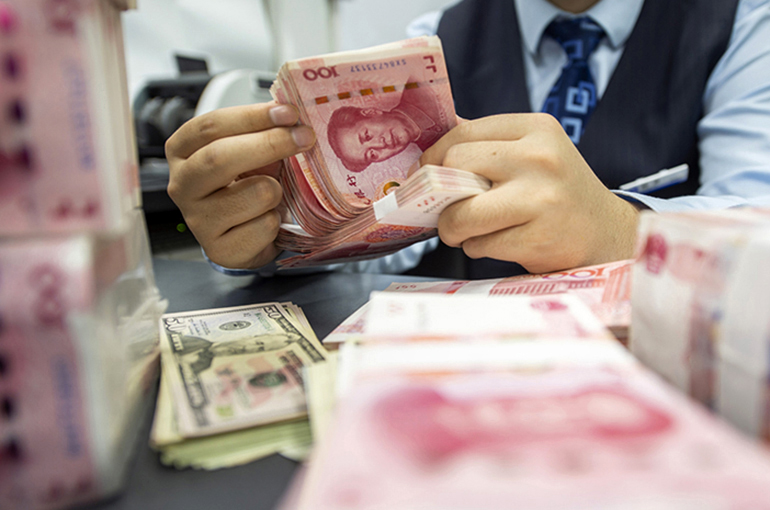
(Yicai) Aug. 27 -- The appreciating Chinese yuan has resulted in foreign-exchange losses at 677 listed Chinese firms in the first half, according to their semi-annual reports. The redback is expected to hold firm against the US dollar, trading within the 6.6-6.9 range, for the rest of the year, analysts said.
The yuan has strengthened against the US dollar since the beginning of the year. On Aug. 21, the offshore yuan briefly rose to 6.7179 against the greenback, hitting its highest level in nearly three and a half years, or since February 2023. For some companies, the forex gains recorded on their books last year have turned into losses this year.
Carmaker Chery Automobile posted a net forex loss of CNY2.1 billion (USD311 million) in the six months ended June 30, compared to a net gain of CNY3.4 billion (USD506 million) in the same period last year. This swing of nearly CNY5.5 billion (USD817 million) in forex gains and losses has become a key factor weighing on the Wuhu-based firm’s year-on-year profit performance.
Similarly, equipment manufacturer Yawei Machine Tool reported a forex loss of CNY10.4 million (USD1.5 million) in the first six months due to exchange rate fluctuations, compared with a CNY10.3 million (USD1.5 million) gain a year earlier. This directly contributed to a 364.8 percent year-on-year surge in its financial expenses.
Micro, small and medium-sized exporters are even more vulnerable. A banking insider told Yicai that given their already thin or near-zero profit margins, an exchange rate fluctuation of just a few percentage points can significantly impact these firms' actual earnings.
Shrinking Surplus
Banks’ foreign exchange settlements and sales surplus narrowed 67.7 percent in July from June to USD18.2 billion, according to data released by the State Administration of Foreign Exchange.
The market has begun to watch whether the contraction in a monthly surplus signals a fundamental shift in supply and demand in the forex market.
The July data is the result of firms making rational trading decisions based on their actual business needs and market conditions, and supply and demand in China’s forex market remains basically balanced, said Li Bin, deputy administrator of SAFE.
The sharp decline in the surplus was a reasonable adjustment at this stage, said Zhang Lin, deputy dean and chief macroeconomic researcher at Far East Credit Rating’s research institute. June’s unusually large settlement surplus may have been driven by factors such as companies’ concentrated settlements at the end of the first half, seasonal conversion of foreign-currency receipts into yuan and accelerated settlement amid stronger expectations for yuan appreciation.
These factors resulted in a temporary concentration of settlement activity, Zhang said. The decline in July likely reflects a normal adjustment following the release of pent-up settlement demand in the previous month.
Looking at a longer timeframe, the cumulative surplus of banks’ forex settlement and sales reached USD289.4 billion in the first seven months, already exceeding the full-year total of USD196.6 billion in 2025. By contrast, banks recorded an overall deficit in 2024.
Conversion Pressure
Historically, firms’ conversion of foreign currency earnings into yuan has been one of the most direct sources of support for the yuan’s appreciation this year.
A July report by the yuan exchange-rate trading team at the Industrial and Commercial Bank of China’s financial markets department said that many exporters chose to hold US dollars from 2023 to 2025. Market estimates put the amount of foreign-currency funds that have not yet been converted at between USD500 billion and USD800 billion.
Once the yuan’s appreciation exceeds the interest-rate advantage of holding foreign currency, companies’ expectations can shift from “waiting for a pullback” to “selling to limit losses.” This can trigger a non-linear release of demand for forex settlement, the team said.
The team expects the third quarter to be a peak period for purchases of foreign currency by Chinese firms listed overseas to fund dividend payments. Market estimates put cumulative demand at nearly USD40 billion. This may offset some corporate demand to convert foreign currency into yuan and bring supply and demand in China’s onshore forex market closer to balance.
On the other hand, companies are gradually moving away from accelerated, concentrated forex settlements toward a wait-and-see approach. As a result, the pace at which settlement demand is released is likely to become steadier.
Yuan Outlook
The marginal slowdown in the forex settlement surplus, together with sharp swings in companies’ forex gains and losses have fueled market discussions about the yuan’s outlook.
Official signals supporting exchange-rate stability remain clear. At a central bank meeting on its work for the second half of 2026, the People’s Bank of China emphasized the need to maintain the market’s decisive role in exchange-rate formation, preserve exchange-rate flexibility, strengthen expectations management and keep the yuan broadly stable at a reasonable and equilibrium level.
The economy’s stable improvement and increasingly rational forex market have laid a solid foundation for the yuan exchange rate to remain steady, said Wen Bin, chief economist at China Minsheng Bank. He expects the redback to remain strong and to trade between 6.6 and 6.9 against the US dollar for the rest of the year.
The redback’s performance in the second half will be influenced by multiple factors, including global geopolitics, monetary policy in major economies, the China-US interest rate spread, changes in the balance of payments, and shifts in market expectations, a report from the National Institution for Finance and Development said. Overall, the exchange rate between the yuan and the US dollar is expected to continue moving in both directions, with limited room for further yuan appreciation.
Editor: Kim Taylor