


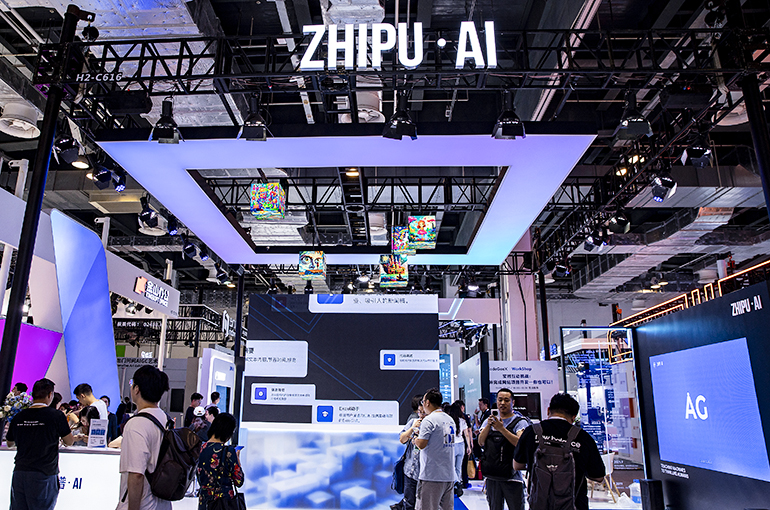
 China’s Z.AI Trims First-Half Loss as Open Platform, API Service Revenue Soars
(Yicai) Sept. 1 -- Z.AI, the first of China’s six “AI tigers" to go public back in January, shrank its first-half loss by 12 percent from a year earlier after income from open platform and application programming interface services soared, powering a fivefold increase in revenue.
The net loss was CNY2.1 billion (USD307.7 million) in the six months ended June 30, according to the Beijing-based company's earnings report released yesterday. Revenue came in at CNY954 million (USD142 million), surpassing last year's total of CNY724.3 million. Income from the open platform and API business soared 27 times to CNY825 million.
The change in revenue mix at Z.AI, formerly known as Zhipu AI, was more noteworthy than the headline growth rate, Board Secretary Xiao Lei said on its earnings conference call. The share of income from localized deployment -- in which large language models were installed in a client’s own environment -- tumbled to 14 percent from 85 percent, while the gross profit margin on API services swelled to 25 percent from minus 0.4 percent, he pointed out.
Spending on research and development climbed 34 percent to CNY2.1 billion in the six months, largely reflecting increased investment in model development and computing infrastructure.
Z.AI’s shares [HKG: 2513] closed down 1.3 percent at HKD1,179 (USD150.36) each in Hong Kong today. They have soared more than 10 times in value from their offering price of HKD116.20 (USD14.82).
As of yesterday, Z.AI's model-as-a-service platform had more than 7.4 million enterprise and developer users, while token call volume had increased over 40 times from the start of the year. The number of paid daily active users surged 603 percent year on year, and average daily call volume among its top 10 customers was up 98 times. In addition, average API pricing doubled.
Improvements in model architecture and inference infrastructure have slashed the cost of serving its models. Inference costs per token have fallen 80 percent since the beginning of 2026, while revenue for each unit of computing power investment (including training and inference) has surged 14-fold. MaaS gross profit margin has reached almost 25 percent.
Z.AI has achieved large-scale low-cost inference using a cluster of 100,000 China-made chips, the company previously told Yicai. Its computing power resources are now diversified, coming from a mix of self-owned clusters, leased capacity, and bought services, supporting the full model development cycle across pre-, mid-, and post-training, as well as production reasoning, Xiao said.
The industry’s main computing power challenge is shifting from whether Chinese chips can run AI models to whether they can do so economically, Xiao noted, adding that Z.AI is more focused on "effective computing power” -- computing power that has actually been installed, can be stably scheduled and run for a long time, and can ultimately be converted into productive token output.
AI models are quickly evolving, and amid fierce industry competition, any advantage on a single leaderboard is likely to be erased soon, noted Z.I Chairman Liu Debing. What really matters is who can sustainably deliver higher intelligence at lower cost, he stressed.
Liu expects the industry to develop two distinct pricing curves. The price of models delivering the same level of intelligence will continue to decline, while those capable of tackling previously inaccessible tasks and materially increasing task completion rates will retain the ability to command higher prices. In that environment, pricing power will come not from the token itself but from the tasks that the token can ultimately complete, he said.
Editor: Martin Kadiev