


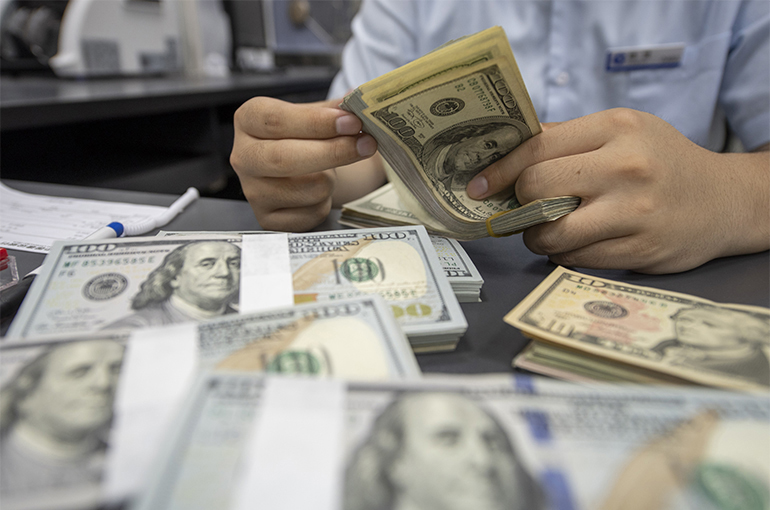
 [Opinion] Why the US Dollar Is Rallying and What It Means for China
(Yicai) Nov. 26 -- The US dollar has appreciated significantly against currencies of major developed economies and emerging markets this month, suggesting that when real interest rates rise and global risk appetite declines, the greenback may strengthen even if nominal interest rates do not change much.
Looking ahead, whether the US dollar will continue to strengthen depends more on monetary policy decisions by the United States and other major economies next month. If the Federal Reserve and the European Central Bank raise interest rates and the short-term nominal interest rate spread remains unchanged, the US dollar's trend will depend more on actual interest rates and risk appetite.
If the market still has high expectations for further Fed rate hikes, the revaluation of artificial intelligence continues, or related credit risks emerge, investors will continue to reduce leverage and increase their US dollar holdings in cash, and the currency may remain high. Conversely, if high interest rates and falling asset prices begin to drag down the US economy and threaten the country's financial stability, the Fed may adjust its policy stance, and the US dollar will fall accordingly.
Rise in Real Interest Rates Affects Gold Prices
On Nov. 19, the US dollar index rose to 103.97 during trading hours, up about 8 percent from this year's low at the end of January and the highest since April last year, while also marking four consecutive weeks of gains. During the same period, US technology stocks fell sharply, and spot gold fell to around USD3,514 per ounce, a 14-month low.
Two points are worth noting about the US dollar strengthening. First, its interest rate advantage over other major currencies has not widened significantly, and the traditional interest rate spread theory framework struggles to fully explain its recent strong performance. Second, the growth-driving factors of the currency exchange rate are becoming increasingly complex. Changes in US real interest rates, the decline in global risk appetite caused by the revaluation of AI, and policy uncertainty stemming from changes in the US political landscape after the midterm elections are important variables shaping the recent trend of the US dollar.
These changes not only affect whether the US dollar can strengthen sustainably, but also significantly impact global financial markets.
The US consumer price index rose 0.4 percent last month from the previous month, while the core consumer price index jumped 0.3 percent, both higher than expected, according to official figures released on Nov. 10.
The Fed should consider hiking interest rates by 50 basis points next month, said Christopher Waller, governor of the Federal Reserve Board. As a result, the yield on 10-year US Treasury bonds surged to 5.14 percent on Nov. 13 from 4.86 percent on Nov. 6, indicating that short-term rate hikes and lower inflation expectations are driving up real interest rates.
The rise in real interest rates means risk assets will face higher pressure on discounted valuation and will raise the cost of leveraged financing and suppress investors' risk appetite. Gold, as a non-interest-bearing asset, is particularly sensitive to this. Rising real interest rates increase the cost of holding gold, making it less attractive than interest-bearing assets.
AI Revaluation Raises Global Hedging Demand
AI is another factor besides rising real interest rates. Over the past two years, US tech giants have invested heavily in data centers and chips, driving up valuations across the entire supply chain. Starting in the second half of this year, the market is increasingly concerned about whether early-stage investments will deliver corresponding returns.
According to Bank of America's Global Fund Manager Survey, the net overweight ratio of technology stocks among surveyed institutions fell to 12 percent this month from 37 percent in October, the largest decline since June 2006.
The International Monetary Fund released a report last month, which listed a significant drop in AI asset prices as one of the three major recent risks, pointing out the issue of "circular financing", where tech giants inject funds into AI companies with weaker financial conditions, which then use the funds to buy services and chips from tech giants.
The risk has been released in a concentrated manner. The Philadelphia Semiconductor Index has dropped after an earlier rise, with a recent pullback greater than that of the US stock market, suggesting that market valuations across the AI-related supply chain are being re-examined and leading to a continued rise in the Chicago Board Options Exchange Volatility Index, which measures global risk appetite.
AI investment is no longer limited to the US stock market. It is closely tied to financing across the global semiconductor supply chain and to global stock and bond markets. International investors may simultaneously reduce their holdings of risk assets, increase demand for US dollar liquidity and safe assets, and further strengthen the greenback.
The global hedging demand triggered by the AI revaluation has spread to the gold market. When the stock market falls sharply, investors must meet margin calls and deleverage, so they often sell the most liquid assets first, such as gold.
Similar situations occurred during the 2008 international financial crisis and the early stage of the Covid-19 pandemic in March 2020. Combined with the impact of rising real interest rates, gold has experienced a significant short-term pullback.
As global investors focus on reducing risk exposure, demand for US dollar cash and short-term US dollar-denominated assets will rise, since the currency is globally dominant.
Impact on Chinese Economy and Yuan
The US dollar index has risen about 5.8 percent this year, while the Chinese yuan has appreciated around 5 percent against the greenback. The yuan has depreciated less than 0.5 percent against the US dollar this month, with limited volatility. This suggests the redback's trend depends more on exports, foreign exchange settlement, and its accelerating internationalization than on simply following the US dollar.
Starting from Nov. 15, China has raised the reserve requirement ratio for foreign currency deposits from 4 percent to 6 percent, the first hike over the past five years, aiming to tighten foreign exchange liquidity and prevent self-reinforcing appreciation expectations. There is little pressure for the yuan to depreciate, but it is necessary to avoid unilateral expectations and significant exchange-rate fluctuations amid a strong US dollar and global market turbulence.
In addition, when global tech stocks adjust, technology growth stocks in the Chinese mainland market are also affected. The financial authorities have optimized two tools to support the capital market: making the re-lending policy for stock repurchases and increased holdings a long-term institutional arrangement, with interest rates down to 1 percent from 1.25 percent, as well as resuming the securities, funds, and insurance companies swap facility, with 31 institutions applying for quotas exceeding CNY100 billion (USD15 billion).
At the same time, low-interest offshore yuan-denominated bonds have become a channel for tech companies to raise funds. Overseas portfolio investment under Qualified Domestic Institutional Investor mechanisms and interconnection has jumped, which may also increase Chinese investors' risk exposure to foreign markets. In addition, a slowdown in US AI investment will affect China's exports and corporate profits by influencing global demand.
To cope with fluctuations in the US dollar and global financial markets, China must continue to uphold monetary policy autonomy, strengthen monitoring of cross-border capital flows and key market fluctuations, expand policy tool reserves and use them flexibly, and maintain financial stability.
The authors of this article are Sheng Songcheng, dean of the research institute of the China Chief Economist Forum, and He Yulin, a postdoctoral fellow in the Intelligent Investment Research and Quantitative Trading Division at Shanghai Pudong Development Bank's financial market department.
Editor: Martin Kadiev
 Sheng SongchengProfessor of economics and finance at China Europe International Business School and the former head of the Financial Survey and Statistics Department at the People’s Bank of China