


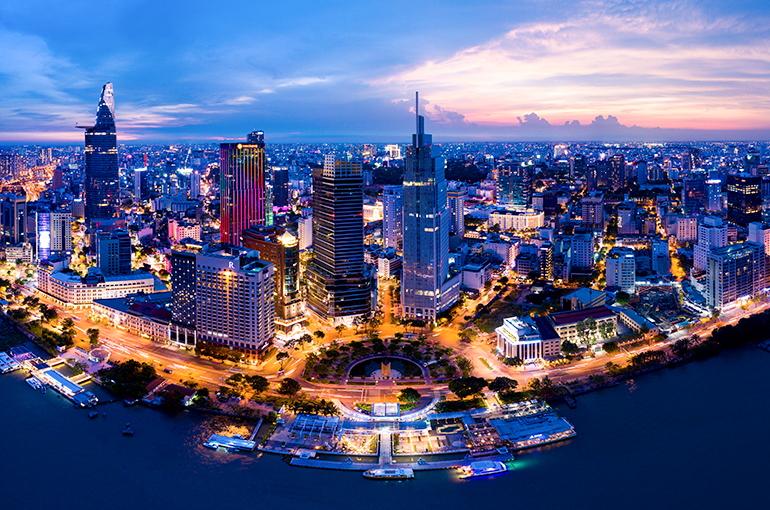
 In Vietnam, I Saw Another Pudong
(Yicai) Nov. 5 -- “That’s our Pudong.” A local pointed to a stretch of empty land across the river from Saigon’s old center. Having spent decades in Shanghai watching the city transform itself, I understood the ambition behind those words.
Over the past two weeks, I have traveled through Hanoi, Da Nang and Ho Chi Minh City. Each visit was an eye-opener: cranes punctuated the skyline, excavations marked the beginnings of new buildings, and the streets were alive with people working and moving. The resemblance to the Shanghai I had watched take shape was unmistakable—not simply in the construction, but in the sense of a city building toward a different future.
The comparison was more than an ambition for a skyline. It suggested a country preparing for a different economic future. Yet the lesson for China is not that another economy is about to replace it. Vietnam can capture new production while Chinese companies supply the machinery, components and expertise that make that production possible. Both countries can gain, even as they compete.
The numbers give the cranes substance. Vietnam’s real gross domestic product grew 9.95% in the third quarter from a year earlier, its fastest quarterly expansion in four years. Growth over the first nine months reached 9.01%. Industry and construction expanded 11.21% over that period, while services grew 8.96%. This is broader than a property-building spree: factories and services are expanding together.[1] [2]
For a fair comparison with its neighbors, consider full-year forecasts rather than mixing a quarterly result with annual figures. The International Monetary Fund’s October outlook projects Vietnamese growth of 8.4% in 2026, against 5.2% in Malaysia, 5.1% in Indonesia, 5.0% in Singapore, 3.4% in the Philippines and 2.1% in Thailand. Vietnam is outpacing these major ASEAN economies and sits among the world’s fastest-growing economies. The IMF forecasts global growth of 3.1%.[3] [4]
Those rates are not interchangeable: 9.95% is a reported quarterly year-over-year result; 8.4% is a full-year forecast. Neither guarantees the same pace next year. But together they show that the energy visible on the streets has a measurable economic counterpart.
Vietnam also has the scale to become more than an export workshop. Its statistics office estimated the population at 102.3 million in 2025, with 62.7% aged 15 to 59. That provides a substantial workforce and a large potential consumer market. It is a demographic opportunity, not an unlimited supply of cheap labor; falling fertility means Vietnam must turn that opportunity into higher productivity.[5]
What distinguishes the moment is the combination of production, infrastructure and financial reform. Manufacturing creates jobs and export income. Better transport can connect those factories to ports and households to employment. More accessible capital markets can help finance businesses beyond the biggest established groups. If these changes reinforce one another, the cranes become signs of productive investment rather than merely expensive structures.
The financial change is already under way. FTSE Russell’s reclassification of Vietnam from frontier to secondary emerging-market status took effect on September 21. Inclusion in its global equity benchmarks is being phased in through September 2027. The first tranche represented 10% of the scheduled investability weight; larger additions are planned for March, June and September next year.[6]
That widens the audience for Vietnamese equities, but it is not a promise that every global index fund will buy, or that every listed company will qualify. FTSE’s classification is not MSCI’s. Foreign-ownership limits and free-float constraints remain. As Thomas Nguyen, chief global markets officer at SSI Securities, told Reuters after the upgrade:
“FTSE is about access into the market. MSCI is about scale.”[7]
The Pudong comparison has a physical counterpart in Thu Thiem, the new urban area across the Saigon River. Vietnam’s international financial-center framework includes Thu Thiem as well as parts of the established Ho Chi Minh City center, with a second location in Da Nang. On October 28, the center said its first 10 members were expected to mobilize and invest $2.7 billion in Ho Chi Minh City through 2027. That is a forward commitment, not money already spent.[8] [9]
This is where the analogy becomes useful—and where it must stop. A new district can provide space for commerce. It cannot manufacture investor confidence by itself. That requires reliable regulation, enforceable contracts and institutions able to allocate capital without confusing rising land prices with rising productivity. Vietnam does not need to reproduce Shanghai’s scale or timetable. It needs to make its own new districts work.
For China, the opportunity starts with what Vietnam buys. In the first nine months of 2026, Vietnam imported USD187.34 billion of goods from China, out of total imports of USD453.72 billion. China therefore supplied 41.3% of its imports, calculated from those official figures.[1] A growing Vietnamese industrial economy is already a substantial market for Chinese production, not merely a rival to it.
There is also a difference between the location of a factory and the nationality of its owners. A July Federal Reserve staff study found that Chinese-owned firms’ share of Vietnam’s exports to the U.S. rose from approximately 11% in 2018–19 to 25% in 2020–23. Its ownership measure includes Hong Kong, and those are historical figures, not a 2026 market-share estimate. The analysis excludes shipments identified as potential rerouting.[10]
The authors’ conclusion is important:
“These findings suggest that higher U.S. tariffs on China may have redirected the geographic location of production without fully severing dependence on China.”[10]
The implication is not that Vietnam’s success belongs to China. Vietnamese workers, entrepreneurs and institutions are creating value on their own soil. It is that Chinese businesses need not choose between exporting from China and losing the business altogether. They can invest in genuine Vietnamese production, retain supplier relationships and earn returns from a larger regional market. Chinese shareholders may benefit even when a China-based factory loses a particular stage of assembly.
Infrastructure can deepen that relationship. In August, Vietnam approved a revised 426-kilometer railway connecting the Chinese border at Lao Cai with Hanoi and Haiphong, at an estimated cost of USD11.1 billion. Completion is targeted for the end of 2030. If delivered, the corridor could make moving industrial inputs and finished goods easier. The commercial gains still depend on construction, financing and effective operation; they have not arrived simply because the project was approved.[11]
Nor is the opportunity confined to assembly. Reuters reported in August that Vietnam had signed 5G rollout deals with Huawei and ZTE. Prime Minister Le Minh Hung urged Chinese companies to treat Vietnam as a long-term investment, production and business base and bring more advanced technology.[12] A country building factories and cities needs better communications as well as machinery. As incomes rise, it also becomes a larger market for consumer goods and services.
China cannot assume these opportunities will last unchanged. Vietnam wants more local suppliers and higher-value activities. As Vietnamese firms improve, they will compete with Chinese exporters. For Chinese businesses, the durable response is to offer technology, train workers and establish trusted local operations—not assume that Vietnam will remain a low-cost extension of an existing supply chain.
There are reasons for caution on both sides. September inflation reached 5.08%, and Vietnam recorded a USD19.42 billion trade deficit over the first nine months. Reuters reported concerns about overheating and potential electricity shortfalls. Rapid construction creates demand for power and finance before it necessarily creates the cash flow to pay for them.[2]
Trade policy is another constraint. On November 2, Reuters reported that an American investigation into Vietnam’s intellectual-property practices was approaching a November 29 deadline, alongside a separate excess-capacity probe.[13] Moving production south is no blanket exemption from trade scrutiny. Chinese ownership does not establish a shipment’s origin, and sending a product through Vietnam does not make it Vietnamese. A sustainable business must rest on real production and defensible compliance, not relabeling.
For investors, the question is therefore more demanding than how to buy a fast-growing country. Economic growth and shareholder returns are different things. The businesses worth examining are those that can convert expanding demand into durable earnings without relying on ever-higher asset prices or continually favorable trade rules. Better market access matters; so do governance, valuation and minority-shareholder protection.
Thirty years in China taught me to watch the cranes. They show where people expect the future to happen. They do not tell me which projects will succeed.
In Vietnam, I saw another Pudong—not a replica, and not a prediction that one country’s rise requires another’s decline. I saw a place attempting the transition from making more to making more value. China has a choice: regard that ambition only as a competitive threat, or help build it and participate in its success. The cranes suggest the opportunity is already taking shape.
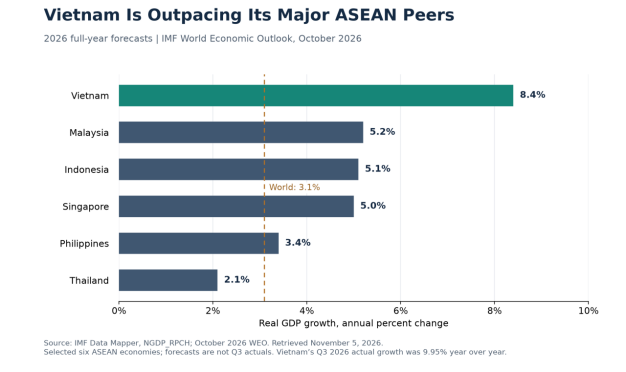
All bars show 2026 full-year real GDP growth forecasts from the IMF’s October 2026 World Economic Outlook. The six-country comparison is not an ASEAN aggregate. Vietnam’s reported Q3 growth of 9.95% is deliberately not plotted alongside annual forecasts. China’s 41.3% import share is calculated as $187.34 billion divided by $453.72 billion, multiplied by 100, for January–September 2026.
[2] Reuters, October 3, 2026: Vietnam’s quarterly GDP grows fastest in four years as exports boom
[4] IMF, October 2026 World Economic Outlook: Global growth outlook and forecast information cutoff
[11] Reuters, August 24, 2026: Vietnam expands the China-border–Hanoi–Haiphong railway project
[13] Reuters, November 2, 2026: U.S. trade investigation into Vietnam approaches its deadline
 Zhou XinVice President of Value Investment Research Institute, a Hong Kong-based think tank. He is a frequent speaker at leading global think tanks and institutions such as the World Economic Forum, Bruegel, Brookings Institution and the Asia Society. His columns also appear in Nikkei Asia, the parent publication of the Financial Times.