 Alibaba's Office App DingTalk Launches OpenClaw-Style AI Agent
(Yicai) March 18 -- DingTalk, a workplace messaging app owned by Chinese tech giant Alibaba Group Holding, has released an artificial intelligence agent to compete with the viral open-source tool OpenClaw.
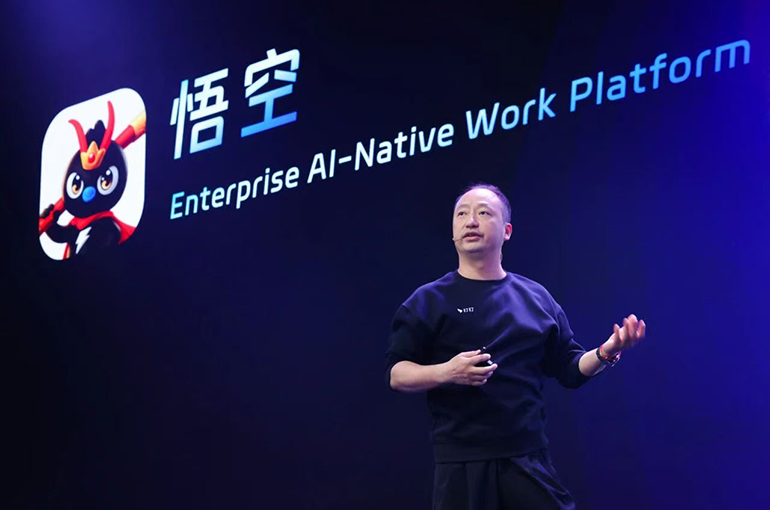
Wukong is specifically designed for enterprise applications, Chen Hang, chief executive of DingTalk, said at a launch event yesterday. It will be able to operate thousands of functions through a command-line interface after being deployed in the office app, which has over 20 million enterprise users, Chen pointed out.
Just two days ago, Alibaba set up Alibaba Token Hub, aiming to elevate its AI business to a new strategic position. The new unit will be overseen directly by the Hangzhou-based company's CEO Eddie Wu, integrating its Tongyi Lab, Qwen, Wukong, the Model as a Service business line, and AI Innovation team.
Alibaba's business capabilities in different segments, including Taobao, Tmall, Alipay, and AliCloud, will be gradually linked to Wukong in the form of skills, making it a unified output terminal of its AI capabilities in workplace scenarios, Chen noted.
Created by Austrian programmer Peter Steinberger, OpenClaw has set off a global craze due to its powerful task execution capabilities. Several Chinese tech giants, including Tencent Holdings, TikTok owner ByteDance, and Baidu, have subsequently launched AI agents with similar functions.
However, the security risks behind OpenClaw have attracted the attention of Chinese regulators, with the National Computer Network Emergency Response Technical Team/Coordination Center and the National Internet Finance Association issuing relevant risk warnings, indicating that the tool may cause information leakage and even cause computers to be remotely controlled by hackers.
Compared with OpenClaw, Wukong has strengthened security risk control, said Zhu Hong, chief technology officer of DingTalk. For example, it automatically inherits the app's enterprise permission rules to ensure that information technology departments can centrally control the AI agent's operating status, resource consumption, and security policies, Zhu said.
In the AI era where tokens play a key role, the future business model of office automation may change from traditional software subscriptions to application programming interface calls, so Wukong will consider pay-on-demand or pay-for-performance business models, Zhu said.
Editors: Dou Shicong, Martin Kadiev