



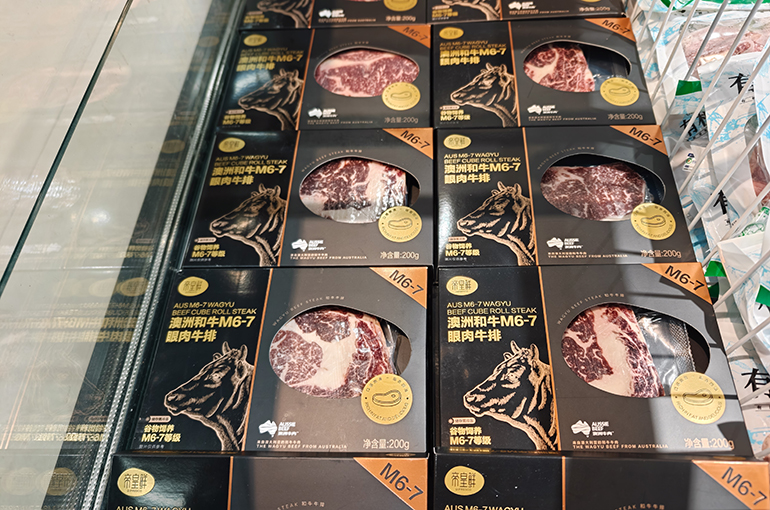
 Australian Beef Imports to China Trigger Extra 55% Tariff After Hitting Annual Quota Mid-Year
(Yicai) June 22 -- Australia’s beef imports to China have already reached the annual quota this month, setting off an additional 55 percent tariff. Some Australian beef suppliers have moved quickly to raise prices, though the retail pass-through appears limited so far.
Australian beef imports had reached 100 percent of the annual quota allowed under China’s safeguard measures on imported beef by June 18, the Ministry of Commerce said on June 19. As a result, the additional 55 percent tariff took effect on June 20.
The safeguard measures, which took effect on Jan. 1 and will remain in force for three years, set country-specific tariff-rate quotas for exporters including Argentina, Australia, and Brazil. Once a quota is exhausted, an additional 55 percent levy applies three days later. The safeguard is intended to help the domestic industry weather its difficulties, according to a ministry spokesperson.
The quotas are set close to import volumes in recent years and will increase each year, the China Chamber of Commerce of Import and Export of Foodstuffs, Native Produce and Animal By-Products said previously. That approach, it said, fully takes into account the reasonable demands of importers and processors while effectively supporting the healthy and sustainable development of beef trade.
A source in the catering sector told Yicai on June 20 that an Australian beef supplier had proposed raising prices by CNY20 (USD3) per kilogram. On the same day, a fresh-food supermarket employee said the price of an Australian beef product in the store had recently increased by CNY20 per kg, but that was mainly due to product scarcity rather than the tariff. Prices of other imported Australian beef products had not changed.
A customer service representative for a fresh-food platform told Yicai that it had not yet received any notice about tariff adjustments. Even so, product prices may still fluctuate depending on market demand, cost changes, and other factors, with the aim of keeping pricing reasonable.
China’s beef production rose 3 percent last year to eight million tons, according to data from the National Bureau of Statistics. Even so, domestic supply still could not keep pace with growing consumer demand. Beef imports fell 2.5 percent to 2.8 million tons, while by value they declined 8 percent to CNY105.9 billion (USD15.6 billion).
Brazil remains China’s largest beef supplier, accounting for about half of the total at CNY56.3 billion (USD8.3 billion), according to the General Administration of Customs. Australia ranked second with a nearly 15 percent share and an import value of CNY15.6 billion. Other major sources of beef imports included Argentina, New Zealand, the United States, and Uruguay.
Editor: Futura Costaglione





