


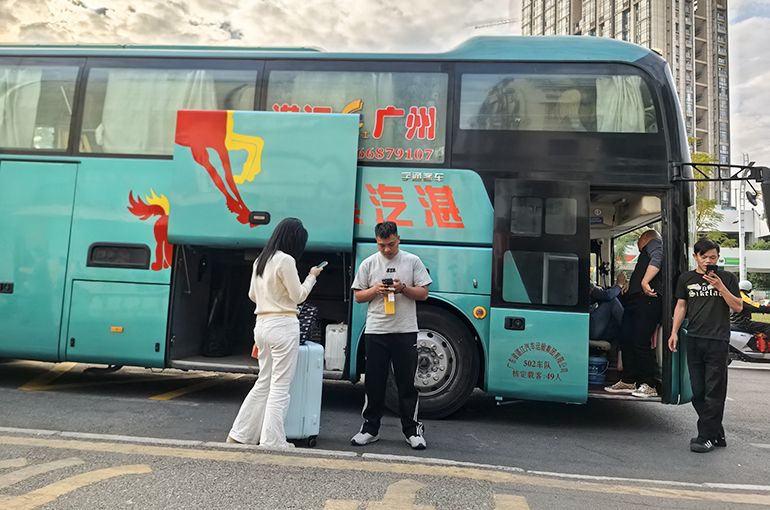
 Low Fares, More Flexible Services Revive Intercity Bus Travel in China
(Yicai) Oct. 15 -- China’s intercity bus operators have found a way to regain passengers for shorter journeys by competing on price, convenience, service flexibility, and operating efficiency.
The intercity bus sector slumped from the late 2010s as the expansion of the nation’s high-speed rail network and rising private car ownership eroded demand, with routes suspended and bus stations shuttered. The pandemic delivered a further blow in the early 2020s. Now, some operators are winning back passengers.
The examples of Yangyang Bus in the Pearl River Delta region and Leopard Transportation in the Ningxia Hui Autonomous Region suggest that lower fares, stops closer to passengers’ homes, more frequent departures, online booking, and demand-based scheduling can make buses attractive again for commuters, students, family visits, and short leisure trips.
Passenger load factors on Yangyang Bus’s main routes exceed 70 percent during off-peak periods and climb to 90 percent to 100 percent in peak hours on work days and at weekends, Zhang Peng, its operations manager, told Yicai.
Yangyang Bus mainly caters to intercity commuters, university and college students, people visiting relatives, and travellers taking short leisure trips, Zhang said. It serves more than 12,000 passengers a day on average, with daily volumes reaching a peak of 30,000 to 35,000 during public holidays.
Competitive fares are one of the main reasons passengers are returning. “From the provincial capital Guangzhou to Shenzhen, our tickets cost less than CNY20 (USD3), while high-speed train fares cost CNY70 to CNY80,” Zhang pointed out. Even during holidays, bus fares stay the same.
Better service is another draw. Traditional long-distance transportation means require passengers to buy tickets at bus stations and then wait there, Zhang said. But now, some intercity bus services stop near metro entrances, business districts, and residential neighborhoods, allowing passengers to board closer to home.
Online ticketing platforms have also made bus travel much more convenient. Passengers can buy tickets just an hour before departure during peak holiday periods and still get a seat. High-speed train tickets can be difficult to secure at such short notice.
Cheaper and More Often
Leopard Transportation’s new express bus service has won passengers back after lowering fares and shortening departure intervals, Han Xiaolei, its deputy general manager, told Yicai.
On the route between Yinchuan and Wuzhong, for example, the fare was cut to CNY12 from CNY20 when the express service was launched, and departures increased in frequency to every 30 minutes from one hour, and then to every 20 minutes. The service now makes 70 round trips a day, with high passenger loads.
Leopard Transportation now operates 12 such express routes, with more than 420 buses serving over 12,000 passengers daily, Han noted, adding that their average load factor is about 80 percent and can rise to 95 percent during holidays.
The two bus operators’ new business models have something in common. Rather than relying on passengers to come to bus stations, they bring services closer to where people live and travel, while using real-world big data to determine how much capacity to deploy.
“We don’t make high profits from a single ticket, but mainly rely on improving load factors and reducing empty runs,” Zhang explained. Yangyang Bus cuts the number of buses in operation during periods with fewer passengers, he said, adding that it maintains both an in-house fleet while also partnering with other fleet operators, allowing otherwise idle vehicles to be put to use during seasonal or other downturns in demand.
The ability to attract passengers is crucial for transport service providers, Han said. Lower fares and stops closer to passengers may be the first steps towards winning customers back. But ultimately companies must ensure that each bus carries enough people and that every vehicle is used as efficiently as possible.
Editors: Tang Shihua, Futura Costaglione