



 Can International Racing Accelerate the Globalization of Chinese Motorcycle Brands?
(Yicai) Sept. 29 -- Chinese motorcycle manufacturers have burst onto the international scene in recent years as global racing becomes more than a test of speed and engineering and emerges as a powerful platform for building brands and winning fans around the world.
China’s exports of motorcycles surged 18 percent in the first seven months from a year earlier to 8.98 million bikes, and their export value soared 22.9 percent to USD6.2 billion. At this pace, full-year exports could exceed 15 million units, accounting for more than 60 percent of the country's total motorcycle production.
For a long time, Southeast Asia and Africa have been the main export markets for Chinese motorbikes. But this picture is changing. Chinese motorcycle manufacturers are moving toward models with larger engine capacities and higher-value-added products. Breakthroughs by brands like CFMOTO and Zhangxue Garage in international racing circuits are accelerating this shift.
On Sept. 14, at the 14th round of the 2026 MotoGP season, rider David Alonso from the CFMOTO Aspar Team clinched victory in the Moto3 race. A week later, 13-year-old Chinese rider Sun Shengbo from the CFMOTO Aspar Junior Team won a race at the Navarra round of the Spanish Superbike Championship. He also secured the overall annual championship in the ESBK Talent class ahead of schedule, becoming the first Chinese road-racing rider to be crowned annual champion in Spain's top-level youth racing series.
When asked why CFMOTO had chosen to invest in expensive top-tier international racing, Vice President Chen Zhiyong told Yicai, “Do you want to win a long-term war, or do you just want to win a single battle?”
“We want to be world-class and make our mark in motorsports. Our ultimate goal is to achieve 'Chinese bikes, Chinese riders, on Chinese tracks' at the highest level. This means doing things that are long-term, difficult, but right, rather than taking the easy route to gain short-lived publicity or attention.”
China Speed
CFMOTO made its debut at the EICMA motorcycle show in Milan in 2005, marking the beginning of its push into the European market. Since 2014, the Hangzhou-based company has maintained top market share in Europe’s All-Terrain Vehicle segment. In 2024, it deepened its localization layout by acquiring European brand GOES.
After nearly two decades of developing its presence in local markets, CFMOTO entered MotoGP, the world’s premier motorcycle racing championship, in 2022, becoming the first Chinese manufacturer to compete in the series. In 2024, CFMOTO teamed up with the legendary Spanish team Aspar, which boasts a 40-year history, penning a long-term agreement that runs through 2031.
Jorge Martínez, founder of Valencia-based Aspar, said he first saw CFMOTO’s vision for global expansion about 10 years ago. It aligned perfectly with his own vision for the "Aspar Universe," an ecosystem integrating riders, racing and the broader motorcycle industry.
"I found that Aspar and CFMOTO share the same philosophy. We both want to dedicate many years working together to accomplish a major project like this," Martínez said. He stressed that the partnership was not an easy decision. It was only after visiting CFMOTO’s factory a few years ago that he gained confidence in the brand.
"I have worked with Aprilia and Ducati, but CFMOTO’s pace of development was completely different. I witnessed 'China Speed' with my own eyes," he said.
Brand Amplifier
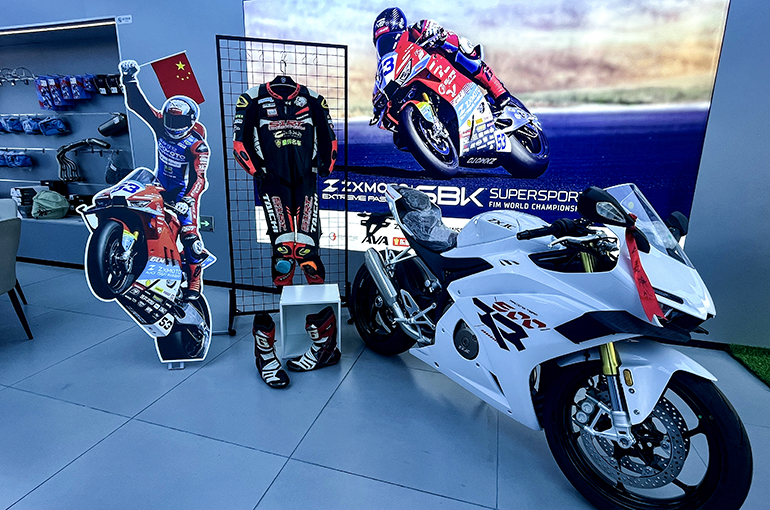
Racing is becoming an amplifier of brand value. At the showroom of Jets Marivent, CFMOTO’s exclusive distributor in Spain, team logos and images of star riders occupy prominent positions.
The distributor’s head told Yicai that CFMOTO commands a 46 percent share of Spain's four-wheel ATV market, making it the market leader. Meanwhile, its 450MT off-road motorbike series has become highly popular and the firm had already achieved its full-year sales target by September.
The executive said CFMOTO has used Spain’s deep-rooted racing culture and localized marketing strategies to build closer connections with local consumers and strengthen brand recognition. The expansion of its retail network has been a direct result of that growing awareness. CFMOTO now has more than 40 stores in the region and plans to accelerate the rollout of new outlets.
Compared with established European and Japanese motorcycle brands, Chinese manufacturers have proved particularly adept at social media and content marketing. They have been able to bring together fans, brands and teams, creating an emotional connection that transcends the technology itself.
Teams maintain accounts on both Chinese and international social media platforms and use activities such as race-day content and live broadcasts featuring riders to engage directly with fans. At races, CFMOTO Aspar Team staff are often approached by fans who recognize them and actively greet them, a sign that racing is helping turn spectators into brand enthusiasts.
This fan loyalty is also translating into merchandise revenue. CFMOTO said sales of branded merchandise have continued to rise. At the recent MotoGP event at the Misano World Circuit in Italy, CFMOTO T-shirts sold out quickly.
Chinese brands have their own strengths in community building, social media and content distribution, said Carlos Ezpeleta, chief sporting officer of Dorna Sports, the sports and entertainment group that operates MotoGP.
Chinese manufacturers have an opportunity to combine products, brands, communities and events to create greater value rather than simply focusing on technological research and development, he said.
Long-Term Mindset
"What Chinese firms currently lack most is a long-term mindset," Chen said. “Short-term efforts to attract attention cannot sustain a brand over the long run. Only by competing alongside the best can we drive technological development."
He summarized this approach with the Chinese slogan "self-strength makes everything strong," which means that only by building its own capabilities can a company truly establish a firm foothold in global competition.
For CFMOTO, racing is not an expensive showcase but an accelerator for technological development. Chen said the firm’s "racing-driven research and development" strategy is more than a slogan.
CFMOTO’s flagship V4 SR-RR superbike, launched this year, is powered by a self-developed V4 engine and set a Chinese motorcycle speed record of 315.82 kilometers per hour. Key technologies used in this model, including engine performance tuning, aerodynamic design and electronic-control calibration, have directly benefited from data accumulated and validated on the track through CFMOTO’s MotoGP program.
Ezpeleta noted that much of the technology now widely applied in high-performance production bikes today was developed through decades of competition in racing. Manufacturers have to keep innovating and improving technological efficiency, he said.
So can international racing accelerate the globalization of Chinese motorcycle brands? The answer is yes. But the acceleration is not necessarily in shipment volumes. Rather, it is about reshaping the position of Chinese companies in the global industry from "suppliers" to "partners," and ultimately to “rule-shapers.”
There is one prerequisite for this acceleration and that is staying on the track long enough. As Chen put it, firms need to do things that are “long-term, difficult, but right.”
The real race has only just begun.
Editor: Kim Taylor





