



 Could 2026 Be Chinese Motorcycle Racing's Inaugural Year?
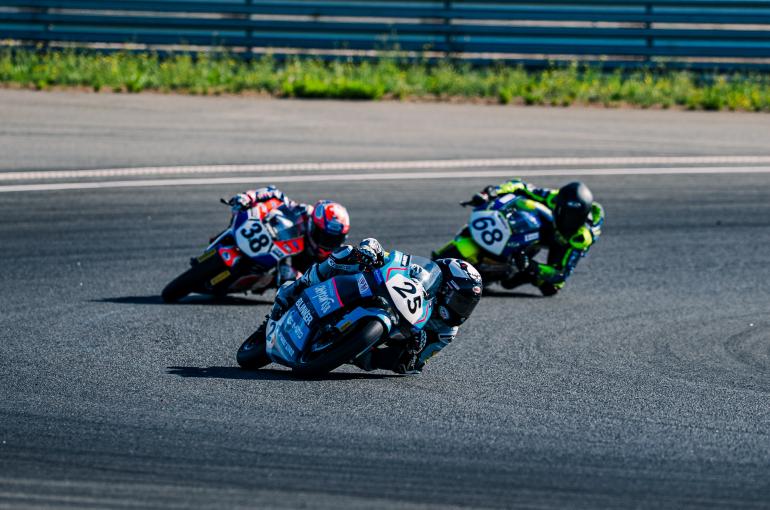
(Yicai) Sept. 22 -- Sun Shengbo, a 13-year-old Chinese rider for the CFMoto Aspar Junior Racing Team, secured the 2026 Spanish Superbike Championship in the ESBK Talent category ahead of schedule this weekend after claiming nine victories and one runner-up finish in the first twelve races.
Yicai met Sun on a Spanish racetrack in the middle of last month. Despite already standing shoulder-to-shoulder with his father, he still carried a hint of boyish innocence. Though he was not at his best that day, he calmly analyzed his race execution within half an hour, treating the intense, high-speed battle on the track like another classroom math problem.
Carlos Ezpeleta, deputy chief executive of MotoGP Group, the world's top motorcycle racing series, told Yicai that he traveled to Shanghai last October to meet with local officials. “Multiple regions in China have expressed strong interest in collaborating to host Superbike World Championship (WSBK) and MotoGP events.”
Chinese manufacturers are making history, young drivers are securing championships on the track, and organizers are mapping out a Chinese calendar at the negotiation table. As these three converge, the fundamental question remains whether this year marks the true dawn of Chinese motorcycle racing.
From Sponsor to Co-Creators
In 2024, the CFMoto Aspar Team made history by sweeping the Rider, Constructor, and Team World Championships in the Moto3 class of MotoGP. By 2026, the team was fighting for titles on dual fronts in Moto2 and Moto3, extending its partnership with Aspar through 2031. In June, the CFMoto V4 SR-RR set a new Chinese motorcycle land speed record of 315.82 kilometers per hour
When asked why CFMoto chose to heavily invest in high-cost, top-tier international racing, Vice President Chen Zhiyong noted: "Are you trying to win a long-term war, or do you just want to win a single battle?"
"We want to be world-class and build a legacy in motorsport, ultimately achieving our ultimate goal: 'Chinese bikes, Chinese riders, on Chinese tracks,'" Chen stressed. "That means doing the long-term, difficult but correct things, rather than taking the easy route for short-term hype or temporary attention."
Jorge Martínez, the founder of the legendary Spanish Motorcycle team Aspar, offered a more concrete perspective. As a MotoGP Hall of Famer and four-time World Champion, he has witnessed the entire evolution of motorcycle racing, having worked with industry giants like Ducati, Yamaha, and Honda.
"CFMoto's pace of growth is on an entirely different level. I have witnessed 'China Speed' with my own eyes," Martínez noted.
CFMoto's willingness to collaborate was even more impressive, he said. Japanese manufacturers often have long decision-making processes where trackside engineers cannot make final calls without corporate headquarters approval, while CFMoto behaves "more like Europeans" --flexible, agile, and open to feedback, he stressed.
Europe acts like a "boutique shop," offering technical know-how and deep-rooted sporting culture, while China brings technological acceleration and industrial cooperation, Martínez said, adding it is not a matter of replacement, but mutual complementarity.
Systemic Approach to Going Global
Currently, two young Chinese riders sent by the CFMOTO RACING Talent Program have begun to stand out within the CFMoto Aspar Team's youth academy. Sun Shengbo and Liu Shanxu train and race together at the team's Valencia HQ.
Launched by CFMoto in 2023, the talent program is a youth rider training initiative designed to build a clear promotional pathway for riders aged 12 to 18 from junior classes to elite world championships.
Sun won the 190cc World Championship at the FIM MotoMini World Series last year, becoming the first-ever world champion in Chinese road racing history.
Liu finished third in the inaugural CFMoto Racing Talent Cup selection at just 11 years old. Two years later, he arrived in Valencia to join the Aspar training system.
On weekends off from training, they ride bicycles with friends and get swarmed by classmates asking, "How fast can you go?" In their classrooms, their peers look on with absolute curiosity when they learn the two are professional drivers.
On the asphalt, they undergo the same grueling refinement. Sun showed dominant speed this season, and secured the 2026 Spanish Superbike Championship in the ESBK Talent category. Meanwhile, Liu faced a series of sudden mechanical failures during a recent race when his front brakes failed, the throttle would not snap back automatically, and his seat shifted out of alignment, and yet he pushed through to cross the finish line.
"Mindset is everything in racing," Liu noted. "I got a bit anxious at the moment."
"They are just children," said their mothers, who accompany them to races and interviews. However, even at this tender age, the two are already learning the psychological framework of professional athletes, not just how to scrape pegs through corners, but how to reset mentally after a mistake and maintain absolute focus at the absolute limit, they stressed.
"We have successfully built a pipeline for Chinese drivers from the moment they choose a professional career straight into the MotoGP ecosystem," said Su Zhen, head of CFMoto's racing development department.
Previously, Chinese drivers often hit a ceiling in Asian regional championships because Honda, or Japanese and Italian teams, usually would not pick them as their first-choice driver. Thanks to the CFMoto Racing Talent program, as long as Chinese drivers are talented enough, they have a clear path to climb straight to the top.
Within the next few years, we will see a Chinese driver on the starting grid of a premier-class MotoGP race, Ezpeleta stressed.
Event Importation and Ecosystem Building
The timeline for bringing elite motorcycle racing back to China is crystallizing, Ezpeleta said, noting that as more Chinese motorcycle manufacturers find international success, China's importance in the global motorcycle industry will only grow. "Therefore, we are actively driving the development of MotoGP in China."
Ezpeleta's ultimate goal is to integrate MotoGP and WSBK into the Chinese sporting calendar. With MotoGP capped at 22 races per year, he said, "WSBK might enter China first to build momentum, grow the fanbase, and lay the groundwork for MotoGP's future return."
However, this strategy is less about simply bringing events in and more about planting deep roots.
Addressing why CFMoto chose to build a comprehensive ecosystem spanning racing, training, bike research and development, and rider development, Su said that as major Chinese motorcycle brands gain global traction and cultivate their own motorcycle culture, they must inevitably shape the sport itself. "As motorcycle manufacturers, Chinese brands have a collective responsibility to build this ecosystem together."
The partnership with the Aspar Team, particularly its structured training system, gives passionate parents and young drivers a transparent career path and far broader horizons, Su noted.
Through its alliance with CFMoto, Aspar hosts four to five training camps in China a year, flying in European coaches and technicians, while simultaneously bringing elite Chinese drivers to Europe to train alongside the world's best.
Aspar's role is to help CFMoto optimize and complete its talent development framework, said Facundo Garcia, general manager of the Aspar Team.
The definitive verdict on whether 2026 will be remembered as the inaugural year of Chinese motorcycle racing may require a few more years of perspective.
What remains undeniable right now is that two 13-year-old boys are pouring their sweat onto international racetracks; a Chinese manufacturer has become the partner of choice for a legendary European team; and an entire domestic industry is transitioning from manufacturing to branding, and from China to the "global stage.
An inaugural year is not a destination, but a coordinate. The real race has only just begun.
Editor: Martin Kadiev





