



 Can Standards Keep Pace With AI? Experts Weigh In at WAIC
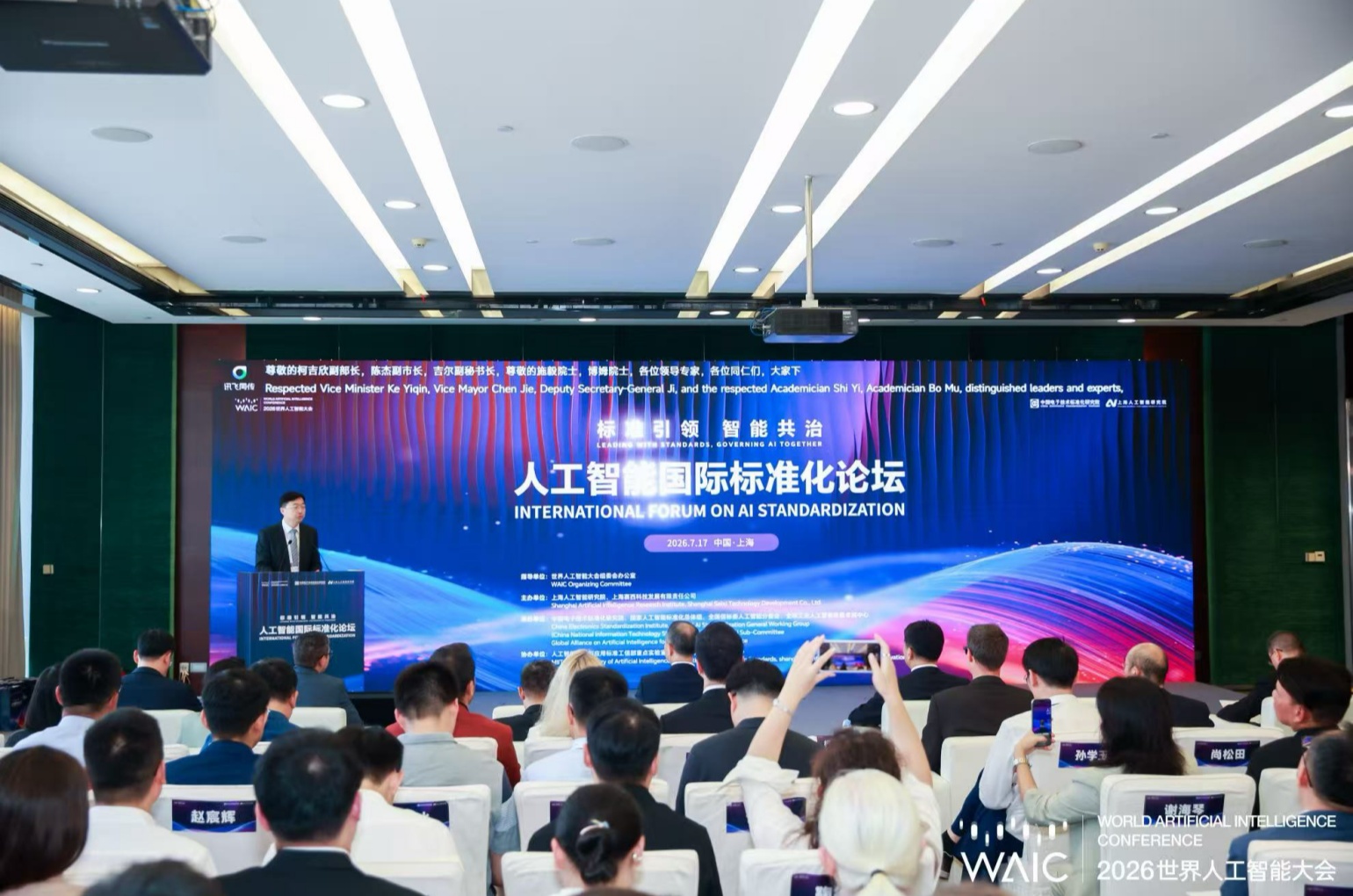
(Yicai) July 20 -- While standards typically take years to develop, embodied intelligence models are now being released about every 48 hours, according to one estimate. At a forum held on the sidelines of the World Artificial Intelligence Conference in Shanghai, representatives from China, Brazil, Russia, the United Kingdom, the European Union, and the United Nations offered answers to the question: Can standards keep pace with AI?
Amandeep Singh Gill, the UN’s under-secretary-general and special envoy for digital and emerging technologies, said that in the past standards were designed for technologies that remained relatively stable after development, but AI is different.
“AI does not sit still,” he said. “It learns, it’s updated, it behaves differently in the world than it did in the laboratory. A standard finalized today may describe a technology that has already moved on. We cannot govern a moving system with a fixed rule.”
Gill proposes dividing AI standards into two parts. The first should contain enduring principle such as human dignity, accountability, and human oversight that remain stable over time. The second should cover technical elements, including performance metrics, testing methodologies, and thresholds, which should be treated as "living instruments" that evolve alongside the technology.
Standards serve as the bridge between broad governance principles and practical engineering requirements, Gill said. “Standards are the connective tissue of this chain,” he said. “They are how a shared value becomes a repeatable practice.”
To help standards keep pace, Zhang Shizong, deputy director of the information technology research center at the China Electronics Standardization Institute, said the organization is testing more flexible drafting approaches that can align with open-source development cycles. A series of standards covering AI agent interoperability has already reduced the development cycle to eight to 10 months, Zhang said.
China’s Ministry of Industry and Information Technology has issued guidelines for establishing a national AI industrial standardization framework, released nearly 200 standards covering areas such as large language models and AI agents, and participated in the development of 75 international AI standards, said Vice Minister Ke Jixin.
Shanghai Vice Mayor Chen Jie said the city has built its own local AI standards system, with more than 20 local standards initiated, while local companies have contributed to over 60 international and 160 national standards.
China has introduced a mandatory national standard requiring AI-generated content to include both human-readable and machine-readable identifiers, said Liu Xiangang, CESI’s deputy director. He described the move as a “world first.” The standard is backed by a public service platform that has registered more than 5,700 users, Liu added.
Separately, he said about 800 Chinese LLMs have completed regulatory filings under a standard on generative AI security, with the products together registering more than 3 billion registered users, a figure that reflects cumulative product sign-ups rather than active AI users.
One Standard, or Many?
“AI standards are a common language for AI governance and an important link for orderly industry development and international cooperation," Chen said. Standards, in this framing, are are becoming more than technical documents, they are becoming strategic infrastructure. Whichever country's standards gain traction first could see its technology and products more easily adopted elsewhere, which helps explain why countries and standards bodies are racing to move faster.
The past decade's focus on trustworthiness, risk, and compliance is no longer sufficient, said Sebastian Hallensleben, who chairs the CEN-CENELEC Joint Technical Committee 21 on Artificial Intelligence, a European body set up to develop standards for AI. He proposed extending standards into a new dimension: quality.
“How can we describe the quality of an AI system in a similar way as you would describe the quality of a car in order to choose the right one for you?,” Hallensleben said. His committee has launched work at the European Telecommunications Standards Institute on an AI Solutions Quality Index.
Andrey Dmitrievich Tsoi, deputy head of the Laboratory for the Quality of Artificial Intelligence Technologies at the All-Russian Institute of Scientific and Technical Information, said experts who combine deep AI knowledge with familiarity with ISO procedures remain scarce, compounded by funding constraints and the language demands of ISO's working languages. The result, he said, is that "the specific needs of developing markets are largely overlooked when international standards are drafted.”
Lydia Xu, standardization director at Microsoft China, argued that international standardization should "pursue coherence, not uniformity" -- providing common baseline concepts and risk-management approaches -- “while allowing reasonable flexibility for local implementation." She also cautioned that "the goal is not to produce more standards," adding that "over-standardization can create barriers, especially for smaller companies and emerging industries."
Larissa Chen, a partner at Brazil's Daniel Law, said many companies mistakenly assume that the absence of a dedicated AI law means no rules apply. "That's not true," she said, noting that existing frameworks -- data protection, intellectual property, consumer protection -- already apply to many AI applications.
Dushyant Sanothara, global business director for AI and Digital Solutions at the British Standards Institution, said standards are inherently written to be generic, but expects more industry-specific standards for sectors such as critical infrastructure, law, and finance to emerge in coming years.
That view was echoed later in the panel discussion. Jiang Zhengwen, vice president of Sangfor Technologies, which specialises in cybersecurity, cloud computing, and information technology infrastructure, said AI safety testing methods are largely transferable across borders, but the standards they are tested against will keep diverging along national lines.
Wang Xiaohui, head of the economic and technical research institute at State Grid Shanghai, made a similar point on power grids, arguing that general standards such as ISO/IEC 42001 fall short of the sector's safety and traceability needs -- a gap he said should be filled by an industry-specific layer.
No one at the forum offered a complete answer to how standards can keep pace with AI. But one thing was clear: standards are becoming tools in a broader contest over rule-making power, and who gets a seat at that table remains an open question.
Editor: Tom Litting





