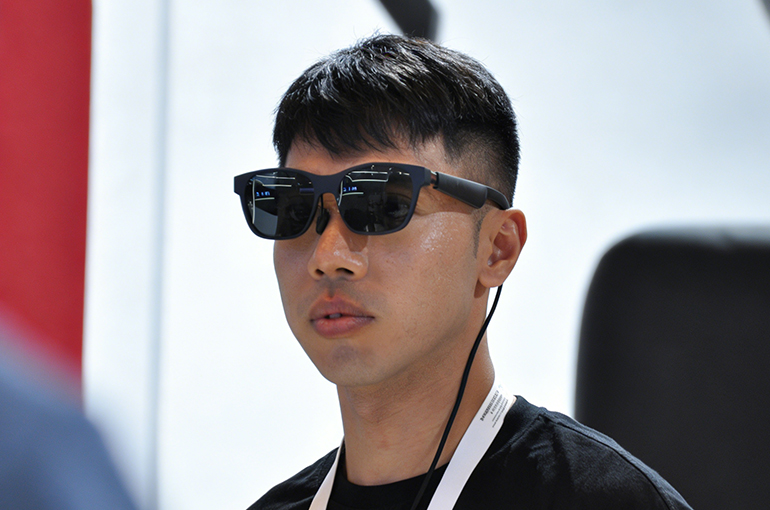
 China Adds Smart Glasses to Trade-In Subsidy Program
(Yicai) Dec. 31 -- China will include smart glasses in its trade-in subsidy program for consumer goods for the first time next year, a move intended to lower costs and speed market adoption as part of broader efforts to boost domestic consumption.
The government will provide subsidies for car scrappage and replacement, home appliance trade-ins, and purchases of new digital products, including smartphones, tablets, smart watches and bands, smart glasses and other smart home devices, according to a policy document jointly released yesterday by the National Development and Reform Commission and the Ministry of Finance.
The trade-in subsidy program, introduced in 2024, aims to boost domestic consumption by incentivizing the replacement of older vehicles, appliances, and digital devices with new ones through purchase subsidies. Funded by the central government and implemented by local authorities, it typically offers discounts of about 15 percent to 20 percent with caps per item.
The addition of smart glasses is intended to push product innovation and cultivate the market, Liu Chuang, a senior researcher at tech industry consultants Runto Technology, told Yicai. By lowering purchase barriers and hastening supply-chain maturation, the subsidy should help move smart glasses from niche, early-adopter purchases toward broader consumer adoption, Liu added.
China’s smart glasses shipments surged 62 percent to 623,000 units last quarter from a year ago, according to International Data Corporation. Deliveries of audio and camera glasses soared 79 percent to 454,000, while those of augmented reality and virtual reality glasses jumped 29 percent to 169,000.
IDC expects China shipments to climb 78 percent next year to about 4.5 million, led by audio and camera glasses at roughly 3.4 million and AR/VR devices at about 1.1 million.
The NDRC and the finance ministry also announced yesterday that CNY62.5 billion (USD8.9 billion) in proceeds from the sale of ultra-long special treasury bonds will be allocated in advance to support consumer goods trade-in subsidies in 2026.
CNY300 billion (USD42.5 billion) was set aside last year, split evenly between equipment upgrades and consumer goods trade-ins. This year, CNY200 billion went to equipment renewals and CNY300 billion to consumer products, while coverage was expanded to digital devices such as phones and tablets.
In the first 11 months of 2025, the trade-in program helped lift consumer goods sales above CNY2.5 trillion (USD354.2 billion) and benefited 360 million consumers, according to commerce ministry figures. The subsidies supported purchases of 11.2 million vehicles, 128.4 million home appliances, and 90.2 million digital products.
Next year, home appliance subsidies will continue to apply to refrigerators, washing machines, televisions, air conditioners, computers, and water heaters, while stoves, microwave ovens, and several other categories will be excluded. Only products carrying a Level 1 energy-efficiency label, the highest standard, will qualify.
The subsidy rate for appliances will be cut to 15 percent from 20 percent of the purchase price, and the maximum payout per item will be lowered to CNY1,500 from CNY2,000 (USD214 from USD286). Subsidies for digital products will remain unchanged at 15 percent, with a CNY500 (USD71) cap.
Editors: Dou Shicong, Martin Kadiev