



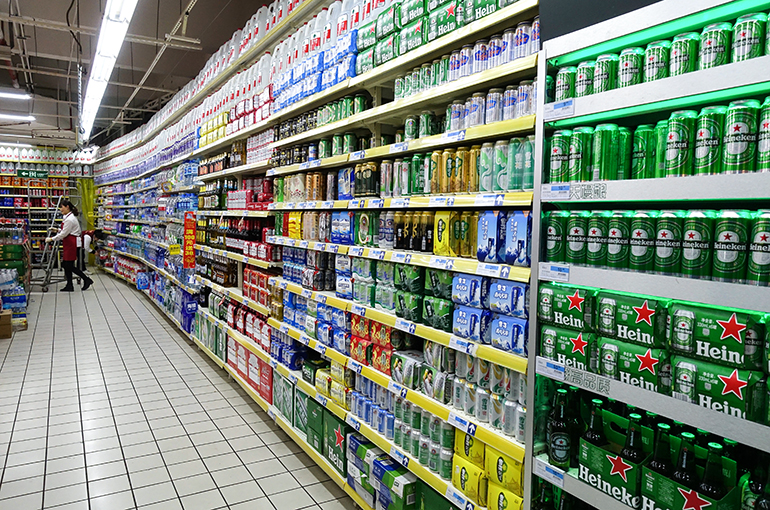
 China Closes Consumption Tax Loophole for Brewers
(Yicai) April 3 -- China’s tax authority has moved to close a consumption tax loophole that allowed brewers to use affiliated distributors to manipulate prices and lower their tax bills.
Starting April 1, beer makers are now subject to a consumption tax rate based on the highest of their ex-factory prices and the market prices of their affiliated sales companies, the State Taxation Administration said in a notice issued yesterday.
China previously taxed brewers in tiers based on ex-factory prices, Tian Zhiwei, director of the Institute of Public Policy and Governance at Shanghai University of Finance and Economics, told Yicai. Beer priced above CNY3,000 (USD436) per ton was taxed at CNY250 (USD36) per ton, while beer priced below that was taxed at CNY220 per ton.
As a result of this brewers set up affiliated distributors to which they sold more expensive products for under CNY3,000 per ton so as to pay less consumption tax. The beer was then sold on to consumers at normal market prices.
To close this loophole, regulators changed the tax collection method after 2002 to one based on the sales price of affiliated distributors. But some producers later found ways around that by colluding with their sales affiliates to artificially lower prices, Tian pointed out. The SAT’s new policy shuts off that avenue, he said.
Some Chinese beer makers are keen to exploit policy loopholes because consumption tax is their main tax burden, according to industry insiders. One listed brewery’s financial report showed that it paid over CNY1.7 billion (USD247.1 million) in consumption tax last year, accounting for about 73 percent of its total taxes and surcharges in the period.
This kind of tax avoidance also occurs among other consumer goods manufacturers, Tian Binbin, vice dean of the School of Public Finance and Taxation at Zhongnan University of Economics and Law, told Yicai. This is because China levies consumption tax at the production stage and based on the sales revenue of taxable products, giving businesses room to exploit the loopholes and avoid taxes by setting up affiliates.
Even though this collection model is relatively efficient from an administrative standpoint, the existence of related-party transactions is still greatly weakens the consumption tax base, Tian Binbin noted. The fundamental solution to the problem is to shift collection to the end-consumption stage and anchor taxation to the final consumer price of the product, he added.
Editors: Tang Shihua, Futura Costaglione





