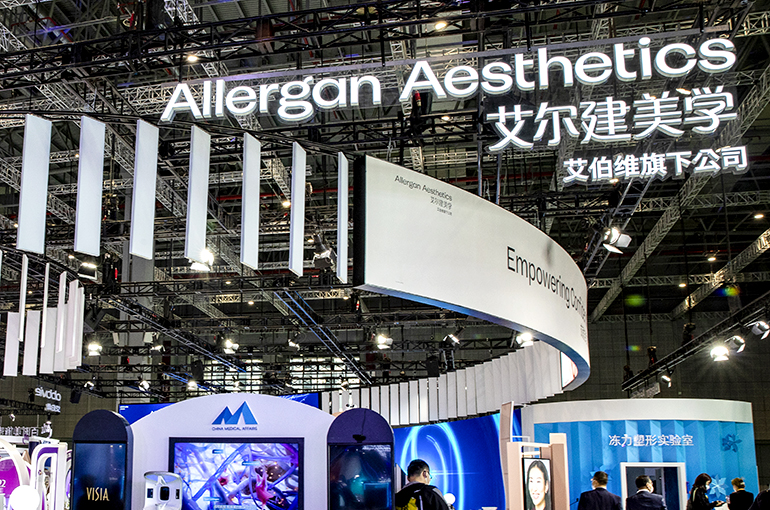
(Yicai) May 22 -- Botox, the flagship product of Allergan Aesthetics, was approved for use on forehead lines in China. The subsidiary of US pharmaceutical giant AbbVie plans to focus on medical compliance in the Chinese market going forward.
Allergan held a launch event for Botox's new indication in China on May 20. The product, which entered the Chinese market in 1999, was approved for the treatment of forehead lines by the National Medical Products Administration on April 24.
Botox was already available in China for the treatment of glabellar lines, lateral canthal lines, and masseter muscle prominence. Its sales will likely grow rapidly in the first half of the year from a year earlier, Ethan Qiu, vice president of Allergan and general manager of the company's China business, said at the event.
The Chinese medical aesthetics industry is defined by three trends, Qiu believes. On the demand side, consumers are shifting from impulsive to more considered decision-making; on the supply side, product offerings have become increasingly abundant; and on the regulatory side, regulation continues to tighten.
In recent years, China's medical aesthetics industry has entered an adjustment phase amid stricter regulation and cooling consumer sentiment. The Chinese retail market for injectable medical aesthetics expanded to CNY67 billion (USD9.9 billion) in 2023 from CNY25.7 billion in 2018, achieving a compound annual growth rate of 21 percent, according to a report from Frost and Sullivan.
Growth has slowed down since 2023, but as the market matures and competition intensifies, injectables such as botulinum toxin, hyaluronic acid, and energy-based treatments remain the dominant segment.
Allergan has taken a three-front approach to adapt to this environment. On the product side, the company has secured new indication approvals, including Botox for forehead lines and Juvederm for the temporal region. On the physician side, it has built an education infrastructure through the Allergan Medical Institute Medical Partner Program, which has now trained more than 2,500 physicians. On the standards side, it has driven the establishment of industry-wide aesthetic benchmarks.
At the launch event, Li Qin, director of the Facial Rejuvenation Branch of the Chinese Association of Plastics and Aesthetics, presented the Medical Consensus on Upper Face Rejuvenation Treatment for the Chinese Population, the first clinical consensus in the field, rooted in the anatomical and aesthetic characteristics of Chinese patients.
The medical consensus shifts the industry from an experience-based approach of treating individual wrinkle sites toward a standardized framework of upper facial muscle balance management.
"Chinese patients have distinct anatomical features and aesthetic preferences, and there has long been a lack of unified clinical standards," Li said. "The new indication approval further solidifies the evidence base and compliance foundation for implementing this consensus," he noted. “The two reinforce each other, giving upper face rejuvenation treatment a clear clinical pathway to follow.”
Compliance as Baseline
"China is an incredibly exciting part of the world for medical aesthetics," said Mark Chaplin, associate vice president of international medical education at Allergan. “There's been unprecedented growth over the last few years, so we really feel it's now time to really focus on medical quality compliance.”
Chaplin sees new indications for clinical practice as a roadmap for physicians. "Before you get an indication, there are many people already using these products, but they're probably all using different protocols," he explained. “By being able to bring these indications to your market, we're bringing tried and tested protocols to China.”
Off-label use has emerged as the single greatest legal risk exposure for medical aesthetics clinics, with tightening regulations becoming fundamental to reshape the logic of clinic operations.
"Against the backdrop of normalized regulatory oversight, off-label treatment is one of the biggest legal risks clinics face," said Lu Yiguang, a partner at Shanghai-based Llinks Law Offices. “Using Botox's newly approved forehead lines indication as the basis for standardized clinical practice is a critical step for clinics in building a compliance firewall and achieving sustainable operations.”
"Compliance is the baseline of clinical practice," Shi Bing, chairman of the Plastic and Aesthetic Professional Committee of the China Association of Non-Public Medical Institutions, said at the event.
"The approval of the forehead lines indication further completes Botox's on-label matrix for the upper face, giving physicians clear regulatory grounding and authoritative clinical evidence," Shi noted. “It makes treatment more standardized and practice more protected and provides an institutional anchor for the industry's return to its medical roots.”
Allergan also offers a full-chain traceability system, including single-vial-per-patient dispensing and QR code-based authentication, to reduce the risk of counterfeit products and false advertising at source.
Competition in China's injectable aesthetics market is intensifying. Beyond multinationals such as Allergan, domestic firms including Bloomage Biotech, Imeik Technology Development, and Sino Biopharmaceutical have been ramping up their portfolios across botulinum toxin, biostimulator, and skinbooster categories in recent years.
In an environment of increasing price competition, companies with approved indications, physician education infrastructure, and clinical evidence capabilities are attempting to establish a new basis for competitive differentiation, according to industry insiders.
Education and Pipeline
China is one of the core markets for Allergan's global medical education investment, Chaplin, who also oversees the international education operations of the AMI, told Yicai at the event.
The AMI has a huge role to play in terms of medical quality compliance, Chaplin said, adding that it has dedicated training and innovation centers to this, and it is going to open even more of these centers over the coming years.
After the establishment of Allergan's first Chinese AMI center in Chengdu in 2019, the firm has worked hard to open new training centers in other cities on track by 2027, with the Beijing one located in central Chaoyang district, Qiu noted.
Allergan has more than 500,000 registered consumer members in China, Qiu pointed out, adding that it is using digital tools, including its Allergan Digital mini-program, to upgrade the connection between consumer education and clinic services.
Moreover, Allergan is in discussions with Chinese innovators about potential collaboration, with the goal of bringing new breakthroughs to local consumers in a more scientific and long-term-oriented way, according to Qiu.
Editor: Futura Costaglione