 China Discovers Graphitic Carbon, Natural Nanomaterials in Lunar Samples for First Time
(Yicai) Jan. 20 -- Chinese researchers have made the world's first discovery of naturally occurring graphitic carbon and finely structured single-walled carbon nanotubes in lunar soil, demonstrating nature's ability to synthesize key materials under extreme conditions.
A research team from Jilin University in northeastern China made the breakthrough while analyzing lunar soil samples retrieved by the Chang'e 6 probe, which for the first time in history brought back samples from the far side of the Moon in June 2024.
This finding reveals the intricate nature of high-energy physical-chemical processes on the lunar surface and provides crucial data for studying the history of the Moon's evolution. The research was recently published in Nano Letters, saying the findings could inspire “a paradigm shift in carbon science and offer new pathways for designing human-fabricated novel and emerging materials.”
Researchers utilized a variety of microscopy and spectroscopy techniques to examine the samples and successfully identified graphitic carbon for the first time, tracing its possible formation process, according to the study. Earlier, the team had discovered naturally formed few-layered graphene in the near-surface lunar samples retrieved by the Chang'e 5 mission.
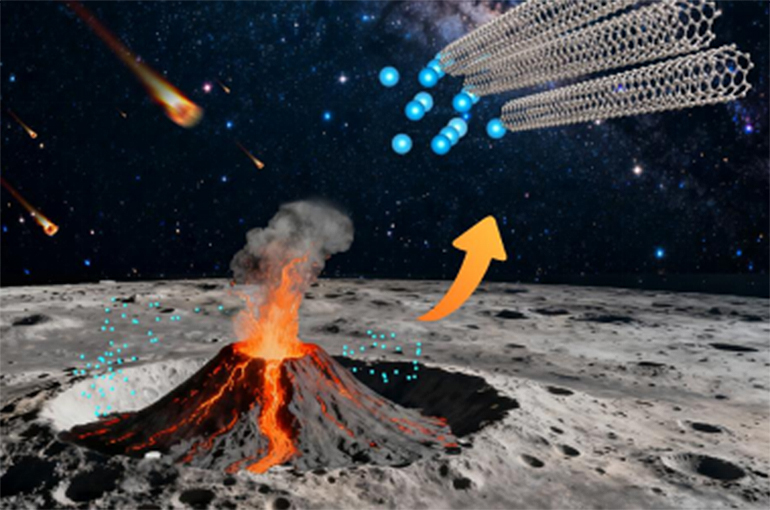
The study also confirms for the first time the existence of single-walled carbon nanotubes that have formed naturally and without human intervention, and suggests the formation of these CNTs may be closely related to iron-catalyzed processes that are influenced by multiple factors, including micro-meteorite impacts, volcanic activity, and solar wind irradiation throughout the Moon's history.
Single-walled CNTs are formed by rolling up a single layer of graphene, and they have excellent electronic, mechanical, and physical properties. They can serve as additives to enhance the performance of most known materials. However, their large-scale production and application are currently limited by manufacturing processes.
The Chang’e-6 probe was launched from China on May 3, 2024, and returned to Earth 53 days later. It brought back over 1.9 kilograms of samples from the far side of the Moon, the first time this had been achieved.
Editor: Tom Litting